How do I accurately model and calculate costs for different data plans?

Click For Summary

Discussion Overview

The discussion revolves around modeling and calculating costs for different data plans offered by an internet provider. Participants explore various mathematical models, including linear, quadratic, and logarithmic functions, to represent the pricing structures of these plans. The conversation includes finding intersection points of these models and the implications of removing included gigabytes from the plans.

Discussion Character

  • Technical explanation
  • Mathematical reasoning
  • Debate/contested

Main Points Raised

  • Participants propose piecewise linear models for three current data plans: Appetizer, Quest, and Voyager, detailing monthly fees, included gigabytes, and costs for additional gigabytes.
  • One participant asks how to graph these models and find intersection points, indicating uncertainty about the process.
  • Another participant suggests that removing included gigabytes shifts the graphs left, leading to new linear equations for each plan.
  • There is discussion on how to input these models into Wolfram|Alpha for graphing and finding intersection points.
  • Participants share their calculated intersection points but face challenges in verifying their results, leading to corrections and clarifications about the equations used.
  • One participant expresses confusion about how to model the effects of removing included gigabytes, seeking guidance on the implications for quadratic and logarithmic models.
  • Another participant emphasizes the need to equate the non-horizontal portions of the models to find intersection points accurately.
  • Participants discuss the transition from current plans to potential new plans, including quadratic and logarithmic models, and the associated costs.

Areas of Agreement / Disagreement

Participants generally agree on the initial modeling of the current plans but express differing views on the implications of removing included gigabytes and how to approach the new models. The discussion remains unresolved regarding the best way to model these changes and find intersection points for the new plans.

Contextual Notes

Participants note the importance of correctly identifying the portions of the piecewise functions when finding intersection points, highlighting potential confusion in mathematical representation. There are also references to specific software tools for graphing, which may have limitations based on user input.

Who May Find This Useful

This discussion may be useful for students or professionals interested in mathematical modeling, particularly in the context of pricing strategies for services, as well as those looking to understand piecewise functions and their applications in real-world scenarios.

needalgebra
Messages
45
Reaction score
0
Re: Are my answers correct? Quadratic and logarithmic modeling

I actually have a few more things that i'd like you to check for me please.

Answers:

Appetizer: {0<=x<=10 y=7 x>10 y=2(x-10)+7 or y=2x-13

Quest: {0<=x<=40 y=40 x>40 y=1(x-40)+40 or y=x)

Voyager: {0<=x<=60 y=60 x>60 y=.5(x-60)+60 or y=.5x+30

Question:

CURRENT PACKS:

develop equations that model the three current packs. including the domain for each equation.
find the intersection points of at least 3 different models.

appetizer : monthly access fee \$7, included gigabyte 10, cost per additional gigabyte \$2

quest: monthly access fee \$40, included gigabyte 40, cost per additional gigabyte \$1

voyager: monthly access fee \$60, included gigabyte 60, cost per additional gigabyte
\$0.50

Extra notes:

i don't exactly remember how to get the intersection points, i know its obviously when y crosses with x, but how would i graph this?
 
Mathematics news on Phys.org
Yes, using linear models, you have correctly found:

Appetizer:

$$A(x)=\begin{cases}7 & 0\le x\le10\\ 2x-13 & 10<x \\ \end{cases}$$

Quest:

$$Q(x)=\begin{cases}40 & 0\le x\le40\\ x & 40<x \\ \end{cases}$$

Voyager:

$$V(x)=\begin{cases}60 & 0\le x\le60\\ \frac{1}{2}x+30 & 60<x \\ \end{cases}$$

A popular program online for plotting functions is Wolfram|Alpha: Computational Knowledge Engine.

Entering this command there:

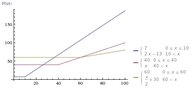
piecewise[{{7,0<=x<=10},{2x-13,10<x}}],piecewise[{{40,0<=x<=40},{x,40<x}}],piecewise[{{60,0<=x<=60},{x/2+30,60<x}}] where x=0 to 100

produces this graph:

View attachment 1166

This will give you an idea where to look for the intersection points. To find them, set the two functions equal to one another (using the appropriate piece), and then solve for $x$, then use this value of $x$ in either function to find the value of $y$.
 

Attachments

  • needalgebra.jpg
    needalgebra.jpg
    8.3 KB · Views: 170
Thanks Mark! :D

I've got the same plotting question for my other post, how would i graph the logarithm and quadratic models?
 
I've got one more last question regarding this!

how do i model the effects on the cost to the customer by removing the "included gigabytes usage".

Is it the same as the graph you showed me but instead of having a horizontal line for the "included gigabytes" i just go straight down normally?
 
If you remove the included gigabytes, then this has the effect of shifting the graphs of the respective packages to the left by an amount so as to remove the horizontal portion of each graph. Thus, you would have:

$$A(x)=2x+7$$

$$Q(x)=x+40$$

$$V(x)=\frac{1}{2}x+60$$
 
oh ok and how would i put that on W.A?
 
needalgebra said:
oh ok and how would i put that on W.A?

I would use:

y=2x+7,y=x+40,y=x/2+60 where x=0 to 50

It's a lot simpler when the functions are not piecewise defined. :D
 
I can't get it to work...
 
What happens when you enter the above command?
 
  • #10
never mind! it was just my browser! haha thanks! :D
 
  • #11
ok so for my intersection points i got:

appetizer / quest : 33 , 73

appetizer / voyager : 26.5 , 60

Quest / voyager : 20 , 60
 
  • #12
The first point is correct. Show what you did for the other two so we can figure out where you went wrong.
 
  • #13
Quest & Voyager:

1x + 40 = + 0x + 60
1x - 0x = 60 - 40
+ 1x = 20
x = 20/ + 1
x = 20y = 1 * (20) + 40
y = 20 + 40
y = 60

Appetizer & Voyager:

2x + 7 = + 0x + 60
2x - 0x = 60 - 7
+ 2x = 53
x = 53/ + 2
x = 26.5

y = 2 * (26.5) + 7
y = 53 + 7
y = 60
 
  • #14
Why are you using 0x + 60 for Voyager? You want x/2 + 60.
 
  • #15
its the same thing.. i think. please do lead me the right way
 
  • #16
They are not the same...1/2 times $x$ is different from 0 times $x$, in the same way that 1/2 is not equal to 0. Try solving the systems using x/2 + 60 for the Voyager model.
 
  • #17
Appetizer & Voyager:

2x + 7 = + 0.5x + 60
2x - 0.5x = 60 - 7
+ 1.5x = 53
x = 53/ + 1.5
x = 35.3333333333y = 2 * (35.3333333333) + 7
y = 70.6666666667 + 7
y = 77.6667
 
  • #18
Those are correct, well at least for decimal approximations. :D

Good work! You should have no trouble finding the remaining point.
 
  • #19
woooooooooooooo! (Music)

(i forgot to mention that the three intersect points i just did were for the graphs without the included gigabytes)

is this one fine?

Quest & voyager
x + 40 = 0.5x + 60
x - 0.5x = 60 - 40
0.5x = 20
x = 20/ 0.5
x = 40

y = 1 * (40) + 40
y = 40 + 40
y = 80(this one right here is for the normal graph with the included gigabytes) is it fine?

Appetizer and Voyager:

2x - 13 = 0.5x + 30
2x - 0.5x = 30 - -13
1.5x = 43
x = 43/ + 1.5
x = 28.6666666667

y = 2 * (28.6666666667) - 13
y = 57.3333333333 - 13
y = 44.3333

How do i get the intersection points of the logarithm and quadratic models? (i think i should ask this on the other post)
 
  • #20
needalgebra said:
woooooooooooooo! (Music)

(i forgot to mention that the three intersect points i just did were for the graphs without the included gigabytes)

is this one fine?

Quest & voyager
x + 40 = 0.5x + 60
x - 0.5x = 60 - 40
0.5x = 20
x = 20/ 0.5
x = 40

y = 1 * (40) + 40
y = 40 + 40
y = 80

Yes, that is correct. You can check by substitution:

$$40+40=\frac{40}{2}+60$$

$$80=80$$

This is true, so you know your solution is correct.

needalgebra said:
(this one right here is for the normal graph with the included gigabytes) is it fine?

Appetizer and Voyager:

2x - 13 = 0.5x + 30
2x - 0.5x = 30 - -13
1.5x = 43
x = 43/ + 1.5
x = 28.6666666667

y = 2 * (28.6666666667) - 13
y = 57.3333333333 - 13
y = 44.3333

If you notice from the graph, the Appetizer line intersects the other piece of the Voyager line, i.e., the horizontal part.
 
  • #21
so how would i get that?
 
  • #22
Equate the non-horizontal portion of Appetizer to the horizontal portion of Voyager.
 
  • #23
i have to find the intersection points for appetizer & quest, appetizer & voyager and quest & voyager.

Im not exactly understanding what you mean.

i mean for example, with appetizer and voyager, what would happen to 0 - 10 on the x-axis and the rest after 60 for voyager..

im kind of confused.

This is for the normal graph, with the included gigabytes. i already figured out the other one
 
  • #24
Using the graph as a guide, we can see that it is the non-horizontal portion of Appetizer that intersects with the horizontal portion of Voyager. So, you already know the $y$-coordinate of this point, you simply need to solve the resulting equation for $x$ to get that coordinate.
 
  • #25
ugggh. i just saw that i have to model the effects to the customer of removing the "included gigabytes usage". i guess it means for these including the logarithmic and quadratic functions... how do i do what the question is asking me?
 
  • #26
Can you give the problem here, in its entirety, as it is given to you?
 
  • #27
The question says:

model the effects on the cost to the customer of removing the "included gigabytes usage'.
 
  • #28
Isn't that what we've done?

I was hoping you would present the problem in its entirety, from beginning to end, including everything.
 
  • #29
Yeah, sure i can do that no problem!

an internet provider is reviewing its monthly broadband usage packs, currently, customers can choose one of the three following options:

CURRENT PACKS:
appetizer : monthly access fee \$7, included gigabyte 10, cost per additional gigabyte \$2
quest: monthly access fee \$40, included gigabyte 40, cost per additional gigabyte \$1
voyager: monthly access fee \$60, included gigabyte 60, cost per additional gigabyte \$0.50

these packs comprise a monthly access fee which includes usage up to a certain number of gigabytes plus an additional cost per gigabyte over and above that.

The internet provider intends to discontinue the quest pack. they are considering two new pack options to replace it.

Replacement pack options:

(option 1) quadratic model, monthly access fee \$20, included gigabytes 20, cost per additional gigabyte *see below (*)

(option 2) logarithmic model, monthly access fee \$30, included gigabytes 25, cost per additional gigabyte *see below (**)

(*) The charge option 1 will increase quadratically after 20 gigabytes with customers paying the same amount as voyager customers at 60 gigabytes.

(**) The charge option 2 will increase logarithmically in the form ƒ(x) = a + b 1n|x| after 25 gigabytes with customers also paying the same amount as voyager customers at 60 gigabytes.

in addition, they are also looking into the possibility of removing the 'included gigabyte usage' from each pack . this would mean that the customer would pay the monthly access fee plus the cost of each gigabyte used.

this activity requires you to write a report to the internet provider including
(i) a recommendation of an appropriate new pricing pack for medium users to replace the quest pack.
(ii) an analysis of the effect of the cost to the customer of removing the 'included gigabytes usage' from your recommended replacement of the quest pack option and the two remaining packs, appetizer and voyager.

Task:

-graph the current pack options -appetizer, quest and voyager.
-graph the two replacement pack options - option 1 - quadratic model, option 2 - logarithmic model.
-develop equations that model the three current and the two replacement pack options, including the domain for each equation - full working must be shown.
-find the intersection points of at least 3 different models.
-model the effects on the cost to the customer of removing the 'included gigabytes usage'


when analyzing the results of your modeling you will need to:

compare and contrast the different plans, describing the positive and negative aspects of each plan for potential customers

recommend which of the replacement pack options should replace the quest pack option, with justification

state any assumptions, generalizations and reflections you make during your modelling

discuss the effect on the cost to the customer of removing the "included gigabyte usage"

provide clear recommendations to the internet provider based on your findings

:cool:
 
  • #30
Okay, I suspected something was omitted from the original statement of the problem, which I have highlighted in red:

(*) The charge option 1 will increase quadratically after 20 gigabytes with customers paying the same amount as voyager customers at 60 gigabytes.

(**) The charge option 2 will increase logarithmically in the form ƒ(x) = a + b 1n|x| after 25 gigabytes with customers also paying the same amount as voyager customers at 60 gigabytes.

This changes things, and means we need to start over with the quadratic and logarithmic models. Can you state the two points through which each model must pass?
 

Similar threads

  • · Replies 37 ·
2
Replies
37
Views
6K
  • · Replies 43 ·
2
Replies
43
Views
6K
  • · Replies 11 ·
Replies
11
Views
3K
  • · Replies 3 ·
Replies
3
Views
2K
  • · Replies 2 ·
Replies
2
Views
4K
  • · Replies 0 ·
Replies
0
Views
4K
  • · Replies 5 ·
Replies
5
Views
3K
  • · Replies 22 ·
Replies
22
Views
5K
  • · Replies 2 ·
Replies
2
Views
4K
  • · Replies 3 ·
Replies
3
Views
2K