How Do I Calculate Heat Transfer Through a Multi-Layered Ceiling?

  • Thread starter Thread starter Ziga Casar
  • Start date Start date
  • Tags Tags
    Heat Heat transfer
Click For Summary

Discussion Overview

The discussion revolves around calculating heat transfer through a multi-layered ceiling, specifically focusing on the impact of different materials and their thermal properties. Participants explore the theoretical aspects of heat transfer, including conduction and convection, and the application of relevant equations.

Discussion Character

  • Technical explanation
  • Mathematical reasoning
  • Debate/contested

Main Points Raised

  • One participant presents a scenario involving a multi-layered ceiling with specific materials and their thermal properties, seeking assistance in calculating heat transfer.
  • Another participant suggests thinking of the problem in terms of resistors in series, implying an analogy between electrical circuits and heat transfer.
  • A participant questions the clarity of the analogy and requests further explanation on how to apply it to the heat transfer problem.
  • Further discussion includes the relationship between heat flow and temperature difference, likening it to current and voltage in electrical circuits.
  • One participant reports a significant discrepancy in calculated heat flux values when considering only conduction versus when including multiple layers, expressing skepticism about the effectiveness of insulation provided by air.
  • The participant emphasizes the need for convection coefficients (alphas) to accurately account for convection in their calculations, questioning the relevance of convection in the overall heat flow analysis.

Areas of Agreement / Disagreement

Participants do not reach a consensus on the importance of convection in the calculations, and there is a clear disagreement regarding the interpretation of the heat transfer analogy with electrical circuits. The discussion remains unresolved regarding the calculation of convection coefficients.

Contextual Notes

Participants express uncertainty about how to calculate convection coefficients in the context of layered materials and the influence of temperature differences across layers. There are also unresolved questions about the assumptions underlying the heat transfer calculations.

Ziga Casar
Messages
4
Reaction score
0
Hello guys,

I have a problem and I don't know how to solve it properly ...

So I have this situation:
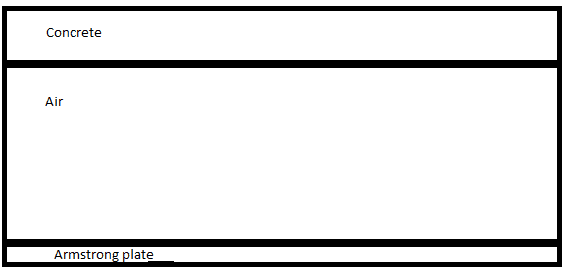
armstrongplosca.png

And I must calculate the heat transfer (Q) through it ...

I know that the Indoor Temperature is 21C and the outdoor Temperature is 0C, I also know the following data for all layers:
Concrete: d (thickes) = 0.4m, k (Thermal conductivity) = 1.10 W/mK
Air: d = 2.25m, k = 0.0244 W/mK
Armstrong plate: d = 0.015m, k = 0.06 W/mK

And the surface is S = 731.9 m^2

I know I should calculate through this expression: Q = U S (T1-T2) and 1/U = SUM(d/k) = SUM(1/alpha)

the sum of d/k is no problem but for sum of 1/alpha, I do not know hot to calculate the alphas (Convection coefficient), because there is one alpha from air to Armstrong and one alpha from concrete to air (Or are there 2 alphas for each because the temperature under Armstrong plate is higher that the temperature above the Armstrong plate ...?)

So here is the problem, because there is a natural motion of air and a big horizontal plate I do not know hot to calculate the alphas... Can somebody please help me?
 
Engineering news on Phys.org
You need to concentrate on what the variables represent - and think: resistors in series.
 
I do not exactly understand what you mean. Can you explain it a little bit better?
 
How would you find the current through resistors in series?
Now: heat flow = current, temperature difference voltage.
 
I completely understand the resistance circuits. But when I calculate the heat flux through the concrete only I get 42 253W, but when I calculate the heat flux through concrete, air and plate I get 165.5W. But this is only conduction, in real there is there also convection, and for convection I need alphas ... or is it not important to consider convection by calculating the heat flow?

I mean the heat flux difference is huge. I can not imagine that if you lower a ceiling with this plates you safe so much of energy? Air is a good isolator, but so good?
 

Similar threads

  • · Replies 34 ·
2
Replies
34
Views
6K
  • · Replies 6 ·
Replies
6
Views
2K
Replies
15
Views
3K
Replies
22
Views
5K
Replies
7
Views
3K
  • · Replies 15 ·
Replies
15
Views
4K
Replies
5
Views
3K
  • · Replies 6 ·
Replies
6
Views
3K
  • · Replies 27 ·
Replies
27
Views
7K
Replies
4
Views
2K