How do I calculate the moment of inertia for a wagon wheel with spokes?

Click For Summary
SUMMARY

The discussion focuses on calculating the moment of inertia for a wagon wheel with spokes, specifically addressing the contributions from both the rim and the spokes. The rim's moment of inertia is calculated using the formula MR², while the spokes are treated as rods, requiring the use of ML²/12 for each spoke. Participants also explore related problems involving angular speed and torque calculations, emphasizing the importance of understanding rotational dynamics and conservation of energy principles.

PREREQUISITES
  • Understanding of moment of inertia calculations, including MR² and ML²/12.
  • Familiarity with rotational dynamics concepts such as torque and angular speed.
  • Knowledge of conservation of energy principles in rotational motion.
  • Basic grasp of free body diagrams and Newton's laws as they apply to rotational systems.
NEXT STEPS
  • Study the derivation of moment of inertia for composite shapes, including spokes and rims.
  • Learn about the application of torque in rotational dynamics, specifically the relationship between torque and angular acceleration.
  • Explore conservation of energy in rotational systems, focusing on potential and kinetic energy transformations.
  • Investigate the effects of friction and tension in pulley systems, including the moment of inertia of the pulley itself.
USEFUL FOR

Students and professionals in physics, mechanical engineering, and anyone involved in the study of rotational dynamics and mechanics.

cukitas2001
Messages
62
Reaction score
0
Ok in addition to my other post for help i have some other problems puzzling me.

1)A wagon wheel is constructed as shown in the figure. The radius of the wheel is 0.300 m, and the rim has mass 1.49 kg . Each of the eight spokes, that lie along a diameter and are 0.300 m long, has mass 0.220 kg.

What is the moment of inertia of the wheel about an axis through its center and perpendicular to the plane of the wheel?

Ok i know that the moment of inertia of just the outer rim is MR^2 but how do i take into account the Moment of inertia of the eight spokes?
I tried treating the spokes as if they were rods and using ML^2/12 and multiplying by 8 for the eight spokes but my answer came out wrong? so how is it supposed to be?

2) A uniform, solid disk with mass m and radius R is pivoted about a horizontal axis through its center. A small object of the same mass m is glued to the rim of the disk.

If the disk is released from rest with the small object at the end of a horizontal radius, find the angular speed when the small object is directly below the axis.

I have no idea where to begin on this any hints or tips?

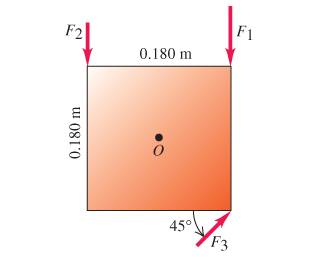
3)A square metal plate 0.180 m on each side is pivoted about an axis through point O at its center and perpendicular to the plate
yf_Figure_10_40.jpg


Calculate the net torque about this axis due to the three forces shown in the figure if the magnitudes of the forces are F_1=18.0N, F_2=24.0N, and F_3=14.0N. The plate and all forces are in the plane of the page. Take positive torques to be counterclockwise.

Ok so i know that the effective lever arm r is perpendicular to O so for torque_1 is did T_1=18.0N*.09m=2.34 N*m and for T_2 similarly i did T_2=24N*.09m=1.62N*m but for T3 I am stuck... after i found all the individual torquest are they simply added together for net torque or must i multiply by and angle between them all?

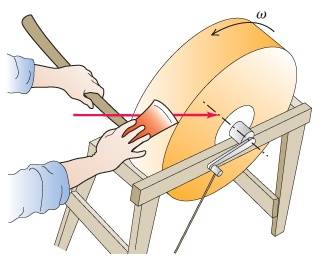
4) A grindstone in the shape of a solid disk with diameter 0.460m and a mass of = 50.0kg is rotating at omega = 840 rev/min . You press an axe against the rim with a normal force of F = 220N, and the grindstone comes to rest in 7.00s .
yf_Figure_10_44.jpg


Ok i thought this one was going to be easy but i was wrong. I tried using W_other=-K1 since my other works canceled out. i converted omega into rad/s and for K1 i got -5116J. W_other should be the force times the distance it was done at correct? what i did was soemthing like d=r*t but i did d=omega*t and also tried using the tangent v=omega*r to find the distance that the friciton force acts to get its work.

Anyone see where I am goin wrong or have a better method on this one?
 
Physics news on Phys.org
ok i figured out 1,3, and 4...any word on 2?
 
edit: late post
 
2 looks like straight forward conservation of energy. What have you tried with 2?
 
Conservation of energy makes sense but how can it be applied to 2?
 
cukitas2001 said:
Conservation of energy makes sense but how can it be applied to 2?

\Delta Potential Energy = \Delta Rotational Kinetic Energy
 
ok i know that kinetic rotation energy is defined as: (1/2)I*omega^2 but what's potential in rotational motion? Please don't tell me its mgh or my head will explode:eek:
 
cukitas2001 said:
ok i know that kinetic rotation energy is defined as: (1/2)I*omega^2 but what's potential in rotational motion? Please don't tell me its mgh or my head will explode:eek:

Yes, it is indeed mg\Delta h, but in this case \Delta h = R \Rightarrow E_{p} =mgR. Don't let you head explode, brain is hell to get off a computer moniter! :biggrin:
 
This moment of inertia topic has been the hardest for me to get so far...i want to go back to collisions :!) lol

Ok for my angular speed omega i got sqrt((4*g)/R) but it says I am off by a multiplicative factor. Is there a way to take into account the part that says "when the small object is directly below the axis"? Is that where I am going wrong?
 
  • #10
cukitas2001 said:
This moment of inertia topic has been the hardest for me to get so far...i want to go back to collisions :!) lol
No you don't rotational dynamics is awesome. :-p
cukitas2001 said:
Ok for my angular speed omega i got sqrt((4*g)/R) but it says I am off by a multiplicative factor. Is there a way to take into account the part that says "when the small object is directly below the axis"? Is that where I am going wrong?
Don't forget that the small object will also have rotational kinetic energy (you can treat it as a point mass).
 
  • #11
What does it mean when you treat something as a point mass?
 
  • #12
cukitas2001 said:
What does it mean when you treat something as a point mass?
A point mass is an object that has a mass but no volume. The moment of inertia of a point mass is therefore just I = mr2, where r is the distance from the axis of rotation.
 
  • #13
cool i have to remember that point mass rule

I have one last problem that's bothering me and if you could help i'd appreciate it astronomically:

A textbook of mass 1.99kg rests on a frictionless, horizontal surface. A cord attached to the book passes over a pulley whose diameter is 0.130m, to a hanging book with mass 2.90kg. The system is released from rest, and the books are observed to move a distance 1.16m over a time interval of 0.850s.

Part A) What is the tension in the part of the cord attached to the textbook?
Part B) What is the tension in the part of the cord attached to the book?

Okay so the tensions of the two should be the same since they are the same cord right? so what i tried doing was how it was done using Newtons second law. I drew freebody diagrams of the two and had two equations for both of the bodies. I calculated acceleration to be
a=5.81m/s^2 and pluging this back into the tension expressions i had form the free body diagrams i calculated tension to be 11.56N but it came back wrong? is this not the way to approach this problem?
 
  • #14
cool i have to remember that point mass rule
That's just the standard form of the moment of inertia - I = \sum mr^2

However, how did you obtain your answer of a=5.81m/s2? I have achieved a different acceleration.
 
Last edited:
  • #15
for the hanging mass i had an expression: 28.42N-T=2.90*a and then for the sliding body i had T=1.99*a adding both expressions and cancelling T i got 28.42N=4.89*a solving for a i get 5.81m/s^2
 
  • #16
Sorry, just to correct myself from the previous post, the tension is not uniform. I forgot to take into account the moment of inertia of the pulley. because the blocks are accelerating, the pulley must have angular acceleration, therefore the two tensions must be different, therefore there is a different tension force acting on each block. I suggest setting up three different equations, one for each block and one for the pulley.
 
Last edited:
  • #17
You seem to have gone quiet, so I'll start for you. Let T1 be the horizontal tension; T2 be the vertical tension. So;

Smaller Block

T_{1} = 1.99a

Larger Block

28.499 - T_{2}=2.9a

Pulley

\sum \tau = I\alpha = (T_{2} - T_{1})R

For the moment of inertia of the pulley you should use a disc.

Can you go from here?
 
  • #18
sorry i didnt even notice we were on page two...could you explain the expression you have for the pulley?
 
  • #19
the pulley equation is throwing me off some because from what i see there are two unknowns the mass of the pulley and alpha. Can i express alpha in terms of linear kinematics?
 
  • #20
cukitas2001 said:
sorry i didnt even notice we were on page two...could you explain the expression you have for the pulley?

Certainly, it is know as Newton's second law of rotation;

\sum \tau = I\alpha

In words, the sum of the torques is equal to the product of the moment of inertia and and angular acceleration. Angular acceleration is given by the formula;

\alpha = \frac{a}{R}

Where a is linear acceleration and R is radius. Therefore, we can rewrite the original expression;

\sum \tau = I\cdot \frac{a}{R}

Now, torque(\tau) (as you probably know) is given by the product of force and distance from the axis of rotation (R). The forces in this case are the tensions thus;

\sum \tau = T_{2}R - T_{1}R = I\cdot\frac{a}{R}

Factoring out the R we have;

(T_{2} - T_{1})R = I\cdot\frac{a}{R}

This is equivalent to the expression I gave originally, but in a more useful form. Do you follow?
 
  • #21
Yeah..lemme try to git 'r done tis time

quick question...when i solve for a in the pulley equation i have (2*(T_2-T_1))/M would M be the mass of the pulley or the combined mass of the textbook sliding and book hanging?
 
Last edited:
  • #22
cukitas2001 said:
Yeah..lemme try to git 'r done tis time

quick question...when i solve for a in the pulley equation i have (2*(T_2-T_1))/M would M be the mass of the pulley or the combined mass of the textbook sliding and book hanging?

Sorry I didn't notice your question there. M is the mass of the pulley, you then solve it simultaneously with the other two equations to obtain your tensions.
 
Last edited:
  • #23
sorry i know this is an old thread but I'm stuck on a similar problem. how did you eliminate the mass M of the pulley?
 

Similar threads

Replies
11
Views
3K
Replies
3
Views
2K
Replies
8
Views
14K
  • · Replies 4 ·
Replies
4
Views
2K
  • · Replies 3 ·
Replies
3
Views
1K
  • · Replies 7 ·
Replies
7
Views
2K
Replies
24
Views
4K
  • · Replies 27 ·
Replies
27
Views
5K
  • · Replies 21 ·
Replies
21
Views
3K
Replies
2
Views
4K