How Do I Connect an Oscillator, Capacitor, and Resistor on a Breadboard?

  • Thread starter Thread starter STEMucator
  • Start date Start date
  • Tags Tags
    Breadboard Time
Click For Summary
SUMMARY

This discussion focuses on connecting an oscillator, capacitor, and resistor in series on a breadboard. The user describes wiring the positive terminal of the oscillator to the capacitor and resistor, with a ground reference established. They detail their setup using specific bus connections, indicating a positive voltage on bus 5 and a negative connection on bus 7. The conversation emphasizes the safety features of modern function generators, which provide protection against potential mistakes during initial setups.

PREREQUISITES
  • Understanding of basic electronic components: oscillator, capacitor, and resistor
  • Familiarity with breadboard layout and connections
  • Knowledge of circuit grounding techniques
  • Experience with function generators and their safety features
NEXT STEPS
  • Research breadboard circuit design principles
  • Learn about the function generator's specifications and safety features
  • Explore capacitor and resistor behavior in series circuits
  • Study grounding techniques in electronic circuits
USEFUL FOR

Electronics enthusiasts, hobbyists building circuits, and beginners learning about breadboarding and component connections.

STEMucator
Homework Helper
Messages
2,076
Reaction score
140
I want to build a circuit consisting of an oscillator, capacitor, and resistor connected in series. I've never used a breadboard before though, and I want to make sure nothing goes wrong.

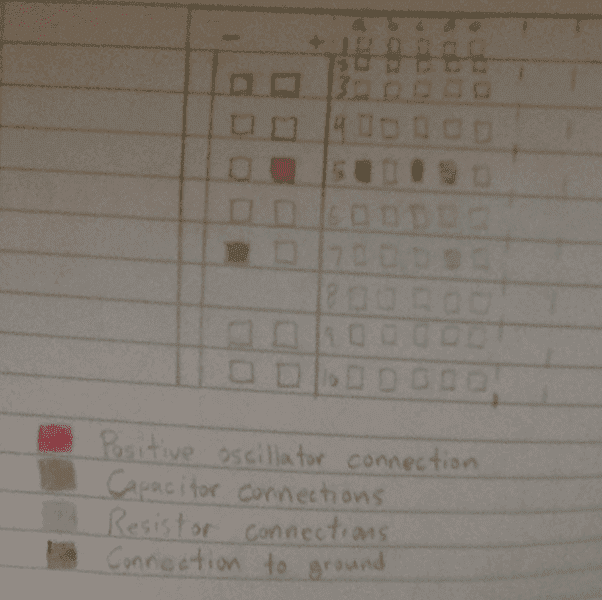
From what I understand, I need to wire the +ve of the oscillator in series with the capacitor and resistor. Then connect a reference to ground. I drew what I think this would look like in the image below:
Screen Shot 2014-10-01 at 8.12.50 PM.png


So I have the +ve wired along bus 5 supplying power to the capacitor connected across a5 and c5. I then hook up the resistor along d5 so it is in series with the capacitor and create a short to d7. The -ve is located along bus 7.

This would work I hope.
 
Engineering news on Phys.org
Wow my first attempt was terrible. I have a new attempt that should actually work now I think:
 

Attachments

  • Screen Shot 2014-10-01 at 11.00.56 PM.png
    Screen Shot 2014-10-01 at 11.00.56 PM.png
    67.2 KB · Views: 557
Last edited:
Zondrina said:
Wow my first attempt was terrible. I have a new attempt that should actually work now I think:
That's right. If your current source is any sort of modern function generator you shouldn't worry too much about just hooking it up and seeing if it works. Function generators usually have a breaker and other built-in protection that'll keep you from burning them up if you make a mistake, as long as you aren't doing anything crazy.
 
Most likely this can only be answered by an "old timer". I am making measurements on an uA709 op amp (metal can). I would like to calculate the frequency rolloff curves (I can measure them). I assume the compensation is via the miller effect. To do the calculations I would need to know the gain of the transistors and the effective resistance seen at the compensation terminals, not including the values I put there. Anyone know those values?

Similar threads

  • · Replies 10 ·
Replies
10
Views
2K
  • · Replies 3 ·
Replies
3
Views
1K
  • · Replies 6 ·
Replies
6
Views
2K
Replies
3
Views
2K
  • · Replies 3 ·
Replies
3
Views
3K
  • · Replies 10 ·
Replies
10
Views
2K
Replies
12
Views
2K
  • · Replies 41 ·
2
Replies
41
Views
7K
  • · Replies 7 ·
Replies
7
Views
4K
Replies
20
Views
2K