How do I draw a FBD for centripetal force

Click For Summary
SUMMARY

This discussion focuses on the use of Free Body Diagrams (FBD) to explain how banked curves enhance vehicle safety during turns by providing necessary centripetal force. Participants confirm that the normal force (Fn) acts towards the center of the curve, contributing to centripetal acceleration, which is essential for maintaining control. The equations Fnsinθ=mv²/r and Fncosθ=mg illustrate the relationship between speed, radius, and the angle of banking (θ). The conversation emphasizes that banking reduces reliance on friction, which can be unreliable at high speeds and sharp turns.

PREREQUISITES
  • Understanding of Free Body Diagrams (FBD)
  • Basic knowledge of centripetal force and acceleration
  • Familiarity with the concepts of normal force and friction
  • Ability to apply trigonometric functions in physics contexts
NEXT STEPS
  • Study the derivation of the banking angle formula tanθ=v²/rg
  • Explore the effects of different road surface materials on friction
  • Investigate the role of static friction in vehicle dynamics
  • Learn about the physics of circular motion in high-speed scenarios
USEFUL FOR

Physics students, automotive engineers, traffic safety analysts, and anyone interested in the mechanics of vehicle dynamics and road design.

Biochemgirl2002
Messages
29
Reaction score
1
Moved from technical forum so no template
The question
Sometimes road surfaces have banked curves, use a FBD to explain how it helps cars make turns more safely My trial:

I drew this FBD (attached below)
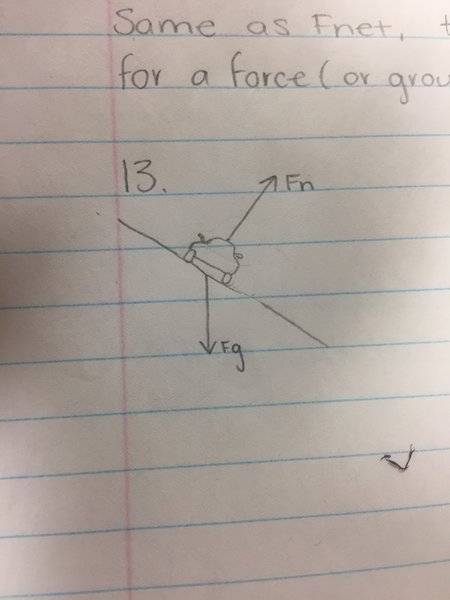
Image1512568486.090307.jpg


And I think it helps make driving more safe because the Fn acting on the car is pointed more towards the middle of the curve, which acts as a centripetal force. Which like in space, where centripetal force acts as your gravity, the centripetal force will cause the car to stick to the road and not slip as much Does this sound correct? How can I elaborate more?
 

Attachments

  • Image1512568486.090307.jpg
    Image1512568486.090307.jpg
    20.8 KB · Views: 2,082
Physics news on Phys.org
You're on the right track. What other forces might be involved?

rhiana said:
the Fn acting on the car is pointed more towards the middle of the curve, which acts as a centripetal force.
That's good.

In order to turn, you need some centripetal force. Without banking, what force are you relying on?
 
rhiana said:
The question
Sometimes road surfaces have banked curves, use a FBD to explain how it helps cars make turns more safelyMy trial:

I drew this FBD (attached below)

View attachment 216225

And I think it helps make driving more safe because the Fn acting on the car is pointed more towards the middle of the curve, which acts as a centripetal force. Which like in space, where centripetal force acts as your gravity, the centripetal force will cause the car to stick to the road and not slip as muchDoes this sound correct? How can I elaborate more?
Friction is not always reliable at circular turn if high speed and sharp turns are involved.To aviod dependence on friction, the roads are banked at the turn so that the outer part of the road is somewhat lifted up as compared to inner part.The surface of the road makes an angle θ with the horizontal throughout the turn.The normal force Fn makes an angle θ with vertical. At correct speed,the horizontal component of Fn is sufficient to produce the centripetal acceleration
Fnsinθ=mv^2/r
Fncosθ=mg
From these two
tanθ=v^2/rg
The angle θ depends on v as well as r.roads are banked for average expected speed.if the speed of particular vehicle is little more than that the correct speed, the self adjustable static friction operates between the tyres and road and the vehicle doest not skid or slip.
 
Doc Al said:
You're on the right track. What other forces might be involved?That's good.

In order to turn, you need some centripetal force. Without banking, what force are you relying on?

To turn, would you just be relying on the friction of the tires? If there was no banking
 
Abhishek kumar said:
Friction is not always reliable at circular turn if high speed and sharp turns are involved.To aviod dependence on friction, the roads are banked at the turn so that the outer part of the road is somewhat lifted up as compared to inner part.The surface of the road makes an angle θ with the horizontal throughout the turn.The normal force Fn makes an angle θ with vertical. At correct speed,the horizontal component of Fn is sufficient to produce the centripetal acceleration
Fnsinθ=mv^2/r
Fncosθ=mg
From these two
tanθ=v^2/rg
The angle θ depends on v as well as r.roads are banked for average expected speed.if the speed of particular vehicle is little more than that the correct speed, the self adjustable static friction operates between the tyres and road and the vehicle doest not skid or slip.

Okay, so when you go faster, the more grip (or static friction) you have on the road?
 
rhiana said:
To turn, would you just be relying on the friction of the tires? If there was no banking
Exactly.

rhiana said:
Okay, so when you go faster, the more grip (or static friction) you have on the road?
Yes. Static friction will increase as needed to prevent slipping -- up to its maximum for the given surfaces.
 
  • Like
Likes   Reactions: Abhishek kumar
rhiana said:
Okay, so when you go faster, the more grip (or static friction) you have on the road?
Upto a certain maximum speed.
 

Similar threads

Replies
31
Views
1K
  • · Replies 15 ·
Replies
15
Views
4K
  • · Replies 12 ·
Replies
12
Views
2K
Replies
2
Views
1K
  • · Replies 9 ·
Replies
9
Views
2K
  • · Replies 9 ·
Replies
9
Views
4K
  • · Replies 3 ·
Replies
3
Views
1K
Replies
4
Views
5K
  • · Replies 1 ·
Replies
1
Views
1K
Replies
16
Views
2K