How do I find refractive index uncertainties?

Click For Summary
To find the uncertainty in the refractive index from prism experiments, it's essential to account for the uncertainties in both the minimum angle of deviation (Dmin) and the prism angle (A). The formula used should express the sine of a sum as a product of trigonometric functions, which aids in simplifying the calculations. It is crucial to apply error propagation techniques, taking derivatives of the refractive index expression with respect to A and Dmin. This method helps in accurately determining how uncertainties in the measurements affect the final refractive index value. Properly addressing the correlation between uncertainties in the numerator and denominator is key to obtaining reliable results.
Sam D
Messages
3
Reaction score
0
Member advised to use the formatting template for all homework help requests
I've been doing an experiment where I've used prisms and a spectrometer to find the exact angles inside the prisms and the refractive index of the prisms by finding the minimum angle of deviation.

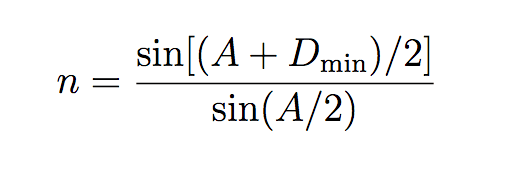
I have attached a picture of the formula I've been using to find the refractive indices. Where Dmin in the minimum angle of deviation and A is the measurement I've made of the angles in the prism (both of which in themselves have uncertainties).
Screen Shot 2018-10-16 at 10.24.51.png

I'm now trying to find the uncertainty in my value for the refractive index but I'm really struggling because there are so many components to go through. I'd be really grateful if someone could talk me through the easiest way of finding the uncertainty in my refractive index values.

Thanks in advance for your help.
 

Attachments

  • Screen Shot 2018-10-16 at 10.24.51.png
    Screen Shot 2018-10-16 at 10.24.51.png
    3.7 KB · Views: 1,453
Physics news on Phys.org
This does not look too complicated. The only point I see is that you should use the formula to express the sine of a sum as a sum of products of the trigonometric functions of the individual variables.
 
I found the uncertainties of A and Dmin, the uncertainty when they're added together and divided by two, the uncertainty of them in sin, the uncertainty of a/2 in sin and then the uncertainty of everything on the top divided by everything on the bottom?
 
Sam D said:
[...]and then the uncertainty of everything on the top divided by everything on the bottom?
That's the problematic point as the uncertainties in the numerator and denominator will be correlated. Rather use error propagation. In the first step, you will have to take derivatives of your expression with respect to A and Dmin.
 
The book claims the answer is that all the magnitudes are the same because "the gravitational force on the penguin is the same". I'm having trouble understanding this. I thought the buoyant force was equal to the weight of the fluid displaced. Weight depends on mass which depends on density. Therefore, due to the differing densities the buoyant force will be different in each case? Is this incorrect?

Similar threads

  • · Replies 1 ·
Replies
1
Views
2K
  • · Replies 13 ·
Replies
13
Views
4K
  • · Replies 1 ·
Replies
1
Views
2K
  • · Replies 7 ·
Replies
7
Views
14K
  • · Replies 11 ·
Replies
11
Views
2K
  • · Replies 1 ·
Replies
1
Views
2K
  • · Replies 2 ·
Replies
2
Views
2K
  • · Replies 1 ·
Replies
1
Views
4K
  • · Replies 9 ·
Replies
9
Views
3K
  • · Replies 7 ·
Replies
7
Views
7K