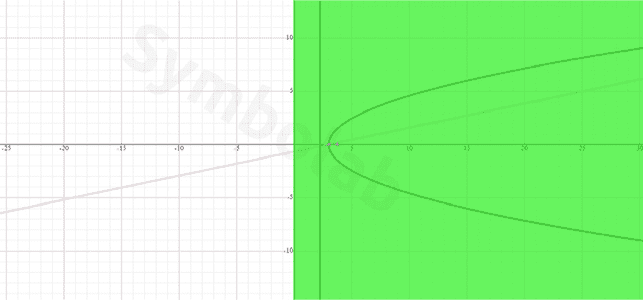
How do I find the area of the region bounded by following?

Click For Summary
SUMMARY

The discussion focuses on finding the area of a region bounded by multiple functions using integrals. Participants emphasize the importance of identifying intersection points of the equations and suggest integrating either over x or y, depending on which setup appears simpler. A key recommendation is to split the area into two regions for easier calculation in certain scenarios. The conversation highlights the necessity of clarity in presenting mathematical approaches and solutions.

PREREQUISITES
  • Understanding of integral calculus
  • Familiarity with finding intersection points of functions
  • Knowledge of setting up definite integrals
  • Ability to interpret graphical representations of functions
NEXT STEPS
  • Research methods for finding intersection points of equations
  • Learn about setting up definite integrals for area calculation
  • Explore techniques for splitting regions in integral calculus
  • Study graphical interpretation of functions and their boundaries
USEFUL FOR

Students and educators in mathematics, particularly those focusing on calculus and integral applications, as well as anyone involved in solving area-related problems in a multi-variable context.
Drioton
Messages
2
Reaction score
0
Homework: Misplaced Thread -- Member warned to post homework questions in the appropriate area
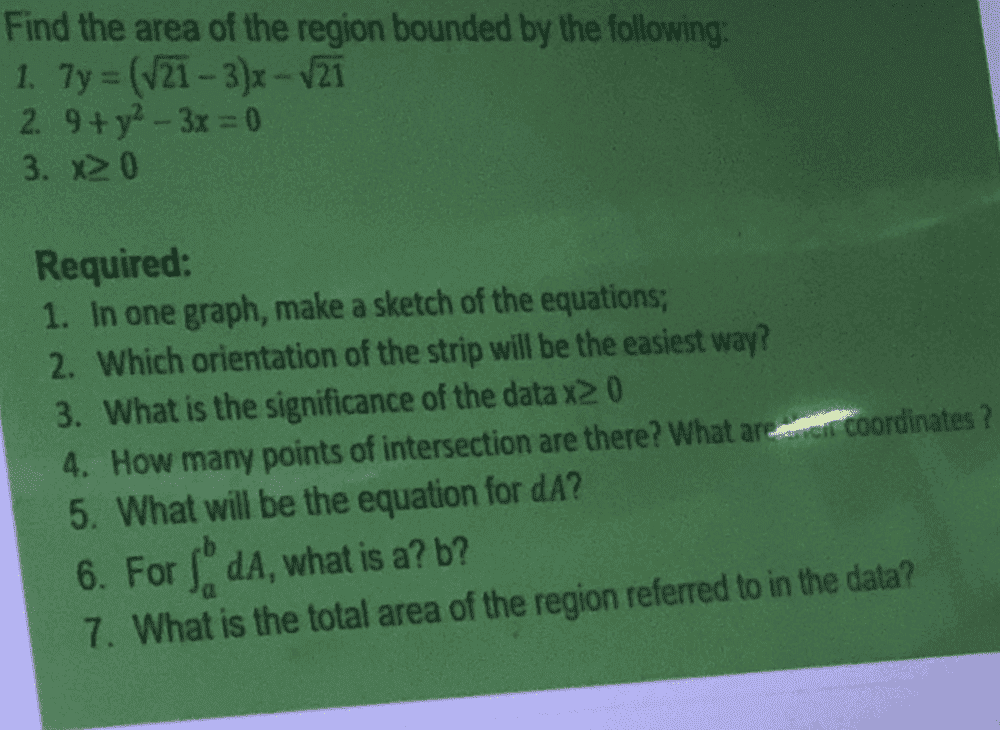
Using integrals, consider the 7 requirements:
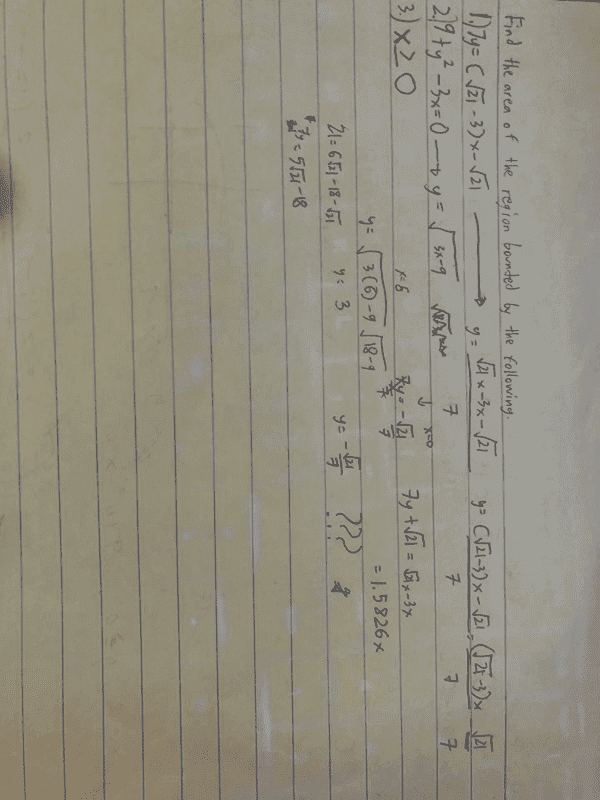
Any my attempted solution that I have no idea where I am going:
And the other one provides the graph:
241145
241146
241147
 
Physics news on Phys.org
I'm not sure what you did in your approach besides rewriting the equations and it is difficult to read or understand.

This shouldn't be the first "find the area" problem you encounter. How did you solve the previous problems?

You have marked two intersections of the different equations already. What are their coordinates? Where is a third intersection at the boundary of your area?

You can integrate over x or over y. How would you set up the integrals? Which one looks easier?
 
mfb said:
I'm not sure what you did in your approach besides rewriting the equations and it is difficult to read or understand.

This shouldn't be the first "find the area" problem you encounter. How did you solve the previous problems?

You have marked two intersections of the different equations already. What are their coordinates? Where is a third intersection at the boundary of your area?

You can integrate over x or over y. How would you set up the integrals? Which one looks easier?
F07813A0-8387-4907-89FA-876E87CFD491.jpeg

Here, but these two problems are different. they only consist of one function. Whereas this question has “x is greater than or equal to zero” (what is the meaning of this with respect to the problem) part, and has two functions. Besides the solution in yellow paper, it is unclear how I figure these out?
 
You could rotate your images in the correct orientation, that would help already.
Drioton said:
Here, but these two problems are different. they only consist of one function.
It is still the area between four boundary lines. Here you just have three.

In one of the two options for the integration it is advisable to split the area into two regions, calculate their area separately and then add them. In the other case (the easier one!) this is not necessary.
 

Similar threads

  • · Replies 5 ·
Replies
5
Views
2K
  • · Replies 19 ·
Replies
19
Views
2K
Replies
2
Views
2K
  • · Replies 24 ·
Replies
24
Views
2K
  • · Replies 6 ·
Replies
6
Views
2K
  • · Replies 4 ·
Replies
4
Views
1K
  • · Replies 4 ·
Replies
4
Views
2K
  • · Replies 2 ·
Replies
2
Views
1K
Replies
4
Views
3K
  • · Replies 5 ·
Replies
5
Views
1K