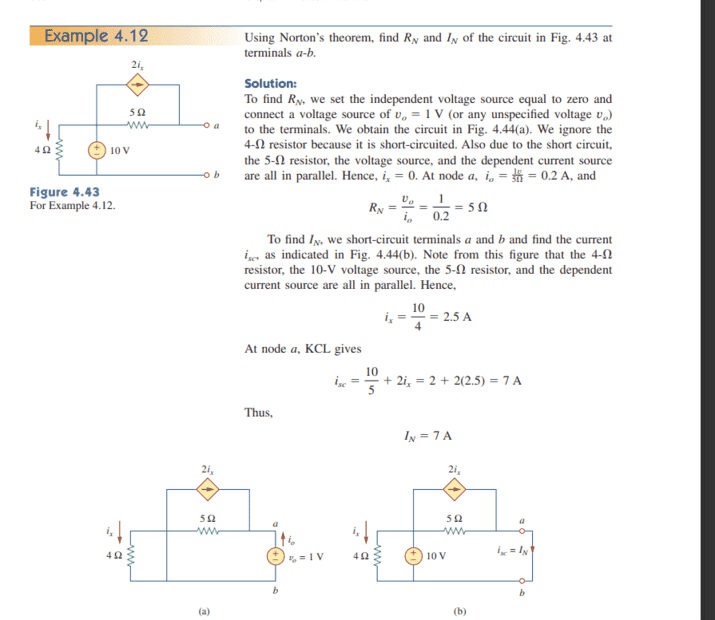
How do I know that ##i_x = 0## ?

  • Context: Engineering 
  • Thread starter Thread starter link223
  • Start date Start date
link223
Messages
70
Reaction score
12
Homework Statement
How do I know that ##i_x = 0 ~ ?## Is it because of the fact that resistor, source and dependent current source are in parallel? If that is not the reason, what is?

Thanks in advance.
Relevant Equations
Norton's theorem
I was first thinking that i_x is zero because the 4 ohms resistor can be ignored because it is parallel with a short circuit, but I assumed that only the resistance is zero whilst i_x flows through and that is what'd make the voltage across 4-ohms resistor to be zero.
1650710254845.png
 
In figure 4.44(a), the voltage across the 4-ohm resistor is zero. Therefore, there is no current flowing through the 4-ohm resistor. The resistance of that 4-ohm resistor has not changed. It is simply short-circuited.
 
  • Love
Likes   Reactions: link223
Ahaaa got it, thank you!
Just to make sure, So when I have a short circuit parallel to a resistor, the resistor will basically always stay intact, whilst the current will be zero on the other hand.

I was kind of confused, because we say the 4-ohms resistor is short-circuited from which I derive that it acts as a short circuit i.e. current can freely run through that branch(/resistor) which is basically not the case at all.
 

Similar threads

Replies
15
Views
4K
  • · Replies 3 ·
Replies
3
Views
2K
Replies
3
Views
2K
  • · Replies 9 ·
Replies
9
Views
3K
  • · Replies 3 ·
Replies
3
Views
2K
  • · Replies 13 ·
Replies
13
Views
3K
  • · Replies 3 ·
Replies
3
Views
8K
  • · Replies 7 ·
Replies
7
Views
4K
  • · Replies 10 ·
Replies
10
Views
4K
  • · Replies 15 ·
Replies
15
Views
3K