(Marko)
- 2
- 1
I've found many methods on how to know whether resistances are in parallel or in series but I don't know how to apply any of them on this one
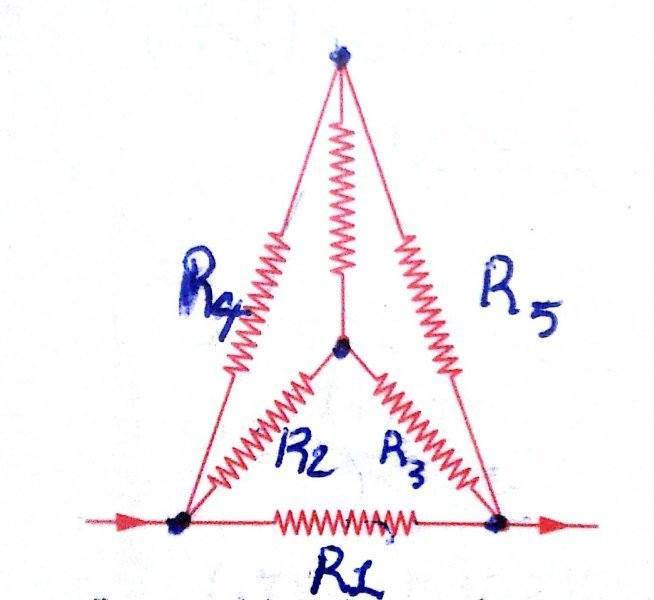
The discussion revolves around identifying whether resistances in a given circuit are in series or parallel. Participants explore various methods and approaches to analyze the circuit, including the application of Kirchhoff's laws and specific circuit configurations like Wheatstone bridges and Y-Delta transformations.
Participants express varying opinions on the classification of the circuit elements, with some agreeing on the complexity of the arrangement and the usefulness of specific methods, while others highlight the existence of alternative configurations. No consensus is reached on a definitive approach to the problem.
Participants note that the circuit's analysis may depend on specific conditions, such as equal resistances, and that the presence of complex arrangements like Wheatstone bridges and Y-Delta transformations adds to the difficulty of classification.