How Do I Solve a Complex Double Integral Problem?

  • Thread starter Thread starter etf
  • Start date Start date
  • Tags Tags
    Stuck
Click For Summary

Homework Help Overview

The discussion revolves around a complex double integral problem, with participants exploring various substitution methods and coordinate transformations to simplify the integral. The original poster expresses difficulty in progressing beyond initial attempts.

Discussion Character

  • Exploratory, Assumption checking, Mathematical reasoning

Approaches and Questions Raised

  • Participants discuss the merits of different substitutions, including polar coordinates and a suggestion to use a transformation involving u and v. There is uncertainty about the correctness of the original equation and the effectiveness of the substitutions attempted.

Discussion Status

The conversation is ongoing, with participants providing suggestions and expressing their thoughts on the complexity of the integral. Some guidance has been offered regarding potential substitutions, but there is no clear consensus on the best approach yet.

Contextual Notes

Participants mention the challenges of calculating the Jacobian for certain substitutions and the implications of using computational tools like Matlab, indicating a mix of analytical and numerical approaches to the problem.

etf
Messages
179
Reaction score
2
Here is my task and attempt for solution:
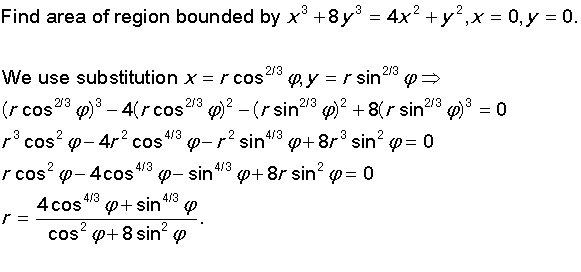
attempt.gif


As you can see, I tried with substitutions but I have no idea what to do next.
Any suggestion?
 
Last edited:
Physics news on Phys.org
The equation you start with looks nasty. Are you sure it's not supposed to be x3+8y3=x2+4y2, or somesuch?
Either way, I can't see the merit of that substitution. Why not just go to the usual polar coordinates? At least you can get as far as writing the area as a single integral. Still tough though.
 
I'm sure it's how I wrote it... I tried usual polar coordinates too and I got that r=(4*cos(phi)^2+sin(phi)^2)/(cos(phi)^3+8*sin(phi)^3). I don't think that this substitution is more useful than previous. I tried with few other substitutions in order to make region easier but without success. I really have no idea what to do here :(
 
Last edited:
etf said:
I'm sure it's how I wrote it... I tried usual polar coordinates too and I got that r=(4*cos(phi)^2+sin(phi)^2)/(cos(phi)^3+8*sin(phi)^3). I don't think that this substitution is more useful than previous. I tried with few other substitutions in order to make region easier but without success. I really have no idea what to do here :(
I agree it's still nasty, but at least you can write out the integral for the area now . With your other substitution you'd have to calculate quite a messy Jacobian to get that far. (Did you compute the Jacobian? Maybe it simplifies magically, but I doubt it.)
 
I've had maybe a better idea. Try u = x, v = y/x.
 
Wow! This one is key to my problem :)
If I didn't make mistake somewhere, area should be:

povrsina1.gif
 
Looks good until you get to the last line. A = ∫∫dxdy = ∫∫Jdudv etc. I'm afraid it's going to get quite complicated, but it's all doable.
 
I computed it using Matlab, I didn't try to do it by hand...
Thanks a lot!
 
etf said:
I computed it using Matlab, I didn't try to do it by hand...
Thanks a lot!
OK, I see - I misread your double integral as two separate integrals. (That's not the way I write them.)
The simplicity of the answer does suggest we've missed a trick somewhere.
 

Similar threads

Replies
3
Views
2K
Replies
10
Views
2K
  • · Replies 4 ·
Replies
4
Views
2K
Replies
7
Views
2K
Replies
2
Views
2K
Replies
10
Views
2K
  • · Replies 4 ·
Replies
4
Views
4K
  • · Replies 9 ·
Replies
9
Views
2K
  • · Replies 2 ·
Replies
2
Views
2K
  • · Replies 7 ·
Replies
7
Views
2K