How do I solve for the centroid of a function with a given range?

Click For Summary
To solve for the centroid of the function Y(x) = 96.4x(100-x) over the interval (0, 93.7) cm, the area bounded by the function and the x-axis must first be calculated. The bar{x} and bar{y} coordinates of the centroid can be determined by integrating with respect to x, considering the height of the function. The first moment of area in the y-direction can be expressed as δS_y = (1/2)f(x)²δx, which allows for integration across the specified limits. The discussion emphasizes the importance of using integration techniques to find the centroid coordinates effectively.
Guillem_dlc
Messages
188
Reaction score
17
Summary:: I'm solving an exercise.

I have the following center of gravity problem:

Having the function Y(x)=96,4*x(100-x) cm, where X is the horizontal axis and Y is the vertical axis, ranged between the interval (0, 93,7) cm. Determine:
a) Area bounded by this function, axis X and the line X=93,7 (in cm2)
b) The bar{x} coordinate of its centroid (in cm)
c) The bar{y} coordinate of its centroid (in cm)
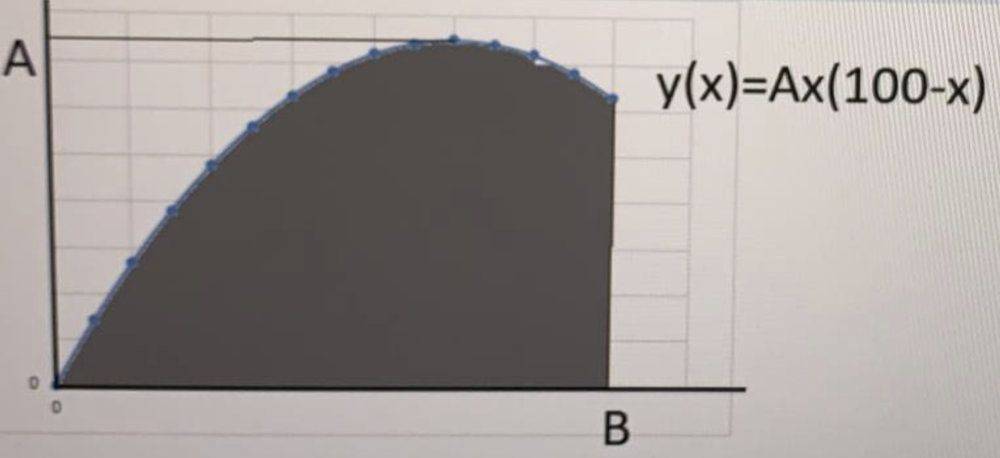
8BDE096C-6720-494B-A873-4C2146EC05C5.jpeg

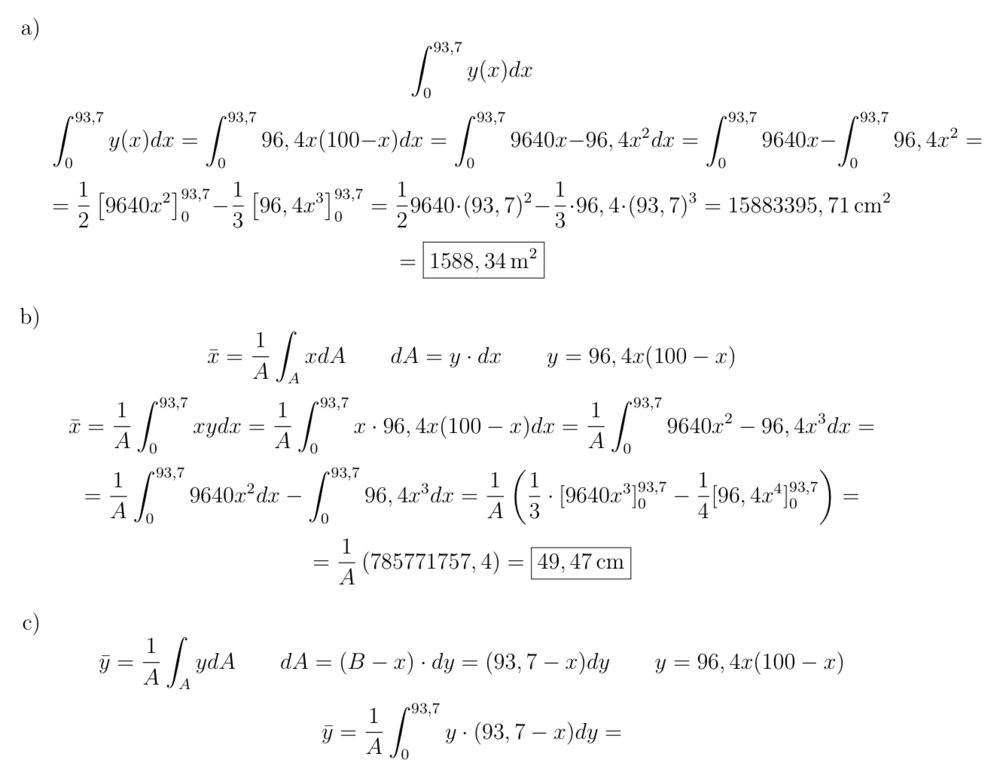
My attempt at resolution:

7AE6BF30-7086-4851-ADC1-1F6E4D77391B.jpeg

How can I calculate the last section if I can't clear the x?

Thanks!
 
Physics news on Phys.org
Guillem_dlc said:
How can I calculate the last section if I can't clear the x?
You are given y as a function of x, ##y = 96.4x(100 - x)##. Solve this equation for x in terms of y.
IOW, you have y = f(x), Solving for x gives you ##x = f^{-1}(y)##.
 
Mark44 said:
You are given y as a function of x, ##y = 96.4x(100 - x)##. Solve this equation for x in terms of y.
IOW, you have y = f(x), Solving for x gives you ##x = f^{-1}(y)##.
Okay perfect thank you!
 
You can do it with the inverse that can sometimes be unwieldy if the function is complicated. You can also find ##\bar{y}## by integrating wrt ##x##. Consider a vertical strip of width ##\delta x## and height ##f(x)##, then the incremental change in the first moment of area in the ##y## direction is

##\delta S_y = \frac{1}{2} {f(x)}^2 \delta x##

and then you can just integrate up over your limits and divide by the total area.
 
Last edited by a moderator:
etotheipi said:
You can do it with the inverse but as an additional point that might sometimes be a little unwieldy if the function is complicated. You can also find ##\bar{y}## by integrating wrt ##x##. Consider a vertical strip of width ##\delta x## and height ##f(x)##, then the incremental change in the first moment of area in the ##y## direction is

##\delta S_y = \frac{1}{2} {f(x)}^2 \delta x##

and then you can just integrate up over your limits and divide by the total area.
Yes, I applied this second method in the end, i.e. integrating with respect to ##x## and considering that ##y## was in the middle of the differential.
 
Thread 'Correct statement about size of wire to produce larger extension'
The answer is (B) but I don't really understand why. Based on formula of Young Modulus: $$x=\frac{FL}{AE}$$ The second wire made of the same material so it means they have same Young Modulus. Larger extension means larger value of ##x## so to get larger value of ##x## we can increase ##F## and ##L## and decrease ##A## I am not sure whether there is change in ##F## for first and second wire so I will just assume ##F## does not change. It leaves (B) and (C) as possible options so why is (C)...

Similar threads

  • · Replies 19 ·
Replies
19
Views
2K
  • · Replies 2 ·
Replies
2
Views
2K
  • · Replies 1 ·
Replies
1
Views
6K
  • · Replies 2 ·
Replies
2
Views
22K
  • · Replies 19 ·
Replies
19
Views
28K
  • · Replies 20 ·
Replies
20
Views
8K
Replies
1
Views
1K
  • · Replies 11 ·
Replies
11
Views
2K
Replies
4
Views
2K
  • · Replies 8 ·
Replies
8
Views
2K