SUMMARY
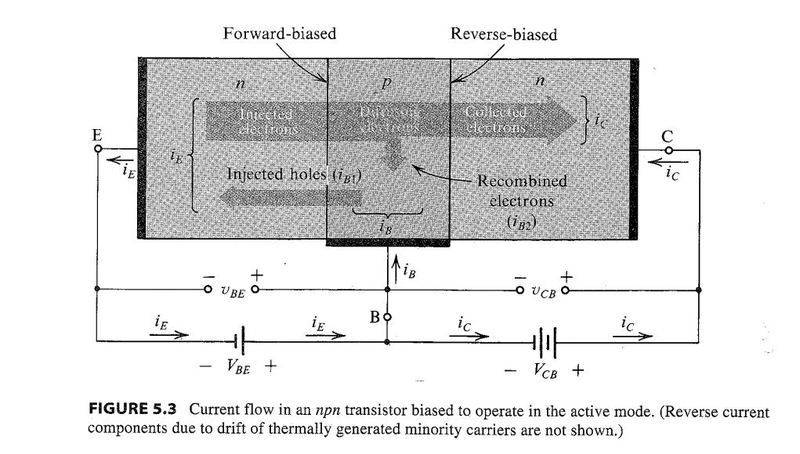
The discussion focuses on the flow of injected holes in an NPN transistor, specifically addressing how holes diffuse from the P-type base to the N-type emitter. It is established that while holes can flow from the base to the emitter due to the positive voltage at the base, the number of holes injected is significantly lower than the electrons flowing in the opposite direction due to doping levels. The conversation clarifies that when holes are injected into the emitter, they quickly recombine with free electrons, limiting their movement. The participants also explore the behavior of electrons transitioning between conduction and valence bands during this process.
PREREQUISITES
- Understanding of NPN transistor operation
- Knowledge of semiconductor physics, specifically P-type and N-type materials
- Familiarity with concepts of electron and hole mobility
- Basic principles of current flow and charge carriers in semiconductors
NEXT STEPS
- Study the operation of bipolar junction transistors (BJTs) in detail
- Learn about charge carrier recombination and diffusion in semiconductors
- Explore the role of doping in semiconductor behavior
- Investigate the energy band theory of semiconductors, focusing on conduction and valence bands
USEFUL FOR
Electrical engineers, students of semiconductor physics, and anyone involved in the design or analysis of transistor circuits will benefit from this discussion.