How Do Planes Intersect in Various Linear Systems?

Click For Summary

Discussion Overview

The discussion revolves around the geometric interpretation of planes represented by a linear system of equations, particularly focusing on how these planes intersect under different conditions defined by the parameter k. Participants explore scenarios of no solutions, unique solutions, and infinitely many solutions, seeking to clarify the relationships between the planes in these cases.

Discussion Character

  • Exploratory
  • Technical explanation
  • Conceptual clarification
  • Debate/contested
  • Mathematical reasoning

Main Points Raised

  • One participant identifies that for k = 0 or 2, the system has no solutions, while for other values of k, it has a unique solution.
  • Another participant suggests that in cases where k = 0 or 2, the coefficient matrix has rank 2 and the augmented matrix has rank 3, leading to the conclusion that each plane intersects the other two in a line.
  • Some participants express confusion regarding the geometric interpretation of the planes and the orientation that leads to the solution sets.
  • There is a suggestion to visualize the problem through diagrams, though participants are uncertain about how to begin this process.
  • Discussion includes the representation of one of the planes as parallel to the z-plane under certain conditions, specifically when k^2 - 2k ≠ 0.

Areas of Agreement / Disagreement

Participants generally agree on the conditions under which the system has no solutions or unique solutions, but there is uncertainty and confusion regarding the geometric interpretations and the specifics of how the planes relate to each other. Multiple viewpoints exist on how to visualize and understand these relationships.

Contextual Notes

Participants mention the rank of matrices and the orientation of normals to the planes, but there are unresolved aspects regarding the specific geometric configurations and how to effectively represent them visually.

srg263
Messages
15
Reaction score
0
Hi all,

I'm stuck on progressing a problem i have received some feedback around as detailed below. I would greatly appreciate some assistance, and thank you in advance for your time and contributions.

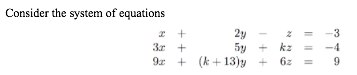
So i have a linear system:
View attachment 6673

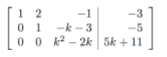
Which is row reduced to:
View attachment 6674

I have identified that the system has no solutions for values of k = 0 or 2, and thus a unique solution if k does not equal 0 or 2.

I am stuck on the second part however which is:
"Each of these equations represents a plane. In each case (no solutions, infinitely many solutions or a unique solution, give a geometric description of the three planes."

I understand that:
*No solution = no common intersection of all thee planes
*Unique solution = three planes intersect in a single point
*Infinite solutions = intersection is either a plane or straight line.

I'm confused how to relate this to the systems of equations?

(Also apologies for the screen-shots, i cannot seem to get the maths symbol coding to work - any help with that would also be great!)

Many thanks mathematicians! :-)
 

Attachments

  • Screen Shot 2017-06-20 at 11.39.40 am.png
    Screen Shot 2017-06-20 at 11.39.40 am.png
    2.4 KB · Views: 154
  • Screen Shot 2017-06-20 at 11.43.54 am.png
    Screen Shot 2017-06-20 at 11.43.54 am.png
    1.3 KB · Views: 158
Physics news on Phys.org
Hello srg263,

If you've learned about rank, then considering that (in cases $k = 0, 2$) the coefficient matrix has rank 2 and the augmented matrix has rank 3, each plane intersects the other two planes in a line. If you haven't learned about rank, you can reach the same conclusion by considering the normals to the planes defined by the three equations. Indeed, the normals are coplanar (since the coefficient matrix has determinant $0$), but no two normals are multiples of each other (which implies that no two of the three planes are parallel). So again, each plane intersects the other two in a line.
 
Euge said:
Hello srg263,

If you've learned about rank, then considering that (in cases $k = 0, 2$) the coefficient matrix has rank 2 and the augmented matrix has rank 3, each plane intersects the other two planes in a line. If you haven't learned about rank, you can reach the same conclusion by considering the normals to the planes defined by the three equations. Indeed, the normals are coplanar (since the coefficient matrix has determinant $0$), but no two normals are multiples of each other (which implies that no two of the three planes are parallel). So again, each plane intersects the other two in a line.

Hi Euge,

Thank you for your response - i very much appreciate your time. Unfortunately i didn't quite understand your explanation there regarding the orientation of the planes that gives this solution set.

I was thinking drawing some diagrams might help me to understand, but I'm not really sure where to start.

Many thanks.
 
Let's start with the 3rd equation (in reduced form).
Which plane does it represent?
 
srg263 said:
Hi Euge,

Thank you for your response - i very much appreciate your time. Unfortunately i didn't quite understand your explanation there regarding the orientation of the planes that gives this solution set.

I was thinking drawing some diagrams might help me to understand, but I'm not really sure where to start.

Many thanks.

Think of a triangular prism.
 
I like Serena said:
Let's start with the 3rd equation (in reduced form).
Which plane does it represent?

Thanks for your response.

Does it represent the z plane?
 
srg263 said:
Thanks for your response.

Does it represent the z plane?

It represents a plane parallel to the z-plane, but only if there is at least 1 solution.

More specifically, the equation is:
$$(k^2-2k)z=11k+5$$
You already found that if $k^2-2k=0$, it has no solution.
And if $k^2-2k \ne 0$, we can write it as:
$$z=\frac{11k+5}{k^2-2k}$$
which is a plane parallel to the z-plane.

Which plane would the 2nd equation represent?
 

Similar threads

  • · Replies 5 ·
Replies
5
Views
2K
  • · Replies 1 ·
Replies
1
Views
1K
  • · Replies 29 ·
Replies
29
Views
3K
  • · Replies 5 ·
Replies
5
Views
2K
  • · Replies 4 ·
Replies
4
Views
3K
  • · Replies 1 ·
Replies
1
Views
2K
  • · Replies 2 ·
Replies
2
Views
2K
  • · Replies 4 ·
Replies
4
Views
2K
  • · Replies 3 ·
Replies
3
Views
1K
  • · Replies 2 ·
Replies
2
Views
2K