How Do Support Reactions Affect 2D Static Equilibrium in a Shopping Cart?

Click For Summary

Homework Help Overview

The discussion revolves around forming 2D static equilibrium equations for a shopping cart, focusing on the role of support reactions and the analysis of the cart's structure. Participants are exploring the implications of fixed and roller supports in the context of static equilibrium.

Discussion Character

  • Exploratory, Assumption checking, Problem interpretation

Approaches and Questions Raised

  • Participants are considering how to analyze the support reactions at various points of the cart, particularly questioning whether point A can be treated as a fixed support and the nature of forces acting between points C and A. There is also discussion about the components to divide the cart into for analysis.

Discussion Status

The conversation is ongoing, with participants providing guidance on how to approach the problem by suggesting the need to define components first. There are multiple interpretations being explored regarding the support types and their effects on the equilibrium equations.

Contextual Notes

Participants are navigating uncertainties regarding the definitions of static equilibrium and the forces acting on the cart, including whether to consider internal forces and the implications of adding structural elements like a column between points B and E.

muna
Messages
3
Reaction score
0
Thread moved from the technical forums to the schoolwork forums
Hey guys, help me out a bit here. I want to form 2d static equilibrium equations for a shopping cart. This is for an assignment. I'm kind of confused about the support reactions. I'm not sure how I should analyze the basket. I was going with A as a fixed support (see image) since I'm guessing the weight fw and load fl will create moments there but I don't know if that makes sense since the whole thing seems like a fixed frame but I'm not sure if I should analyze it as a frame. I know for sure D and E would be have one reaction force each as they are roller supports. Also I don't know if a force should be acting from C to A. I would really appreciate some help here because there is just a lot I don't understand about these topics.
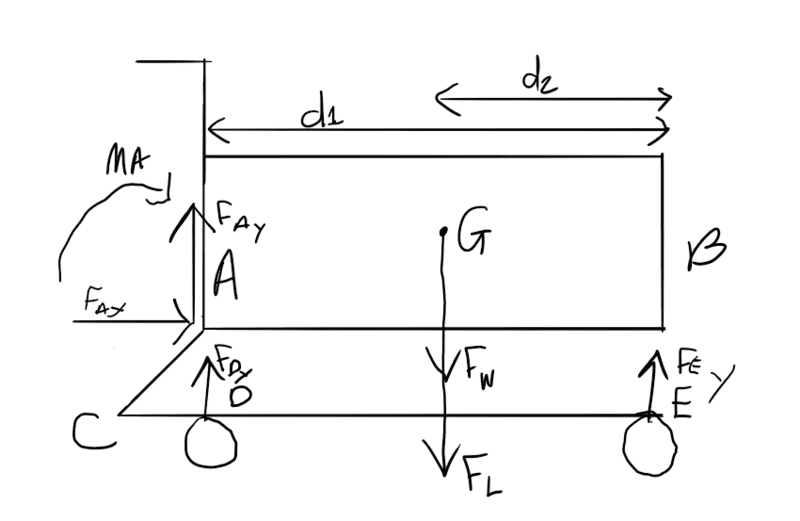
Screenshot 2021-11-21 134203.png
 
Physics news on Phys.org
It's up to you to decide what components to divide it into. Once you have done that you can consider the forces acting on each component, but ignore forces acting within them.
 
haruspex said:
It's up to you to decide what components to divide it into. Once you have done that you can consider the forces acting on each component, but ignore forces acting within them.
Okay so I can just look at A as a fixed support? And should I include a force from C to A?
 
muna said:
Also I don't know if a force should be acting from C to A.
When you say "static equilibrium", do you mean there are no other forces acting on the cart except for its own weight?
 
berkeman said:
When you say "static equilibrium", do you mean there are no other forces acting on the cart except for its own weight?
Yes, and a load which acts at the same point as its weight. Okay I see what you are saying. If I include a force there I would probably be an internal force. But would you happen to know if the trolley's basket should be looked at as a fixed support?
 
muna said:
Okay so I can just look at A as a fixed support? And should I include a force from C to A?
As I posted, first decide which components to divide it into. I can’t answer that question until you have done that.
 
If you weld a column between points B and E, how that changes the 2d static equilibrium equation (for the whole cart, I guess) that you want to form?
 

Similar threads

  • · Replies 14 ·
Replies
14
Views
1K
  • · Replies 24 ·
Replies
24
Views
4K
Replies
8
Views
3K
  • · Replies 13 ·
Replies
13
Views
5K
Replies
6
Views
2K
  • · Replies 10 ·
Replies
10
Views
3K
  • · Replies 6 ·
Replies
6
Views
3K
Replies
12
Views
3K
  • · Replies 4 ·
Replies
4
Views
5K
Replies
3
Views
6K