How do the nozzles on spray bottles work when misting?

  • Context: High School 
  • Thread starter Thread starter The Bill
  • Start date Start date
  • Tags Tags
    Spray Work
Click For Summary
SUMMARY

The discussion centers on the mechanics of spray bottle nozzles, specifically the operation of reciprocating piston pumps that create a mist. When the trigger is pumped, air pressure forces water up through a tube to the pump, where a piston compresses a spring to facilitate water ejection through a nozzle. The nozzle design disrupts the liquid flow, atomizing it into a mist. Participants sought detailed engineering insights into nozzle design, emphasizing the need for specific references on spray bottle mechanics rather than broader industrial applications.

PREREQUISITES
  • Understanding of reciprocating piston pump mechanics
  • Familiarity with fluid dynamics and atomization principles
  • Knowledge of nozzle design and its impact on fluid flow
  • Basic principles of pressure and air displacement in liquid systems
NEXT STEPS
  • Research "Reciprocating piston pump design" for in-depth mechanics
  • Explore "Fluid dynamics of atomization" to understand droplet formation
  • Investigate "Nozzle design principles" specific to spray applications
  • Examine "Surface tension and viscosity effects on misting" for practical insights
USEFUL FOR

Engineers, product designers, and anyone involved in the design and optimization of spray bottle nozzles or similar misting applications.
The Bill
Messages
373
Reaction score
146
I looked up misting nozzle design, but the results I found referred to two types of industrial misting nozzles which don't match up to what a spray bottle looks like at all. I tried looking up design elements of spray bottle nozzles specifically, but all I found were details on how the pump, valves, fittings, and tubing work together, nothing on the misting nozzle part.

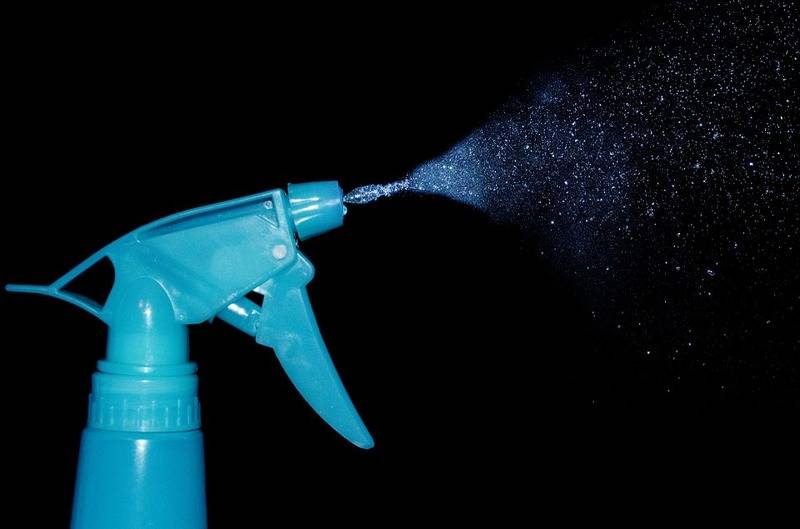
Just to be clear, this is the type of bottle and nozzle I mean:
spray-316524_960_720.jpg
 

Attachments

  • spray-316524_960_720.jpg
    spray-316524_960_720.jpg
    33 KB · Views: 3,981
Physics news on Phys.org
When you pump the trigger it pressurizes the air in the top of the bottle. The pressure at the top of the bottle forces the water up the tube until it reaches the pump. In the pump there is a cylinder, in the cylinder there is a spring and a piston. As you pump the trigger the piston is pushed into the cylinder compressing the spring so when you release the trigger the spring pushes the piston back up which sucks in more water. If you continue pumping the water will be spayed out through a hole in the nozzle that focuses it. The pump design is called a reciprocating piston pump if you would like to look up more information.

Edit to ad: Forcing the water through a nozzle that disrupts the flow of the liquid turns it into a mist.
 
Last edited:
Fig Neutron said:
Edit to ad: Forcing the water through a nozzle that disrupts the flow of the liquid turns it into a mist.

I am looking for explanations of the design philosophy and workings of this part of the spray bottle nozzle's function. I want sources that would tell an engineer enough to be able to design these types of nozzles, and/or satisfy a physicist that a thorough understanding of their workings had been attained. Saying that it "disrupts the flow of the liquid turns it into a mist" does not get me any closer to the information I seek.

anorlunda said:
Did you search before posting?

Yes. The fist page you linked is one that I read before posting, in fact. The second is about the impeller design. Since I am asking only about spray bottles, I believe it was already clear that I am not interested in impeller type misting nozzles.
 
The Bill said:
The second is about the impeller design.

Not true. The paper is about nozzle design. The paper doesn't even mention the word impeller. Further, it cites 26 other related references.

Are you working on the impression that a misting nozzle for spray bottles has different physics than nozzles for other applications?
 
I have’nt been able to find any links better than the ones listed above.

I tried searching diagrams and videos. There were not many, but you may be able to find what you want that way.

This may not be as descriptive as you would like, but I thought I would post it anyway in case it might help. There are a few other videos like this one.
 
  • Like
Likes   Reactions: The Bill
anorlunda said:
Not true. The paper is about nozzle design. The paper doesn't even mention the word impeller. Further, it cites 26 other related references.

Are you working on the impression that a misting nozzle for spray bottles has different physics than nozzles for other applications?

My mistake. It does cover several types of nozzle, though only two in any depth. First, "Centrifugal or swirl-type pressure nozzle" which appear to be what I referred to as impeller designs. Second, "Pneumatic type nozzle (twin-fluid type nozzle)" about which it says "this type of nozzles require large amount of energy to atomize water," so I don't think this is the type of nozzle I'm looking for, though I may be mistaken about the energy requirements of small plastic spray bottles.

That article also tangentially mentions impingement nozzles, which I don't think are what I am looking for since the first article said "Impingement nozzles tend to be very expensive" based on design considerations. Then it mentions atomization by the flashing of superheated water, which I don't think is what is going on in a plastic spray bottle. Then it says "Other methods of atomization like by mechanical vibration, by supersonic or subsonic vibration and by high-voltage electricity[...]" Those do not seem to be what I am looking for, either.

As far as your question as to whether I am "working on the impression that a misting nozzle for spray bottles has different physics than nozzles for other applications?" Of course not. However, I would I would like an explanation of the specific mechanics of what is happening in the specific type of nozzle I am asking about. Would an engineer use a survey article about the design of 21st century military aircraft as a primary reference when working on a project to reconstruct and analyze World War One biplanes? I feel like that example displays a similar level of distance between the reference and application as here.
 
Are you interested in the physics of how a stream of liquid breaks into droplets, and how the process is a function of surface tension, density, and viscosity? If so, try searching atomization of liquids.
 
  • #10
Fig Neutron said:
When you pump the trigger it pressurizes the air in the top of the bottle.
That function isn't necessary because you can make a simple mist pump work by just dipping the feed tube under an open liquid surface. The feed is achieved with a simple lift pump arrangement (with a ball type non return valve at the top of the delivery tube), followed by a force pump to inject liquid at high pressure through the misting nozzle.
 
  • Like
Likes   Reactions: davenn
  • #12
  • Like
Likes   Reactions: Enveks, sophiecentaur and Tom.G
  • #13
  • Like
Likes   Reactions: The Bill and sophiecentaur

Similar threads

  • · Replies 32 ·
2
Replies
32
Views
10K
  • · Replies 3 ·
Replies
3
Views
3K
  • · Replies 7 ·
Replies
7
Views
2K
  • · Replies 3 ·
Replies
3
Views
3K
  • · Replies 1 ·
Replies
1
Views
2K
  • · Replies 30 ·
2
Replies
30
Views
3K
  • · Replies 4 ·
Replies
4
Views
7K
  • · Replies 2 ·
Replies
2
Views
3K
  • · Replies 2 ·
Replies
2
Views
644
  • · Replies 1 ·
Replies
1
Views
2K