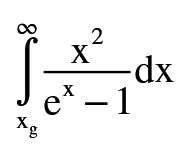
How do we integrate x^2/(e^x - 1) from xg to infinity?

  • Context: Undergrad 
  • Thread starter Thread starter Max Loo Pin Mok
  • Start date Start date
  • Tags Tags
    Infinity Integrate
Click For Summary
SUMMARY

The integral of the function x²/(e^x - 1) from xg to infinity does not have a closed form. However, if xg is greater than 1, it can be approximated by the integral ∫(x²/e^x)dx from xg to infinity, which simplifies to (xg² + 2xg + 2)/e^(xg). This approximation becomes increasingly accurate as xg moves further from 1, with significant agreement observed for xg values of 5 or greater, matching numerical results from Wolfram Alpha.

PREREQUISITES
  • Understanding of integral calculus, specifically improper integrals.
  • Familiarity with exponential functions and their properties.
  • Knowledge of integration techniques, including integration by parts.
  • Experience with numerical integration methods and tools like Wolfram Alpha.
NEXT STEPS
  • Explore the properties of improper integrals and convergence criteria.
  • Learn about integration by parts and its applications in solving complex integrals.
  • Investigate numerical integration techniques for approximating integrals without closed forms.
  • Study the behavior of exponential functions in limit processes and their implications in calculus.
USEFUL FOR

Mathematicians, physics students, and anyone involved in advanced calculus or numerical analysis who seeks to understand complex integrals and their approximations.
Max Loo Pin Mok
Messages
5
Reaction score
7
How do we integrate this function? It is possible if the range is from 0 to infinity, but from xg to infinity? This equation comes from page 512 of the 1961 paper by William Shockley and Hans J. Queisser.

upload_2018-11-20_14-47-26.png
 

Attachments

  • upload_2018-11-20_14-47-26.png
    upload_2018-11-20_14-47-26.png
    1.2 KB · Views: 2,447
Physics news on Phys.org
This integral doesn't have a closed form. You can check the indefinite integral at wolfram https://www.wolframalpha.com/input/?i=integral+x^2/(e^x-1)+dx
However :
If ##x_g## is larger than 1, then you can approximate the original integral by the integral $$\int_{x_g}^{\infty}\frac{x^2}{e^x}dx$$ which has a closed form and it is equal to $$\frac{x_g^2+2x_g+2}{e^{x_g}}$$ (you can compute it by doing integration by parts).

The farthest away is ##x_g## from 1, the better this approximation is. For example I found by experimenting at wolfram that for ##x_g\geq 5## the approximation agrees to the original value (which wolframs computes with numerical integration) in the first 3 significant digits.
 
  • Like
Likes   Reactions: Max Loo Pin Mok, bhobba, DrClaude and 1 other person
Thanks, I'll look at the results from Wolfram Alpha.
 
  • Like
Likes   Reactions: Delta2

Similar threads

  • · Replies 4 ·
Replies
4
Views
2K
  • · Replies 4 ·
Replies
4
Views
3K
  • · Replies 5 ·
Replies
5
Views
1K
  • · Replies 6 ·
Replies
6
Views
2K
  • · Replies 3 ·
Replies
3
Views
9K
  • · Replies 6 ·
Replies
6
Views
2K
  • · Replies 2 ·
Replies
2
Views
1K
  • · Replies 8 ·
Replies
8
Views
2K
  • · Replies 1 ·
Replies
1
Views
3K
  • · Replies 2 ·
Replies
2
Views
3K