Math Amateur
Gold Member
MHB
- 3,920
- 48
I am reading Micheal Searcoid's book: "Elements of Abstract Analysis" ... ...
I am currently focused on understanding Chapter 1: Sets ... and in particular Section 1.4 Ordinals ...
I need some help in fully understanding Theorem 1.4.3 ...
Theorem 1.4.3 reads as follows:

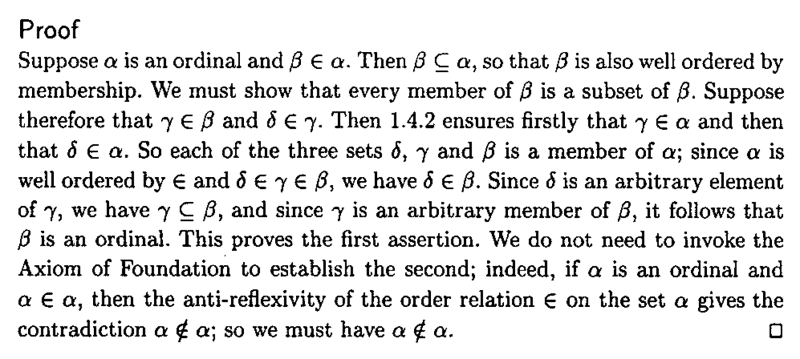
In the above proof by Searcoid we read the following:
"... ... Then ##\beta \subseteq \alpha## so that ##\beta## is also well ordered by membership. ... ...To conclude that ##\beta## is also well ordered by membership, don't we have to show that a subset of an ordinal is well ordered?
Indeed, how would we demonstrate formally and rigorously that ##\beta## is also well ordered by membership. ... ... ?*** EDIT ***
I have been reflecting on the above post on the ordinals ...Maybe to show that that ##\beta## is also well ordered by membership, we have to demonstrate that since every subset of ##\alpha## has a minimum element then every subset of ##\beta## has a minimum element ... but then that would only be true if every subset of ##\beta## was also a subset of ##\alpha## ...
Is the above chain of thinking going in the right direction ...?
Still not sure regarding the original question ...
Peter
*** FINISH EDIT ***
Help will be appreciated ...
Peter
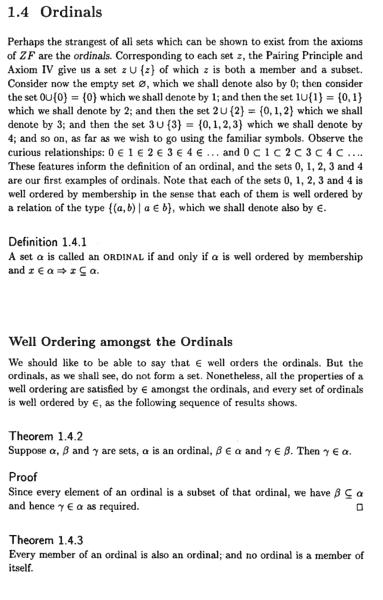
==========================================================================It may help Physics Forums readers of the above post to have access to the start of Searcoid's section on the ordinals ... so I am providing the same ... as follows:
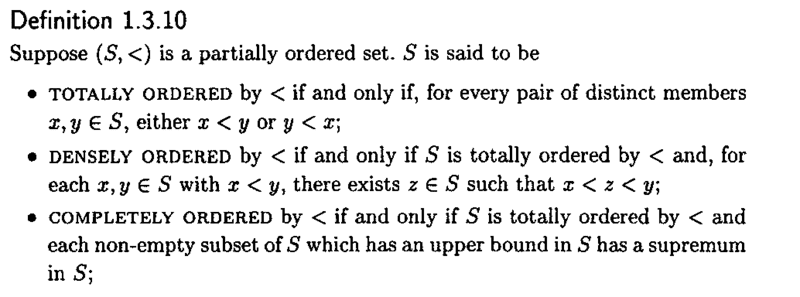
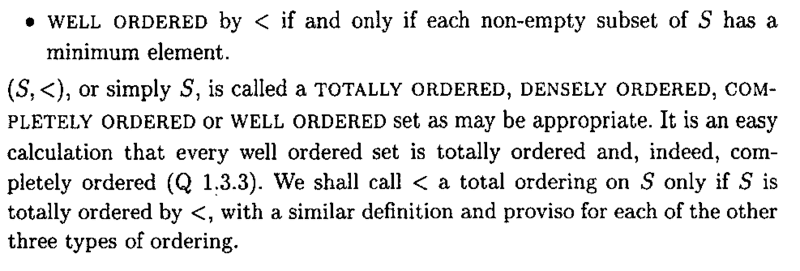
It may also help Physics Forums readers to have access to Searcoid's definition of a well order ... so I am providing the text of Searcoid's Definition 1.3.10 ... as follows:
Hope that helps,
Peter
I am currently focused on understanding Chapter 1: Sets ... and in particular Section 1.4 Ordinals ...
I need some help in fully understanding Theorem 1.4.3 ...
Theorem 1.4.3 reads as follows:
In the above proof by Searcoid we read the following:
"... ... Then ##\beta \subseteq \alpha## so that ##\beta## is also well ordered by membership. ... ...To conclude that ##\beta## is also well ordered by membership, don't we have to show that a subset of an ordinal is well ordered?
Indeed, how would we demonstrate formally and rigorously that ##\beta## is also well ordered by membership. ... ... ?*** EDIT ***
I have been reflecting on the above post on the ordinals ...Maybe to show that that ##\beta## is also well ordered by membership, we have to demonstrate that since every subset of ##\alpha## has a minimum element then every subset of ##\beta## has a minimum element ... but then that would only be true if every subset of ##\beta## was also a subset of ##\alpha## ...
Is the above chain of thinking going in the right direction ...?
Still not sure regarding the original question ...
Peter
*** FINISH EDIT ***
Help will be appreciated ...
Peter
==========================================================================It may help Physics Forums readers of the above post to have access to the start of Searcoid's section on the ordinals ... so I am providing the same ... as follows:
It may also help Physics Forums readers to have access to Searcoid's definition of a well order ... so I am providing the text of Searcoid's Definition 1.3.10 ... as follows:
Hope that helps,
Peter
Attachments
-
 Searcoid - 1 - Theorem 1.4.3 ... ... PART 1 ... .....png4.9 KB · Views: 544
 -
 Searcoid - 2 - Theorem 1.4.3 ... ... PART 2 ... ......png35.9 KB · Views: 554
 -
 Searcoid - 1 - Start of section on Ordinals ... ... PART 1 ... .....png31.4 KB · Views: 536
 -
 Searcoid - Definition 1.3.10 ... .....png24.8 KB · Views: 538
 -
 Searcoid - 2 - Definition 1.3.10 ... .....PART 2 ... ....png25.6 KB · Views: 519
 -
 ?temp_hash=bccb60496862d56962ecb212d49f4113.png4.9 KB · Views: 550
 -
 ?temp_hash=bccb60496862d56962ecb212d49f4113.png35.9 KB · Views: 538
 -
 ?temp_hash=bccb60496862d56962ecb212d49f4113.png31.4 KB · Views: 526
 -
 ?temp_hash=bccb60496862d56962ecb212d49f4113.png24.8 KB · Views: 546
 -
 ?temp_hash=bccb60496862d56962ecb212d49f4113.png25.6 KB · Views: 511