Math Amateur
Gold Member
MHB
- 3,920
- 48
I am reading Micheal Searcoid's book: "Elements of Abstract Analysis" ... ...
I am currently focused on understanding Chapter 1: Sets ... and in particular Section 1.4 Ordinals ...
I have another question regarding the proof of Theorem 1.4.4 ...
Theorem 1.4.4 reads as follows:
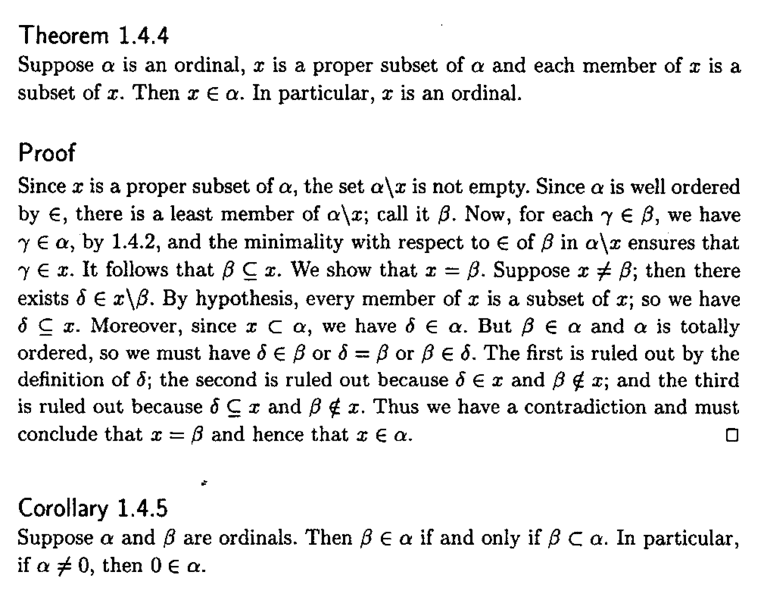 In the above proof by Searcoid we read the following:
"... ... Moreover, since ##x \subset \alpha##, we have ##\delta \in \alpha##. But ##\beta \in \alpha## and ##\alpha## is totally ordered, so we must have ##\delta \in \beta## or ##\delta = \beta## or ##\beta \in \delta## ... ... "My question is regarding the three alternatives ##\delta \in \beta## or ##\delta = \beta## or ##\beta \in \delta## ... ...Now ... where ##(S, <)## is a partially ordered set ... ##S## is said to be totally ordered by ##<## if and only if for every pair of distinct members ##x, y \in S##, either ##x < y## or ##y < x## ... ..So if we follow the definition exactly in the quote above there are only two alternatives ... ##\delta \in \beta## or ##\beta \in \delta## ... ...
My question is ... where does the = alternative come from ... ?
How does the = alternative follow from the definition of totally ordered ... ?
Help will be appreciated ...
Peter
I am currently focused on understanding Chapter 1: Sets ... and in particular Section 1.4 Ordinals ...
I have another question regarding the proof of Theorem 1.4.4 ...
Theorem 1.4.4 reads as follows:
"... ... Moreover, since ##x \subset \alpha##, we have ##\delta \in \alpha##. But ##\beta \in \alpha## and ##\alpha## is totally ordered, so we must have ##\delta \in \beta## or ##\delta = \beta## or ##\beta \in \delta## ... ... "My question is regarding the three alternatives ##\delta \in \beta## or ##\delta = \beta## or ##\beta \in \delta## ... ...Now ... where ##(S, <)## is a partially ordered set ... ##S## is said to be totally ordered by ##<## if and only if for every pair of distinct members ##x, y \in S##, either ##x < y## or ##y < x## ... ..So if we follow the definition exactly in the quote above there are only two alternatives ... ##\delta \in \beta## or ##\beta \in \delta## ... ...
My question is ... where does the = alternative come from ... ?
How does the = alternative follow from the definition of totally ordered ... ?
Help will be appreciated ...
Peter

