Ordinals .... Searcoid, Corollary 1.4.5 .... ....

  • Context: Undergrad 
  • Thread starter Thread starter Math Amateur
  • Start date Start date
Click For Summary

Discussion Overview

The discussion revolves around understanding Corollary 1.4.5 from Michael Searcoid's "Elements of Abstract Analysis," specifically in the context of ordinals as presented in Chapter 1, Section 1.4. Participants seek clarification on the implications of the corollary and its proof, particularly regarding the relationship between elements and subsets of ordinals.

Discussion Character

  • Technical explanation
  • Mathematical reasoning
  • Homework-related

Main Points Raised

  • Peter questions whether Searcoid assumes that if ##\beta \in \alpha##, then ##\beta \neq \alpha##, as this would affect the conclusion that ##\beta \subset \alpha##.
  • Another participant notes that if ##\beta = \alpha## and ##\beta \in \alpha##, it would lead to a contradiction with Theorem 1.4.3.
  • Peter seeks assistance with proving that if ##\alpha \neq 0##, then ##0 \in \alpha##.
  • One participant explains that since 0 is the empty set, it is a subset of every set, leading to the conclusion that ##0 \in \alpha## when combined with ##\alpha \neq 0##.

Areas of Agreement / Disagreement

The discussion includes multiple viewpoints regarding the assumptions in the corollary and the proof of the statement about 0 being an element of non-empty ordinals. No consensus is reached on the implications of the assumptions made in the corollary.

Contextual Notes

Participants express uncertainty about the implications of Searcoid's definitions and theorems, particularly regarding the conditions under which the equivalences hold. There is also a reliance on the definitions and theorems presented in the text, which may not be fully detailed in the discussion.

Math Amateur
Gold Member
MHB
Messages
3,920
Reaction score
48
I am reading Micheal Searcoid's book: "Elements of Abstract Analysis" ... ...

I am currently focused on understanding Chapter 1: Sets ... and in particular Section 1.4 Ordinals ...

I need some help in fully understanding the Corollary to Theorem 1.4.4 ...

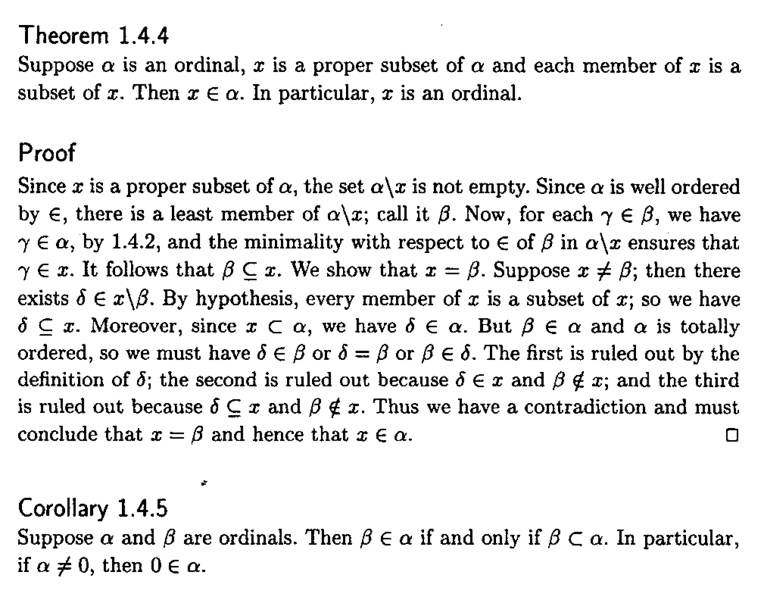
Theorem 1.4.4 and its corollary read as follows:
?temp_hash=9906c1123e18fde7daf9d16d07355c4b.png

Searcoid gives no proof of Corollary 1.4.5 ...

To prove Corollary 1.4.5 we need to show ##\beta \in \alpha \Longleftrightarrow \beta \subset \alpha## ... ...
Assume that ##\beta \in \alpha## ...

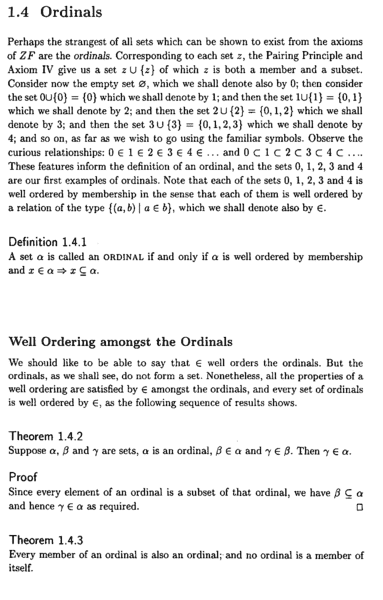
Then by Searcoid's definition of an ordinal (Definition 1.4.1 ... see scanned text below) we have ##\beta \subseteq \alpha## ...

But it is supposed to follow that ##\beta## is a proper subset of ##\alpha## ... !

Is Searcoid assuming that ##\beta \neq \alpha##? ... ... if not how would it follow that \beta \subset \alpha ... ?
Hope someone can help ...

Peter

============================================================================It may help readers of the above post if the start of the section on ordinals was accessible ... so I am providing that text as follows:
?temp_hash=9906c1123e18fde7daf9d16d07355c4b.png

Hope that helps ...

Peter
 

Attachments

  • Searcoid - Theorem 1.4.4 ... ....png
    Searcoid - Theorem 1.4.4 ... ....png
    44.9 KB · Views: 511
  • Searcoid - 1 -  Start of section on Ordinals  ... ... PART 1 ... .....png
    Searcoid - 1 - Start of section on Ordinals ... ... PART 1 ... .....png
    31.4 KB · Views: 494
  • ?temp_hash=9906c1123e18fde7daf9d16d07355c4b.png
    ?temp_hash=9906c1123e18fde7daf9d16d07355c4b.png
    44.9 KB · Views: 540
  • ?temp_hash=9906c1123e18fde7daf9d16d07355c4b.png
    ?temp_hash=9906c1123e18fde7daf9d16d07355c4b.png
    31.4 KB · Views: 491
Physics news on Phys.org
For the forward direction ##\Rightarrow## of the equivalence ##\Leftrightarrow##, having ##\beta=\alpha## together with ##\beta\in\alpha## would give us ##\alpha\in\alpha##, which would contradict Theorem 1.4.3.

For the reverse direction we just use ##\beta\subset\alpha\to \beta\subseteq\alpha## and proceed from there.
 
  • Like
Likes   Reactions: Math Amateur
Thanks Andrew ...

Just another question ... the Corollary goes on to state that, in particular, if ##\alpha \neq 0## then ##0 \in \alpha## ... can you help with the proof of this ... ?Thanks again,

Peter
 
0 is the empty set, which is a subset of every set, so in particular ##0\subseteq\alpha##. Putting this together with ##\alpha\neq 0## gives ##0\subset\alpha##. Applying the corollary to that with the arrow pointing left gives us ##0\in\alpha##.
 
  • Like
Likes   Reactions: Math Amateur
Thanks Andrew,

Peter
 

Similar threads

  • · Replies 2 ·
Replies
2
Views
2K
  • · Replies 2 ·
Replies
2
Views
2K
  • · Replies 2 ·
Replies
2
Views
2K
  • · Replies 2 ·
Replies
2
Views
2K
  • · Replies 2 ·
Replies
2
Views
3K
Replies
2
Views
2K
  • · Replies 1 ·
Replies
1
Views
1K
Replies
2
Views
1K
Replies
2
Views
2K
  • · Replies 1 ·
Replies
1
Views
2K