How do wet/dry vacuum cleaners work? What is the physics behind them?

Click For Summary
SUMMARY

Wet and dry vacuum cleaners operate based on the principles of pressure and airflow dynamics. The fan generates a low pressure difference, typically around 1/20 Atmospheres, which is sufficient to lift water from a few centimeters below the vacuum's base. The formula v1 x A1 = v2 x A2 is crucial for understanding airflow velocity changes, while the design must prevent water from reaching the motor. Notably, the fan's height does not significantly impact performance within a 0.5m range.

PREREQUISITES
  • Understanding of basic fluid dynamics principles
  • Familiarity with pressure and airflow calculations
  • Knowledge of vacuum cleaner components and their functions
  • Experience with the formula v1 x A1 = v2 x A2
NEXT STEPS
  • Research the physics of pressure differentials in fluid systems
  • Explore fan design and its impact on airflow in vacuum cleaners
  • Learn about the construction and function of floating ball valves in wet/dry vacuums
  • Investigate the effects of airflow velocity on liquid suction capabilities
USEFUL FOR

Engineers, product designers, and anyone interested in the mechanics of vacuum technology and fluid dynamics.

Dom95
Messages
1
Reaction score
0
I have a problem designing and understanding Wet and Dry vacuum cleaners. I understand some of the basics behind pressure however things I need to know is:
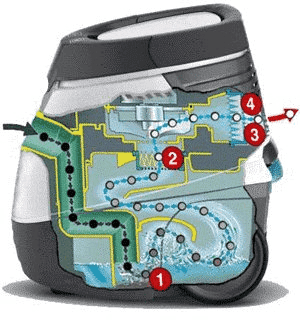
  1. what pressure/ velocity is needed to suck up water?
  2. how to calculate the pressure and velocity generated by the fan? (some examples of the impact different fans have would be great)
  3. What low pressure needs to be made for the water to drop and not get sucked up by the fan?
  4. Does the height of the fan have any impact?
Im aware of the formula v1 x A1=v2 x A2 but not much more.

upload_2018-11-20_14-23-47.png
 

Attachments

  • upload_2018-11-20_14-23-47.png
    upload_2018-11-20_14-23-47.png
    45.3 KB · Views: 1,527
Engineering news on Phys.org
In a typical wet / dry vacuum cleaner, the fan only generates a lowish pressure difference and I don't think a regular wet / dry vacuum cleaner will remove water from more than a few cm below where it's standing. All that's needed is a pressure difference corresponding to a bit less than0.5m head of water (or 1/20 Atmospheres). Too much could be embarrassing. If you want Fireman's capability, you use a Pump!

I would imagine that actual figures about air flow velocities would be hard to get hold of. The only test I know of was more of a (reputed) demonstration really. Early Electrolux salesmen (they used to visit homes in those days) used to turn the (cylinder) cleaner on without the hose connected and it would stick to the ceiling just by the atmospheric pressure difference across the hole. If the cleaner (mostly metal with a bit of bakelite, perhaps) weighed 14lbs and the hole was 2" diameter, the pressure difference would need tohave been 14/(π) = about 4.4 lbs/inch2 So the pressure difference would have been about 1/π atmospheres. It was a brilliant selling feature as the demo was like magic.. This test gave no actual indication of how much dust it would suck up or the maximum air flow it could achieve but it made the point that "Nothing sucks like an Electrolux". Perhaps my estimated 14lbs is a bit on the low side - you can do different maths if you want.

3. When sucking up just water, the speed of flow would be very low. I guess there would be a certain mix of air to water where there is a risk of some water drops being carried into the fan so it would need to be isolated from the motor. But then - you wouldn't want water to come out of the other end haha. The system in your picture is a lot more complicated than my Numatic 'George' model in which the hose comes right onto the side (where it would normally be connected to the dry bag). No deflectors like the ones in your diagram. It has a floating ball valve to turn off the motor when it's full of water or foam.
4. The fan can be at any level but it would be best to have it (and all the electrics) at a high point. Air pressure doesn't vary over a height of 0.5m.
 

Similar threads

  • · Replies 3 ·
Replies
3
Views
4K
  • · Replies 48 ·
2
Replies
48
Views
9K
Replies
0
Views
2K
  • · Replies 6 ·
Replies
6
Views
617
Replies
18
Views
9K
  • · Replies 1 ·
Replies
1
Views
1K
  • · Replies 1 ·
Replies
1
Views
2K
Replies
13
Views
4K
  • · Replies 2 ·
Replies
2
Views
2K
  • · Replies 3 ·
Replies
3
Views
16K