How Do You Apply the Chain Rule to 2/x with Respect to Time?

Click For Summary
SUMMARY

The discussion focuses on applying the chain rule to the function 2/x with respect to time. The correct approach involves recognizing that 2/x is not a constant and using the chain rule formula: d/dt(2/x) = d/dx(2/x) * dx/dt. The derivative of position with respect to time is defined as velocity, which is crucial for solving the problem. Participants emphasize the importance of visualizing 2/x as a function within a function to correctly apply the chain rule.

PREREQUISITES
  • Understanding of calculus, specifically differentiation
  • Familiarity with the chain rule in calculus
  • Basic knowledge of physics concepts such as position, velocity, and acceleration
  • Ability to manipulate algebraic expressions
NEXT STEPS
  • Study the application of the chain rule in various calculus problems
  • Explore the relationship between position, velocity, and acceleration in physics
  • Practice taking derivatives of rational functions
  • Learn how to visualize functions and their derivatives graphically
USEFUL FOR

Students of calculus, physics enthusiasts, and anyone seeking to deepen their understanding of differentiation and its applications in real-world scenarios.

AirForceOne
Messages
49
Reaction score
0
Hi,

Say x=position, v=velocity, a=acceleration, t=time.
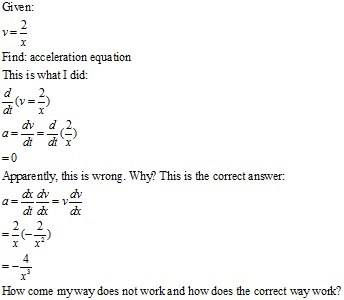
IyzKe.jpg


Thanks!

EDIT: I just realized that 2/x is not a constant and thus I shouldn't have treated it as a constant (taking the derivative of it as 0). However, I don't understand how to take the derivative with respect to t of it.
 
Physics news on Phys.org
AirForceOne said:
Hi,

Say x=position, v=velocity, a=acceleration, t=time.

IyzKe.jpg


Thanks!

EDIT: I just realized that 2/x is not a constant and thus I shouldn't have treated it as a constant (taking the derivative of it as 0). However, I don't understand how to take the derivative with respect to t of it.

Use the chain rule.
d/dt(2/x) = d/dx(2/x) * dx/dt

If you work through this, you'll get what you show as the correct answer.
 
By definition the time derivative of position is velocity.
 
Ugh, I forgot how to use the chain rule *slaps forehead*. I get it now. It was hard to visualize 2/x as a "function within a function".

Thanks guys!
 

Similar threads

  • · Replies 8 ·
Replies
8
Views
2K
  • · Replies 6 ·
Replies
6
Views
4K
  • · Replies 5 ·
Replies
5
Views
2K
  • · Replies 1 ·
Replies
1
Views
2K
  • · Replies 1 ·
Replies
1
Views
1K
  • · Replies 4 ·
Replies
4
Views
1K
  • · Replies 3 ·
Replies
3
Views
3K
  • · Replies 5 ·
Replies
5
Views
3K
  • · Replies 11 ·
Replies
11
Views
2K
  • · Replies 3 ·
Replies
3
Views
2K