How Do You Apply the Chain Rule to 2/x with Respect to Time?

Click For Summary

Discussion Overview

The discussion revolves around applying the chain rule to the expression 2/x with respect to time. Participants explore the differentiation process, particularly in the context of physics where position, velocity, and time are involved.

Discussion Character

  • Mathematical reasoning
  • Conceptual clarification

Main Points Raised

  • One participant notes that 2/x should not be treated as a constant when taking its derivative, indicating a misunderstanding of its nature.
  • Another participant suggests using the chain rule to differentiate 2/x with respect to time, providing the formula d/dt(2/x) = d/dx(2/x) * dx/dt.
  • A third participant states that by definition, the time derivative of position is velocity, linking the mathematical process to physical concepts.
  • A later reply expresses realization about the difficulty of visualizing 2/x as a "function within a function," indicating a moment of clarity regarding the chain rule.

Areas of Agreement / Disagreement

Participants appear to agree on the need to apply the chain rule, but there is no consensus on the specific steps or the clarity of the concept as expressed by different participants.

Contextual Notes

The discussion includes a recognition of the need for clarity in applying the chain rule, but does not resolve the potential confusion surrounding the visualization of the function 2/x in relation to time.

AirForceOne
Messages
49
Reaction score
0
Hi,

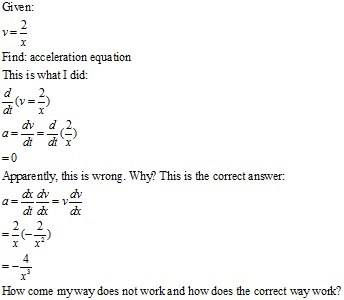
Say x=position, v=velocity, a=acceleration, t=time.
IyzKe.jpg


Thanks!

EDIT: I just realized that 2/x is not a constant and thus I shouldn't have treated it as a constant (taking the derivative of it as 0). However, I don't understand how to take the derivative with respect to t of it.
 
Physics news on Phys.org
AirForceOne said:
Hi,

Say x=position, v=velocity, a=acceleration, t=time.

IyzKe.jpg


Thanks!

EDIT: I just realized that 2/x is not a constant and thus I shouldn't have treated it as a constant (taking the derivative of it as 0). However, I don't understand how to take the derivative with respect to t of it.

Use the chain rule.
d/dt(2/x) = d/dx(2/x) * dx/dt

If you work through this, you'll get what you show as the correct answer.
 
By definition the time derivative of position is velocity.
 
Ugh, I forgot how to use the chain rule *slaps forehead*. I get it now. It was hard to visualize 2/x as a "function within a function".

Thanks guys!
 

Similar threads

  • · Replies 8 ·
Replies
8
Views
3K
  • · Replies 6 ·
Replies
6
Views
4K
  • · Replies 5 ·
Replies
5
Views
2K
  • · Replies 1 ·
Replies
1
Views
3K
  • · Replies 1 ·
Replies
1
Views
2K
  • · Replies 4 ·
Replies
4
Views
2K
  • · Replies 3 ·
Replies
3
Views
3K
  • · Replies 5 ·
Replies
5
Views
3K
  • · Replies 11 ·
Replies
11
Views
2K
  • · Replies 3 ·
Replies
3
Views
2K