How Do You Calculate Current in a Diode-Resistor Series Circuit?

Click For Summary

Discussion Overview

The discussion revolves around calculating the current in a diode-resistor series circuit, specifically focusing on deriving an expression for current as a function of voltage. Participants explore theoretical and practical aspects of the problem, including the diode equation and methods for plotting current versus voltage.

Discussion Character

  • Exploratory
  • Technical explanation
  • Mathematical reasoning
  • Homework-related

Main Points Raised

  • One participant presents the diode equation, iD = Is * exp(vD/(n*Vt)), and seeks help in deriving an expression for current.
  • Another participant questions the correctness of the approximation and suggests plugging in a specific current to find the diode voltage.
  • Several participants discuss the relationship between the currents through the diode and the resistor, and how to express Vtot in terms of these currents.
  • One participant expresses uncertainty about using Newton's method for solving non-linear equations and seeks clarification on obtaining current as a function of voltage.
  • Another participant suggests that the problem may be more about plotting values rather than deriving a complex expression, recommending specific current values for calculations.
  • A later reply introduces Newton's method as a potential iterative solution for finding the diode current, outlining a basic approach to the problem.

Areas of Agreement / Disagreement

Participants exhibit a mix of agreement and disagreement regarding the approach to solving the problem. While some focus on deriving expressions, others emphasize the importance of plotting values. The discussion remains unresolved on the best method to achieve the desired outcome.

Contextual Notes

Participants express uncertainty about the non-linear nature of the diode equation and the application of numerical methods. There are also references to specific current values and their implications for voltage calculations, but no consensus on a definitive method is reached.

Who May Find This Useful

This discussion may be useful for students studying electronics, particularly those interested in diode behavior in circuits, as well as those looking for methods to solve non-linear equations in practical applications.

Bassa
Messages
46
Reaction score
1
Helo,

I am in an electronic course and we just started studying diodes. I am stuck on the following problem:

Place a 100 ohm resistance in series with a diode, and plot current versus voltage across the series combination.
I am also given the following values for the diode:
n = 1, Is = 10^-14A, Vt = 26mVI am trying to come up with an expression for current. I am using the following:

iD = Is * exp(vD/(n*Vt)) ... approximation of the current through the diode.

and

Vr = iR for the voltage drop across the resistor

Then, the total voltage drop is:

Vtot = vD + Vr

I am then trying to solve for current, but I can't get it on its own. Can some one please help me. I have attached a picture of the original problem statement. Thank you very. much!
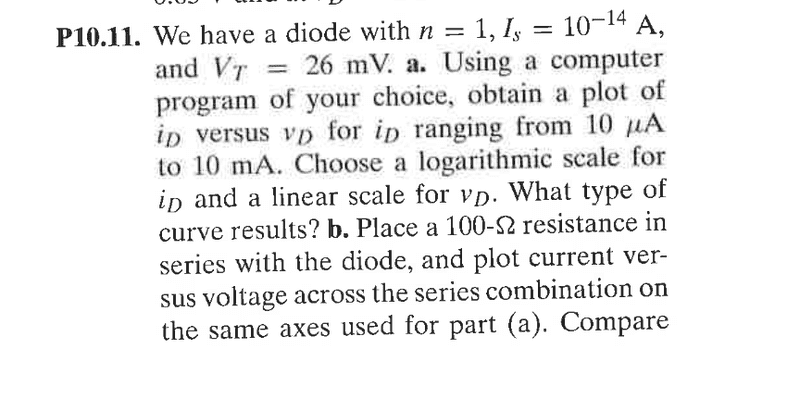
Screen Shot 2017-03-25 at 7.33.08 PM.png
 
Engineering news on Phys.org
I haven't checked to verify that your approximation equation is correct. But if it is, what do you get for the diode voltage if you plug in, say, 1 μA in as the current for the diode?
 
Do you know how to take your expression for the current through the diode (iD = Is * exp(vD/(n*Vt))), and invert it to give vD as a function of iD? Also, how do the current through the diode and the current through the resistor compare? Then if you put these currents into your expression for Vtot, you will have a relation between Vtot and I which you should be able to solve on a computer. Do you know how to use Newton's method to solve a non-linear algebraic equation?
 
phyzguy said:
Do you know how to take your expression for the current through the diode (iD = Is * exp(vD/(n*Vt))), and invert it to give vD as a function of iD? Also, how do the current through the diode and the current through the resistor compare? Then if you put these currents into your expression for Vtot, you will have a relation between Vtot and I which you should be able to solve on a computer. Do you know how to use Newton's method to solve a non-linear algebraic equation?

Thank you for the reply! I do know how to solve the expression for the current through the diode and invert it to get vD. My problem is that I need to get an expression of the current in terms of voltage. Since it is not linear, I am not sure how to do that. I have not used Newton's method to solve non-linear algebraic equations.
 
TomHart said:
I haven't checked to verify that your approximation equation is correct. But if it is, what do you get for the diode voltage if you plug in, say, 1 μA in as the current for the diode?

I think I get the fist part of the question, but I am stuck on getting an expression for the current in terms of voltage for the second situation where we add a resistor.
 
I don't have the time right at the moment to try to come up with an expression; it doesn't look extremely trivial. But it didn't look to me like the problem statement was asking for an expression; it was asking for a plot. So if you pick a current - say, 1 μA - you can rearrange the diode equation and solve for the voltage drop for that particular current. And certainly you can calculate the voltage drop across a 100 ohm resistor for that same 1 μA current. So the total voltage would be VD + VR for that 1 μA current. You could pick a number of currents from 10 μA to 10 mA and come up with a plot. It would be fairly straightforward to do that in Excel, I would think.

Maybe when I have a little more time on my hands, I might try to look at solving for current based on input voltage.
 
TomHart said:
I don't have the time right at the moment to try to come up with an expression; it doesn't look extremely trivial. But it didn't look to me like the problem statement was asking for an expression; it was asking for a plot. So if you pick a current - say, 1 μA - you can rearrange the diode equation and solve for the voltage drop for that particular current. And certainly you can calculate the voltage drop across a 100 ohm resistor for that same 1 μA current. So the total voltage would be VD + VR for that 1 μA current. You could pick a number of currents from 10 μA to 10 mA and come up with a plot. It would be fairly straightforward to do that in Excel, I would think.

Maybe when I have a little more time on my hands, I might try to look at solving for current based on input voltage.

Thank you very much! I will try that!
 
Newtons method is used to solve the non-linear equation of R in series with D.
Supply voltage is Vs. Assume initial diode voltage Vd = 0.
Then resistor R, and diode have series current, I = Vs / R.
An iterative solution for diode current should converge rapidly.
Do.
Given I, find Vd from the diode equation.
Then I' = ( Vs – Vd ) / R
Loop until value is stable.
 
  • Like
Likes   Reactions: Bassa

Similar threads

Replies
93
Views
8K
Replies
23
Views
5K
Replies
12
Views
2K
  • · Replies 5 ·
Replies
5
Views
5K
Replies
3
Views
2K
  • · Replies 1 ·
Replies
1
Views
2K
  • · Replies 14 ·
Replies
14
Views
34K
  • · Replies 9 ·
Replies
9
Views
8K
  • · Replies 6 ·
Replies
6
Views
2K
  • · Replies 2 ·
Replies
2
Views
2K