How Do You Calculate Currents in a Bridge Circuit?

  • Thread starter Thread starter Peto
  • Start date Start date
  • Tags Tags
    Circuit Currents
Click For Summary
SUMMARY

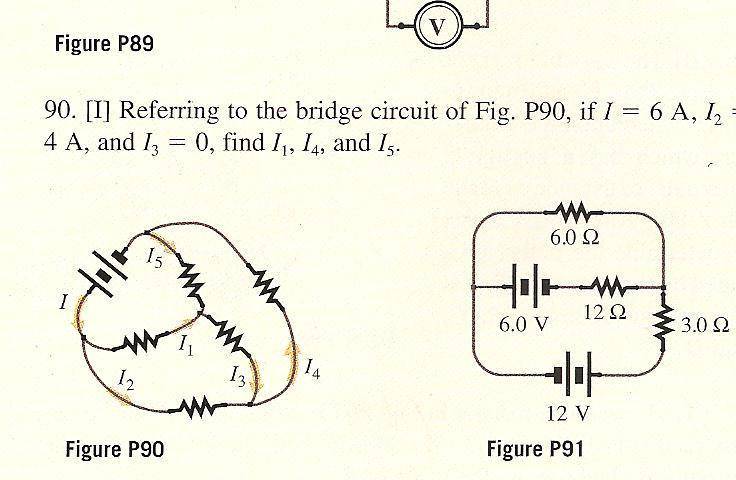
The discussion focuses on calculating currents in a bridge circuit, specifically using the values I=6A, I2=4A, and I3=0. The calculated values are I1=2A, I4=4A, and I5=2A. The logic applied is correct: I1 is derived from the difference between I and I2, while I4 is the sum of I2 and I3, and I5 corresponds to I1. The conclusions drawn are accurate and confirm the calculations presented.

PREREQUISITES
  • Understanding of Kirchhoff's Current Law (KCL)
  • Basic knowledge of electrical circuit theory
  • Familiarity with bridge circuit configurations
  • Ability to perform basic algebraic calculations
NEXT STEPS
  • Study Kirchhoff's Voltage Law (KVL) for comprehensive circuit analysis
  • Learn about different types of bridge circuits, such as Wheatstone bridges
  • Explore advanced circuit simulation tools like LTspice
  • Investigate practical applications of bridge circuits in sensor technology
USEFUL FOR

Electrical engineering students, circuit designers, and anyone involved in analyzing or designing bridge circuits will benefit from this discussion.

Peto
Messages
9
Reaction score
0
Referring to the bridge circuit of fig P90, if I=6A, I2=4A, and I3 = 0, find I1, I4, and I5.
P90.jpg
I did,
I1=2A
I4=4A
I5=2A

My logic being, since I is 6A, and I2 is 4A, I1 must be the difference, 2A. since I4 is coming from I2 and I3 it should be the sum, (0 + 4A = 4A). and I thought because I5 is coming from I1, it must be 2A.

Is this right?
Thanks for any help!
 
Physics news on Phys.org
Yes.
 

Similar threads

Replies
8
Views
2K
  • · Replies 9 ·
Replies
9
Views
4K
Replies
10
Views
2K
  • · Replies 12 ·
Replies
12
Views
2K
  • · Replies 1 ·
Replies
1
Views
2K
  • · Replies 4 ·
Replies
4
Views
4K
  • · Replies 1 ·
Replies
1
Views
1K
  • · Replies 9 ·
Replies
9
Views
3K
  • · Replies 9 ·
Replies
9
Views
2K
  • · Replies 4 ·
Replies
4
Views
2K