How Do You Calculate Forces and Balance a Hanging Cafe Sign?

  • Thread starter Thread starter issacnewton
  • Start date Start date
  • Tags Tags
    Pole Sign
Click For Summary
SUMMARY

The discussion centers on calculating the forces and balance of a hanging cafe sign attached to a horizontal beam in equilibrium. The cafe sign weighs 3 kg and is suspended from a 1 kg beam that is 4 m long. Key equations derived include the tension in the wire, the normal force from the wall, and the upward force supporting the beam. The participants conclude that the problem lacks sufficient information to solve for all unknowns, particularly regarding the position of the sign along the beam.

PREREQUISITES
  • Understanding of static equilibrium principles in physics
  • Knowledge of torque and force balance equations
  • Familiarity with trigonometric functions related to angles in force calculations
  • Ability to interpret and manipulate algebraic equations
NEXT STEPS
  • Study the principles of static equilibrium in detail
  • Learn how to apply torque equations in various physical scenarios
  • Explore the implications of force directionality in structural support systems
  • Investigate similar problems involving forces and torques for deeper understanding
USEFUL FOR

Physics students, engineering students, and professionals involved in structural analysis or mechanics who need to understand the balance of forces in static systems.

issacnewton
Messages
1,035
Reaction score
37
A 3 kg cafe sign is to be hung from 1 kg horizontal beam such that it is in equilibrium. The beam is 4 m long. A wire is attached to the beam at its right end to prevent the sign and the beam from rotating. The beam is pressed against the wall on its left end and is prevented from sliding by a bracket that is fixed to the wall.
a) What is the tension force in the wire ?
b) What is the normal force of the wall pushing against the left end of the beam ?
c) What is the upward force supporting the left end of the beam ?
d) How far from the wall should sign be hung so that it is in equilibrium ?
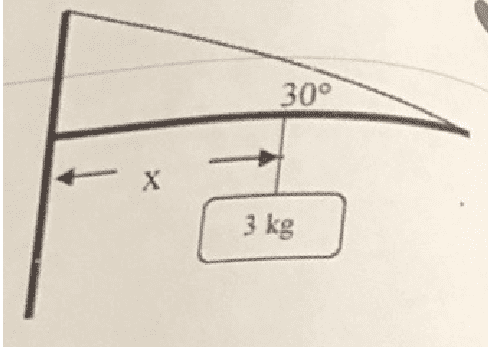
240770

Now following is my attempt at solution. Let ##T## be the tension in the wire and ##\theta = 30 ^{\circ}## be the angle made by the wire with the horizontal. Let ##F## be the upward force supporting the left end of the beam and ##N## be the normal force of the wall pushing against the left end of the beam. Let ##L=4m## be the length of the beam and ##M = 1 kg## be the mass of the beam and ##m=3 kg## be the mass of the cafe sign. Then the condition that the net force on the beam is zero leads to the following equations
$$ N = T\cos(\theta) \cdots\cdots (1)$$
$$ F + T \sin(\theta) = Mg + mg \cdots\cdots (2)$$
Now, the net torque about the right end of the beam is zero. So this leads to the equation
$$ Mg(L/2) +mg(L-x) - FL = 0 \cdots\cdots (3) $$
Also, the net torque about the leftend of the beam is zero. So this leads to the equation
$$ T \sin(\theta) L -Mg(L/2) - mg x = 0 \cdots\cdots (4) $$

Now, it seems that, these four equations are not sufficient to entirely solve this problem with four unknowns ##F,N,T,x##. I just get three equations and 4 unknowns after doing some algebra. So any hints here ?
 
Physics news on Phys.org
Your first equation effectively reduces the problem to three unknowns.
 
so is the problem incomplete ? I think some information is missing
 
IssacNewton said:
so is the problem incomplete ? I think some information is missing

What more information could you have? The problem is physically complete. There can only be one solution.
 
So what am I missing ? Any other equation ?
 
IssacNewton said:
So what am I missing ? Any other equation ?

The tension and forces depend on ##x## of course.
 
Yes, you are right. I got my equations from first and second conditions of equilibrium. How would I get other equations connecting forces with ##x## ?
 
IssacNewton said:
Yes, you are right. I got my equations from first and second conditions of equilibrium. How would I get other equations connecting forces with ##x## ?
Haven't you got enough equations?
 
But like you said, we have 3 equations and 4 unknowns. So how can I solve this ?
 
  • #10
IssacNewton said:
But like you said, we have 3 equations and 4 unknowns. So how can I solve this ?

I didn't say that! You said that.

You'll need to post your attempt.
 
Last edited:
  • #11
IssacNewton said:
A 3 kg cafe sign is to be hung from 1 kg horizontal beam such that it is in equilibrium. The beam is 4 m long. A wire is attached to the beam at its right end to prevent the sign and the beam from rotating. The beam is pressed against the wall on its left end and is prevented from sliding by a bracket that is fixed to the wall.
a) What is the tension force in the wire ?
b) What is the normal force of the wall pushing against the left end of the beam ?
c) What is the upward force supporting the left end of the beam ?
d) How far from the wall should sign be hung so that it is in equilibrium ?
View attachment 240770
Now following is my attempt at solution. Let ##T## be the tension in the wire and ##\theta = 30 ^{\circ}## be the angle made by the wire with the horizontal. Let ##F## be the upward force supporting the left end of the beam and ##N## be the normal force of the wall pushing against the left end of the beam. Let ##L=4m## be the length of the beam and ##M = 1 kg## be the mass of the beam and ##m=3 kg## be the mass of the cafe sign. Then the condition that the net force on the beam is zero leads to the following equations
$$ N = T\cos(\theta) \cdots\cdots (1)$$
$$ F + T \sin(\theta) = Mg + mg \cdots\cdots (2)$$
Now, the net torque about the right end of the beam is zero. So this leads to the equation
$$ Mg(L/2) +mg(L-x) - FL = 0 \cdots\cdots (3) $$

The system is not free to rotate about the right end, so you don't have an equation here.

Is your problem that you have too many equations?
 
  • #12
Okay perhaps I understand your question. Part d) suggests there is only one position ##x##. But, surely the system supports the sign whatever ##x## is.

Is that your question?
 
  • #13
I use Wolfram Alpha to solve these 4 equations and it gives me answer in terms of ##F##.

240793


This means that with my equations, the problem can not be solved completely. Probably, some information is missing in the problem or I am overlooking something.
 
  • #14
can anybody take a look at this problem ?I am stuck on this.
 
  • #15
IssacNewton said:
The beam is pressed against the wall on its left end and is prevented from sliding by a bracket that is fixed to the wall.
Perhaps this means that the beam is supported from underneath by the bracket and the beam's end at the wall is prevented from sliding down but can slide up. In other words, the vertical force ##F## exerted by the wall can be directed up but not down. The value of ##x## at which ##F## changes sign
is what you should be looking for. Anyway, that's my interpretation.
 
  • #16
Thanks I will use that
 
  • #17
kuruman said:
Perhaps this means that the beam is supported from underneath by the bracket and the beam's end at the wall is prevented from sliding down but can slide up. In other words, the vertical force ##F## exerted by the wall can be directed up but not down. The value of ##x## at which ##F## changes sign
is what you should be looking for. Anyway, that's my interpretation.
I am not seeing how that makes much physical sense. In order for F to change signs, x is going to need to exceed the length of the horizontal beam.

Mathematically, that is no problem. But physically, it is tough to hang a sign under a portion of a beam that is absent.

Edit: The solution from Wolfram Alpha contemplates just such a configuration -- set F=0 and see what x evaluates to.
 
  • #18
If we plug ##F=0##, then ##x = 14/3 = 4.67m##. This is longer than the length of the beam. So its not a possible solution. I think some information is probably missing from the problem. All 4 unknowns can not be solved.
 
  • #19
jbriggs444 said:
am not seeing how that makes much physical sense. In order for F to change signs, x is going to need to exceed the length of the horizontal beam.

Mathematically, that is no problem. But physically, it is tough to hang a sign under a portion of a beam that is absent.
Right you are. I was thinking of another problem where the wire is not attached at the tip, but at some given distance from the wall. Part (d) doesn't make sense the way it is written because one has to assume that the rod is in equilibrium to do the previous three parts.
 
  • Like
Likes   Reactions: jbriggs444

Similar threads

  • · Replies 42 ·
2
Replies
42
Views
4K
Replies
8
Views
6K
Replies
6
Views
2K
Replies
2
Views
1K
  • · Replies 5 ·
Replies
5
Views
1K
  • · Replies 1 ·
Replies
1
Views
6K
Replies
17
Views
2K
  • · Replies 2 ·
Replies
2
Views
11K
  • · Replies 10 ·
Replies
10
Views
5K
Replies
5
Views
2K