How Do You Calculate Moments in Complex Physics Problems?

  • Thread starter Thread starter yugeci
  • Start date Start date
  • Tags Tags
    Moments
Click For Summary

Homework Help Overview

The discussion revolves around calculating moments in a physics problem involving forces and torques. Participants are addressing various parts of the problem, including resolving forces, determining distances, and analyzing moments about specific points.

Discussion Character

  • Mixed

Approaches and Questions Raised

  • Participants are attempting to resolve forces into components and calculate moments about pivot points. Questions arise regarding the vertical distance needed for calculations and the implications of the moments summing to zero. Some participants express uncertainty about specific parts of the problem, particularly regarding the maximum moment and the approach to take for certain calculations.

Discussion Status

There has been progress in solving part (a), with some participants successfully calculating moments and forces. However, uncertainty remains regarding parts (c) and (d), with various approaches being discussed. Participants are exploring different interpretations and methods without reaching a consensus.

Contextual Notes

Participants mention the importance of using correct units and conversions, as well as the need to clarify assumptions about forces acting on pivot points. There is an acknowledgment of the complexity of the problem and the requirement for careful reasoning in approaching the calculations.

yugeci
Messages
61
Reaction score
0
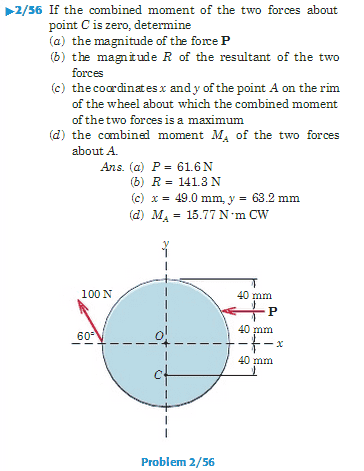
Hello friends, I have this problem I've been stuck on for a while:
JvJNzmg.png


Here are a few relevant equations:

Moment = FxDy + FyDx
Fx = F cos θ
Fy = F sin θ
etc.

I can't even get past part (a). Resolving the 100 lb force is easy. It would be 100 sin 60 for the vertical component and - 100 cos 60 for the horizontal component. And the P component is a horizontal force, with no vertical component. The distance between P and C is 8". The distance between the horizontal component of the 100 lb force would be 8" too I guess (not sure), but what would be the vertical distance?

Part (b) doesn't look too hard once P is figured out.

I am not sure about part (c). Where will point A be if the moment is a maximum?

I don't understand part (d) either.

Help would greatly be appreciated.

Homework Statement


Homework Equations


The Attempt at a Solution

 
Physics news on Phys.org
Hello friend, a request here: make it a little easier on potential helpers and use the template. It also helps you to sort out things, check if you have the right equations (you do) and especially to be conscious of where you get stuck.

Your tackle the exercise in the right way. Your translation from mm to inch is unnecessary, so don't do it. Especially not if you have the wrong conversion factor ( should be 1 mm = 1/25.4 inch) . Same with N to lbf

The vertical distance is the distance between a line through the point where the force acts that is perpendicular to the axis of rotation, and the axis of rotation. Same way as with P, actually.
 
It says the moments sum to zero. The horizontal and vertical components don't necessarily sum to zero because you don't know the forces on the pivot point C.

My first reaction is to work out the torque caused by the 100N force about point C.
 
I am not sure about part (c). Where will point A be if the moment is a maximum?
Not sure what you are not sure about. You repeat the question; that is not an attempt at a solution.
By the time you can calculate the sum of moments around C you can also do so around a point D on the rim straight under C, right?
This helps you with c) and with d).
The fact that c) comes before d) suggests that you don't have to calculate this sum first to answer c). Some smart way to look at c) is indicated.
 
CWatters said:
It says the moments sum to zero. The horizontal and vertical components don't necessarily sum to zero because you don't know the forces on the pivot point C.

My first reaction is to work out the torque caused by the 100N force about point C.

Yes. One can sum the Fy times Dx (there is only one) and the Fx times Dy. The sum has to be zero.
 
OK, I'll use the template from next time. I managed to get solve part (a)

My = 100 sin 60 * 8
Mx = (- 100 cos 60 * 4) + (-8P)

Since they both anti-clockwise, My + Mx = 0

So I got P as 61.6N, and the resultant as 141.26N. Thank you guys for the help.

How will part (c) and (d) be solved?

Edit - just saw the 2 new posts, I'll try.
 
BvU said:
Not sure what you are not sure about. You repeat the question; that is not an attempt at a solution.
By the time you can calculate the sum of moments around C you can also do so around a point D on the rim straight under C, right?
This helps you with c) and with d).
The fact that c) comes before d) suggests that you don't have to calculate this sum first to answer c). Some smart way to look at c) is indicated.

I get what you mean. But I don't get what approach to take for part (c). can think of..

My = 100 sin 60 * x
Mx = (-100 cos 60 * y) + (-P * y)

Where x and y are some values of horizontal distance and vertical distance that give a max moment M = Mx + My. Now what? We don't know what this max value is..
 
Some smart way to look at c) is indicated.
Didn't find one yet, sorry. Thought about vector addition of P and 100 N and drawing a line perp to the sum. Comes close to answer. (addition introduces a small torque as well).
 
I saw the solution in the solution manual and they draw a perpendicular line from the resultant (attached the image). If so they used α to get the x and y values.. it actually makes sense to me since max torque happens when the distance is perpendicular. These questions are pretty insane and require so much thinking.

Edit - this is pretty much the same method you did BvU if I'm not mistaken.. where does the extra torque come from?

With that I think I will be able to do part (d) as well. Thanks for all of the help guys. :)
 

Attachments

  • help.png
    help.png
    9.5 KB · Views: 608
  • #10
Well, this looks real good. Didn't think of moving F along its own line of action until F and P grab at the same point. Totally agree with the solutions manual.

I needed an extra torque because I moved P perpendicular to its axis to the x-axis, then to the point where the 100 N grabs and then added the two. This moving perpendicularly requires the introduction of an extra torque which spoiled an easy finding of the maximum moment point.

You indicate you understand the solution manual way makes sense, so you have learned something useful.
I have learned too: there had to be a shortcut easy way, and there is one. Just didn't find it. Next time (perhaps) both of us will do better.
 

Similar threads

  • · Replies 7 ·
Replies
7
Views
1K
  • · Replies 105 ·
4
Replies
105
Views
5K
  • · Replies 1 ·
Replies
1
Views
2K
Replies
7
Views
2K
  • · Replies 38 ·
2
Replies
38
Views
4K
  • · Replies 4 ·
Replies
4
Views
1K
  • · Replies 24 ·
Replies
24
Views
2K
Replies
3
Views
2K
  • · Replies 42 ·
2
Replies
42
Views
4K
  • · Replies 6 ·
Replies
6
Views
2K