How Do You Calculate the Height of a Wedge in a Physics Problem?

Click For Summary

Homework Help Overview

The discussion revolves around a physics problem involving a block released from a wedge on a frictionless surface. The participants are trying to determine the height of the wedge after calculating the velocities of both the block and the wedge.

Discussion Character

  • Exploratory, Conceptual clarification, Mathematical reasoning, Problem interpretation

Approaches and Questions Raised

  • Participants discuss using conservation of energy to find the height of the wedge, questioning which masses and velocities to include in their equations. Some express confusion about setting up the energy equations correctly.

Discussion Status

Several participants have attempted to set up equations based on conservation of energy, but there is still uncertainty regarding the correct application of the formulas. Some guidance has been offered on how to relate the potential and kinetic energies, but no consensus has been reached on the specific setup.

Contextual Notes

Participants are working under the constraints of a homework assignment, which may limit the information they can use or the methods they can apply. There is a discussion about the potential energy of the wedge and its relevance to the problem.

parwana
Messages
182
Reaction score
0
A small block of mass m1 = 0.300 kg is released from rest at the top of a curved wedge of mass m2 = 2.00 kg, which sits on a frictionless horizontal surface as in Figure P6.59a. When the block leaves the wedge, its velocity is measured to be 4.00 m/s to the right, as in Figure P6.59b.
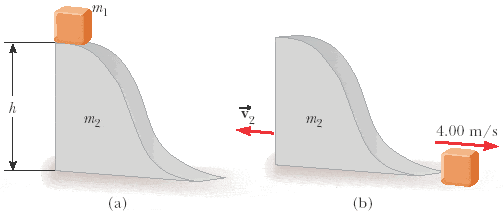
p6-59.gif


(a) What is the velocity of the wedge after the block reaches the horizontal surface?
I found the velocity to be -.6 m/s. I did 0=m2v2 + M(block)V(block)


(b) What is the height h of the wedge?
I don't know how to get the height of the wedge, please help

I know the energy equation will be

mgh= .5mv^2

Please help
 
Physics news on Phys.org
please can anyone help?
 
If you find the velocity of the block and the wedge, you should be able to apply concervation of energy to determine the height of the wedge. This means one point you have to apply the formula to is when M1 is at rest at the top of the wedge. use mgh = (whatever you decide) to determine the height of M1 relative to the ground. This is the same as the height of the wedge.
 
I still don't understand. Can you show me how to set up the equation

Would it be

mgh= .5mv^2 Now which mass and which velocity should I use to find h here
 
parwana said:
I still don't understand. Can you show me how to set up the equation

Would it be

mgh= .5mv^2 Now which mass and which velocity should I use to find h here

As AVD said, you have to use conservation of energy on the system consisting of the block and the wedge. So, write down the sum of kinetic and potential energy for these two momens and set them to equal one another; a) the block rests on the wedge, b) the block is on the horizontal surface.
 
^ I am really sorry, I tried setting it up but I am getting it wrong.
 
would it be?

KE + PE = KE + PE

and go from there?
 
I tried that

.5(.3)(4^2) + .3(9.8)h= .5(32)(.6^2) + 2(9.8)h

is that right

It didnt work for some reason, I got .112 is height, or am I doing something wrong
 
am I showing in notes from that this may be an inelastic collision (m1v1i + m2v2i = (m1 + m2)Vf)... sorry I am not help to you :(
 
  • #10
rkslperez04 said:
would it be?

KE + PE = KE + PE

and go from there?

PE(block) = KE(block) + KE(wedge), where PE(block) is for the moment the block is resting on the wedge, and KE(block) and KE(wedge) are for the moment when the block is on the horizontal surface, and the wedge has the velocity you calculated in part 1.
 
  • #11
^ Its ok, I hope someone else helps
 
  • #12
Thanks so much radou, but why don't we use the PE of the wedge?
 
  • #13
parwana said:
Thanks so much radou, but why don't we use the PE of the wedge?

The wedge has no potential energy, since it is on the horizontal surface all the time.
 
  • #14
^ oh ok thanks a lot
 

Similar threads

  • · Replies 4 ·
Replies
4
Views
2K
  • · Replies 11 ·
Replies
11
Views
3K
  • · Replies 12 ·
Replies
12
Views
3K
  • · Replies 38 ·
2
Replies
38
Views
5K
  • · Replies 5 ·
Replies
5
Views
4K
Replies
7
Views
2K
  • · Replies 18 ·
Replies
18
Views
4K
Replies
17
Views
2K
  • · Replies 5 ·
Replies
5
Views
2K
Replies
3
Views
2K