Nickf_Zar
- 1
- 0
- TL;DR
- Calculating the torque required for an agitator/scraper.
Hi All,
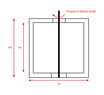
I must calculate the torque and for an agitator motor. An anchor type agitator/scraper, removing crust off the edge of a tank.
My instinct is the max or startup torque will be = (Moment of Inertia) x (Angular Acceleration) + (Drag force of the submerged impeller)* Max radius + (Frictional forces on the edge of the tank)* Max Radius
Tmax = ( I * α ) + [ ( Cd * A * ρ * V² * ½ ) + (µ * F) ] * D/2
• The motor has a soft start but is operated at constant RPM.
• The idea is to get a worst-case scenario to design from.
• Please suggest if you think this problem can be solved with a better solution.
I have very little experience with this type of stuff and would greatly the feedback.
My Questions to the community
• Is this analysis correct?
• What would be an acceptable coefficient of drag to use for a plate with cut-outs in it without doing an experiment
• What would be an acceptable coefficient of friction to use, for the solidified sealing compound attached to the walls?
Thank you
I must calculate the torque and for an agitator motor. An anchor type agitator/scraper, removing crust off the edge of a tank.
My instinct is the max or startup torque will be = (Moment of Inertia) x (Angular Acceleration) + (Drag force of the submerged impeller)* Max radius + (Frictional forces on the edge of the tank)* Max Radius
Tmax = ( I * α ) + [ ( Cd * A * ρ * V² * ½ ) + (µ * F) ] * D/2
• The motor has a soft start but is operated at constant RPM.
• The idea is to get a worst-case scenario to design from.
• Please suggest if you think this problem can be solved with a better solution.
I have very little experience with this type of stuff and would greatly the feedback.
My Questions to the community
• Is this analysis correct?
• What would be an acceptable coefficient of drag to use for a plate with cut-outs in it without doing an experiment
• What would be an acceptable coefficient of friction to use, for the solidified sealing compound attached to the walls?
Thank you