How Do You Calculate Torsion Spring Parameters?

Click For Summary

Homework Help Overview

The discussion revolves around calculating parameters for a torsion spring, specifically focusing on the mechanics of a solid sphere attached to a rod. Participants are exploring the relationships between torque, angular displacement, and the moment of inertia in this context.

Discussion Character

  • Mixed

Approaches and Questions Raised

  • Participants discuss the application of formulas related to arc length, torque, and the moment of inertia. There is an exploration of the parallel axis theorem and its relevance to the problem setup, particularly regarding the motion of the sphere and the rod's rigidity.

Discussion Status

Some participants are providing guidance on the application of the parallel axis theorem, while others are questioning the assumptions made about the rod's rigidity and the resulting implications for the calculations. There is an acknowledgment of differing angular accelerations in the system, suggesting a deeper analysis may be necessary.

Contextual Notes

Participants are navigating potential flaws in the problem's description and the implications of these flaws on their calculations. There is uncertainty regarding whether to treat the rod as rigid or to consider the complexities introduced by its non-rigid nature.

freshcoast
Messages
185
Reaction score
1
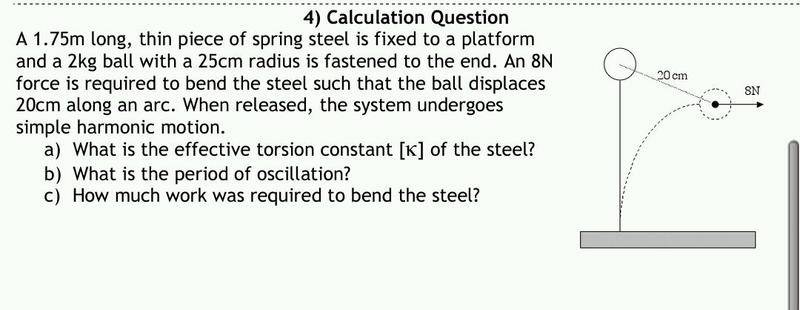
1. Problem statement.
1zwydli.jpg


2. Relative formulas
http://en.m.wikipedia.org/wiki/Torsion_spring

3. Attempt.
Part a)
Since I am given the arc length S and radius, I use the equation s = r(theta) and I solve for theta, with r being the length of the rod and the addition of the radius of the ball.

Now I need to find torque, which is given since I know the radius and the force.

Now applying the equation t = k(theta) , I just solve for k.

Part b)
For this part I need to find the center of mass of the solid sphere (2/5mr^2) and I added distance from the axis of rotation by parallel axis theorem (ML^2)

Now I can find the period by using the equation 2(pi) * sqrt(I/k) since I have I and K.

Part c)
I'm thinking the work done by bending the spring would just be the equation 1/2k(theta^2)
 
Physics news on Phys.org
freshcoast said:
Part b)
For this part I need to find the center of mass of the solid sphere (2/5mr^2) and I added distance from the axis of rotation by parallel axis theorem (ML^2)
Be careful here. When the sphere has moved through an arc of θ, it will have rotated about its centre by rather more. This is because the rod is not a rigid rod sprung at its base.
Your answer for part c seems right.
 
haruspex said:
Be careful here. When the sphere has moved through an arc of θ, it will have rotated about its centre by rather more. This is because the rod is not a rigid rod sprung at its base.

Hmm, I am having trouble understanding this. The Moment of inertia of a solid sphere is (2/5 * MR^2) and you're saying that since the rod it is connected to is not a rigid rod, it would have rotated about its center more? I don't see what changes in my attempt, is the parallel axis theorem still valid? I think the ML^2 is for solid cylinders, is that the value that need's to be modified?
 
freshcoast said:
you're saying that since the rod it is connected to is not a rigid rod, it would have rotated about its center more? I don't see what changes in my attempt, is the parallel axis theorem still valid?
It is and it isn't, depending on how you are applying it.
If you think of the motion of the ball as consisting of two components, one about its mass centre, plus the motion of its mass centre about the base of the rod, then it has two corresponding moments of inertia, ml2 and 2mr2/5. In general, these two motions can have different angular accelerations, αl and αr. The total torque would then be αlml2 + 2αrmr2/5. In the common case, the two angular accelerations are the same, producing the usual parallel axis theorem result: αm(l2 + 2r2/5). But here they will be different.
With a little calculus, I can show that for small oscillations αr = 3αl/2. However, this is the third problem I've seen that you have posted from this source, and the other two both had serious flaws in their descriptions. So I'm not sure whether you are supposed to go into this level of analysis or treat the rod as rigid.
 

Similar threads

  • · Replies 3 ·
Replies
3
Views
2K
  • · Replies 18 ·
Replies
18
Views
2K
Replies
5
Views
1K
  • · Replies 9 ·
Replies
9
Views
2K
  • · Replies 9 ·
Replies
9
Views
2K
  • · Replies 1 ·
Replies
1
Views
7K
  • · Replies 8 ·
Replies
8
Views
2K
  • · Replies 29 ·
Replies
29
Views
2K
  • · Replies 14 ·
Replies
14
Views
2K
  • · Replies 3 ·
Replies
3
Views
2K