How Do You Calculate Velocities Using the Cosine Formula?

  • Thread starter Thread starter jkh4
  • Start date Start date
Click For Summary
SUMMARY

The discussion focuses on calculating velocities using the cosine formula in the context of a collision between two billiard balls. The formula presented is cos(θ) = vi / (vf + v9), where vi represents the initial velocity of the cue ball, vf is the final velocity of the cue ball, and v9 is the velocity of the 9-ball post-collision. Participants emphasize the importance of using conservation of momentum and kinetic energy to derive the necessary equations for solving the unknowns θ, vf, and v9. The discussion highlights the need for clear communication of variables and concepts to facilitate understanding.

PREREQUISITES
  • Understanding of basic physics concepts, specifically conservation of momentum and kinetic energy.
  • Familiarity with trigonometric functions, particularly cosine and sine.
  • Knowledge of vector representation in physics.
  • Ability to interpret and analyze collision scenarios in mechanics.
NEXT STEPS
  • Study the principles of conservation of momentum in two-dimensional collisions.
  • Learn how to apply trigonometric identities in physics problems.
  • Explore the derivation and application of the cosine formula in various contexts.
  • Investigate the relationship between kinetic energy and momentum in elastic and inelastic collisions.
USEFUL FOR

Physics students, educators, and anyone interested in understanding the dynamics of collisions in mechanics, particularly in billiard games or similar scenarios.

jkh4
Messages
49
Reaction score
0
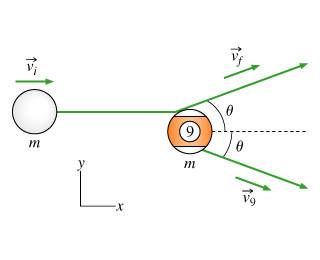
Given the following image and formula:
148087.jpg


cos(x) = (vi)/(vf+V9)

how do you find the value for each of the velocity? I try using Pythagoras theory for the triangel but no use...
 
Physics news on Phys.org
Do you even understand what the picture shows you? I'm not sure since you don't try to explain to us what the question is. For example, I can guess that the "m" under each ball is its mass- so that the two balls have the same mass. I can guess that "vi" and "vj" are the initial and final velocities of the cue ball and that "v9" is the velocity of the 9-ball after being hit by the cue ball. It would have been nice if you had said that rather than requiring anyone who wants to help you to guess. And, of course, the only "x" in your picture is the x-axis so "cos(x)" makes no sense at all. I guess you mean [itex]\theta[/itex] but even if you do not know how to make that symbol, it would have been better to type "theta".

You then can use "conservation of momentum". Using vi, vf, v9 now to mean the speed of each ball (magnitude of the velocity vector) the momentum vector of the cue ball before the collision is <mvi,0>, the momentum vector of the cue ball after the collision is <mvfcos([itex]\theta[/itex]>,mvfsin([itex]\theta[/itex]>, and the momentum vector of the 9-ball after the collision is <mv9cos(\theta),-mv9sin(\theta)>. Conservation of momentum gives
<mvi,0>= <mvfcos([itex]\theta[/itex]>,mvfsin([itex]\theta[/itex]>+ <mv9cos(\theta),-mv9sin(\theta)>.

Setting the x-coordinates equal gives mvi= mvfcos([itex]\theta[/itex])+ mv9cos([itex]\theta[/itex]). From that equation you get cos([itex]\theta[/itex])= vi/(vf+ v9). Setting the y-coordinates equal gives 0= mvfsin([itex]\theta[/itex])- mv9sin([itex]\theta[/itex]) or vf= v9.
That gives you 2 equations for the 3 unknown values vf, v9, and [itex]\theta[/itex] (assuming vi is given). You can use conservation of kinetic energy to get the third equation.
 

Similar threads

  • · Replies 7 ·
Replies
7
Views
1K
Replies
10
Views
2K
Replies
20
Views
3K
  • · Replies 17 ·
Replies
17
Views
4K
  • · Replies 5 ·
Replies
5
Views
3K
  • · Replies 4 ·
Replies
4
Views
1K
  • · Replies 3 ·
Replies
3
Views
1K
Replies
5
Views
1K
  • · Replies 2 ·
Replies
2
Views
1K
Replies
14
Views
2K