MHB How Do You Compute the Inverse Laplace Transform of a Power Series?

Click For Summary
The discussion focuses on computing the inverse Laplace transform of a power series, specifically the expression involving \( S^{-\frac{1}{2}} e^{-\frac{1}{S}} \). The user expresses confusion about the correctness of their approach and the instruction to take the inverse transform term by term, given the infinite series involved. They reference the Cauchy integral formula as potentially relevant to part 2 of the problem, which has not yet been covered in their lectures. Further, they clarify the meaning of double factorials in the context of their calculations. The conversation seeks assistance in understanding these concepts and their application to the problem.
nacho-man
Messages
166
Reaction score
0
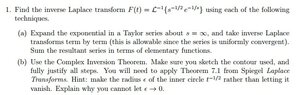
Please refer to the attachment.

For part a)
so far I have:
$e^x = 1 + \frac{x}{1!} + ...+ \frac{x^n}{n!}$
So
$S^\frac{-1}{2}e^\frac{-1}{S} = S^\frac{-1}{2}(1 -\frac{1}{S} + \frac{1}{2!S^2} - \frac{1}{3!S^3} + \frac{1}{4!S^4} + ... - ...)$

I don't think my $S^\frac{-1}{2}$ on the outside is correct though.
I don't know why it says 'take the inverse transform term by term', since this is a never ending series.

Little lost for part 2. They haven't covered it in lectures yet, I briefly recall this being related to the cauchy integral formula... or something similar we did earlier.

Any help is appreciated,

Thanks!
 

Attachments

  • txtbook q1.jpg
    txtbook q1.jpg
    27.2 KB · Views: 127
Physics news on Phys.org
nacho said:
Please refer to the attachment.

For part a)
so far I have:
$e^x = 1 + \frac{x}{1!} + ...+ \frac{x^n}{n!}$
So
$S^\frac{-1}{2}e^\frac{-1}{S} = S^\frac{-1}{2}(1 -\frac{1}{S} + \frac{1}{2!S^2} - \frac{1}{3!S^3} + \frac{1}{4!S^4} + ... - ...)$

I don't think my $S^\frac{-1}{2}$ on the outside is correct though.
I don't know why it says 'take the inverse transform term by term', since this is a never ending series.

Little lost for part 2. They haven't covered it in lectures yet, I briefly recall this being related to the cauchy integral formula... or something similar we did earlier.

Any help is appreciated,

Thanks!

The expansion of F(s) is...

$\displaystyle \frac{e^{- \frac{1}{s}}}{\sqrt{s}} = \sum_{n=0}^{\infty} \frac{(-1)^{n}}{s^{n + \frac{1}{2}}\ n!}\ (1)$

... and because is...

$\displaystyle \mathcal{L}^{-1} \{\frac{1}{s^{n + \frac{1}{2}}}\} = \frac{t^{n - \frac{1}{2}}}{\Gamma(n + \frac{1}{2})} = \frac{(2\ t)^{n}}{\sqrt{\pi\ t}\ (2\ n - 1)!}\ (2)$

... is also...

$\displaystyle \mathcal{L}^{-1} \{\frac{e^{- \frac{1}{s}}}{\sqrt{s}}\} = \frac{1}{\sqrt{\pi\ t}}\ \sum_{n=0}^{\infty} \frac{(-1)^{n}\ (2\ t)^{n}}{n!\ (2 n - 1)!} = \frac{\cos 2\ \sqrt{t}}{\sqrt{\pi\ t}}\ (3)$

Kind regards

$\chi$ $\sigma$
 
Ok, what's with the double factorial? I have never seen that before and this worries me
 
nacho said:
Ok, what's with the double factorial? I have never seen that before and this worries me

$\displaystyle (2 n-1) \cdot (2 n-3) \cdot ... \cdot 3 \cdot 1 = (2 n-1)!$

$\displaystyle 2 n \cdot (2 n - 2) \cdot ...\cdot 2 = (2\ n)!$

Kind regards

$\chi$ $\sigma$
 
We all know the definition of n-dimensional topological manifold uses open sets and homeomorphisms onto the image as open set in ##\mathbb R^n##. It should be possible to reformulate the definition of n-dimensional topological manifold using closed sets on the manifold's topology and on ##\mathbb R^n## ? I'm positive for this. Perhaps the definition of smooth manifold would be problematic, though.

Similar threads

  • · Replies 10 ·
Replies
10
Views
3K
  • · Replies 1 ·
Replies
1
Views
2K
  • · Replies 4 ·
Replies
4
Views
3K
  • · Replies 1 ·
Replies
1
Views
2K
  • · Replies 1 ·
Replies
1
Views
2K
  • · Replies 1 ·
Replies
1
Views
1K
  • · Replies 10 ·
Replies
10
Views
2K
  • · Replies 4 ·
Replies
4
Views
2K
  • · Replies 4 ·
Replies
4
Views
3K
Replies
8
Views
4K