How Do You Describe an Equivalence Class?

  • Context:
  • Thread starter Thread starter andrew1
  • Start date Start date
  • Tags Tags
    Classes Equivalence
Join the discussion
Ask a follow-up here, or get your own question answered by working scientists, mathematicians and engineers — people, not an autocomplete.
Real named experts · corrections over time · the nuance an AI answer skips
3 replies · 2K views
andrew1
Messages
20
Reaction score
0
Hi,

I'm having trouble understanding the concept of equivalence classes and would like some help on what it means to describe an equivalence class.

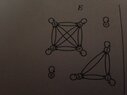
Here is an example that I have deemed to be an equivalence relation but I have no idea about how I can descrive its equivalence class

View attachment 2405
 

Attachments
  • qqG9OiT.jpg
    qqG9OiT.jpg
    70 KB · Views: 130
Last edited:
Physics news on Phys.org
An equivalence class is a group of nodes such that one can travel from one node of the group to any other node of the group along the arrows. So this relation has four equivalence classes.

It's not hard to see that since this is an equivalence relation, one can travel from node $a$ to node $b$ in several steps iff one can travel from $a$ to $b$ in just one step.
 
An equivalence relation on a set has the effect of splitting the set into a collections of subsets (called equivalence classes). Within each equivalence class all the elements of that class are related to each other. But elements of different equivalence classes are not related. In your diagram the equivalence relation on the set $E$ splits it into four equivalence classes, namely $\{a,b,d,e\}$, $\{c\}$, $\{g\}$ and $\{f,h,i\}.$
 
Thanks guys, that sounds much simpler than my notes.