How Do You Integrate Work with a Changing Angle Theta?

Click For Summary

Homework Help Overview

The discussion revolves around integrating work, represented by the equation w = f * d * cos(theta), where theta is a variable that changes. Participants are exploring how to approach the integration with respect to theta rather than other variables.

Discussion Character

  • Exploratory, Assumption checking, Mathematical reasoning

Approaches and Questions Raised

  • The original poster attempts to integrate the work equation with respect to theta, expressing concerns about their current method involving a substitution that does not yield the expected results. Other participants suggest using substitutions for cos(theta) but the original poster seeks a solution specifically in terms of theta.

Discussion Status

The discussion is ongoing, with participants providing input on substitution methods. However, there is a clear emphasis from the original poster on finding a way to integrate directly with respect to theta, indicating a lack of consensus on the approach to take.

Contextual Notes

The original poster mentions having a known answer and a different method but is focused on integrating with respect to theta, which suggests constraints in their current understanding or approach.

morssolis
Messages
2
Reaction score
0
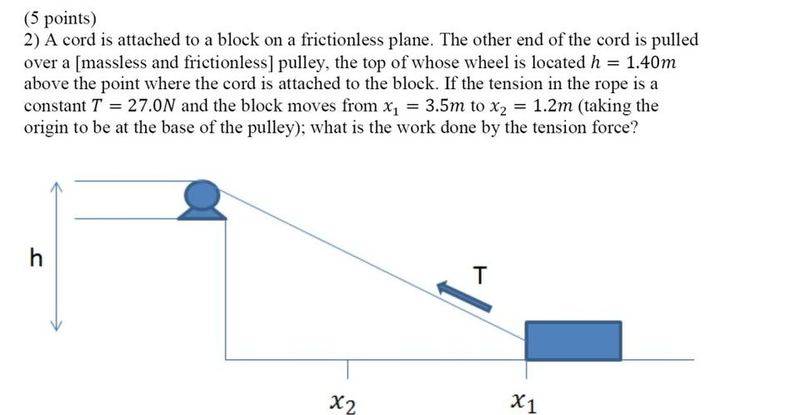
here is the problem. w= f*d*cos(theta). theta is changing so it involves integration.
p1.jpg


i know the answer its about 52. i know one solution for it but i have been trying to figure out how to solve it integrating with respect to theta. the way i know to solve it is let

cos(theta)= x / ((x^2)+(h^2))^(-1/2), then integrate this with respect to x with a u substitution.


i thought that the integral from theta at x1 to theta at x2 of F*d*cos(x) dtheta would work, however it does not. i have been trying to figure this out for days.

any ideas how you can solve this by integrating with theta as opposed to x?

Thanks
 
Last edited:
Physics news on Phys.org
[tex]W=\int_{x1}^{x2}{F \cos{\theta} dx}[/tex]

It is easy to integrate by substituting u=x^2+h^2.

ehild
 
well thank you for the input however i know that already. i said that in the OP. i am trying to figure out how to integrate with respect to theta
 
F=T is constant. Substitute x / ((x^2)+(h^2))^(-1/2) for cos(theta) in the integral and calculate it.

ehild
 

Similar threads

  • · Replies 16 ·
Replies
16
Views
1K
Replies
2
Views
2K
  • · Replies 2 ·
Replies
2
Views
2K
  • · Replies 9 ·
Replies
9
Views
2K
Replies
1
Views
1K
Replies
1
Views
2K
Replies
4
Views
2K
  • · Replies 4 ·
Replies
4
Views
3K
  • · Replies 21 ·
Replies
21
Views
2K