How Do You Interpret Shear and Moment Diagrams?

Click For Summary
SUMMARY

This discussion focuses on the interpretation of shear and moment diagrams in structural analysis, specifically in the context of statics and material strength courses. The maximum bending moment occurs at the location of the applied force, with the moment vector acting about the z-axis at the point of load application. Participants emphasize the importance of understanding the direction and nature of the moment, which is counterclockwise on one side of the load and clockwise on the other. Drawing free body diagrams is recommended as a method to visualize and confirm the behavior of the beam under load.

PREREQUISITES
  • Understanding of shear and bending moment diagrams
  • Knowledge of free body diagram techniques
  • Familiarity with Newton's laws of motion
  • Basic concepts of structural analysis
NEXT STEPS
  • Study the principles of free body diagrams in structural mechanics
  • Learn about the significance of moment vectors in beam analysis
  • Explore examples of shear and moment diagrams for various loading conditions
  • Review the application of Newton's laws in analyzing forces and moments
USEFUL FOR

Students in engineering disciplines, particularly those studying statics and material strength, as well as professionals involved in structural analysis and design.

skaterbasist
Messages
13
Reaction score
0
I passed my statics course and am currently taking material stength course.

The thing that has been on my head is the fact that, although I know how to do shear and bending moment diagrams... I do not know how to READ them. In other words, the diagrams don't mean anything to me.

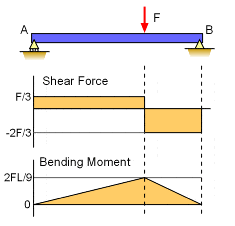
For example, in the diagram below, the maximum moment is being developed under what axis? The z-axis perpendicular to the A support or the z-axis perpendicular to the B support?

I'm not even sure if my question makes any sense. It just bugs me to know that I know how to SOLVE these problems and develop the diagrams, but they're practically meaningless to me.

ANY help would be greatly appreciated!
d8224.gif
 
Engineering news on Phys.org
If you know how to make the diagrams, it's just a matter of practice and repetition because you can "read" them just by looking at them.

The maximum moment is at the location of the force F, the location of largest value on the bending moment diagram.
 
skaterbasist said:
For example, in the diagram below, the maximum moment is being developed under what axis? The z-axis perpendicular to the A support or the z-axis perpendicular to the B support?

Th moment vector points out of plane (perpendicular to the page).
 
skaterbasist said:
For example, in the diagram below, the maximum moment is being developed under what axis? The z-axis perpendicular to the A support or the z-axis perpendicular to the B support?
The internal bending moment in this example acts about the z axis at the point of application of the load. It is counterclockwise acting on the left part of the beam (vectorially pointing outward), and clockwise acting on the right part of the beam (vectorially pointing inward), in accordance with Newton's 1st and 3rd laws. By convention, the moment is considered as a positive moment. You should draw a free body diagram of the section of the beam from the left support to just left of the applied load, to prove this yourself, using Newton 1. Then draw a free body diagram of section of the beam from just right of the applied load to the right support, and proceed in a similar manner.
 

Similar threads

  • · Replies 12 ·
Replies
12
Views
2K
  • · Replies 2 ·
Replies
2
Views
2K
  • · Replies 3 ·
Replies
3
Views
2K
Replies
4
Views
3K
Replies
3
Views
4K
  • · Replies 4 ·
Replies
4
Views
3K
Replies
8
Views
6K
Replies
3
Views
3K
  • · Replies 2 ·
Replies
2
Views
2K
  • · Replies 2 ·
Replies
2
Views
4K