How do you invert a 3D matrix? (Tensor inversion)

Click For Summary
To invert a 3D matrix (tensor) for solving the system of equations Ax=b, where A is an n x m x p tensor, one approach is to convert the tensor into a 2D matrix format by indexing it as [n x (m*p)]. This transformation allows the application of standard matrix inversion techniques. The discussion highlights the challenge of finding clear methods for tensor inversion, similar to regular matrix inversion. Additionally, the possibility of using least-squares methods is questioned but not fully explored. Understanding tensor manipulation is crucial for effectively solving these types of equations.
BoltE
Messages
2
Reaction score
0
TL;DR
I have three systems of equations in the form of Ax=b, where there are three different b-vectors, three different A-matrices, all of which use the same x-vector (A1x=b1, A2x=b2,A3x=b3). The goal is to solve for x. I can also write this as a tensor product: b_ij = sum_k (A_ijk x_k), where I would want to invert A to solve for X. I'm familar with regular linear systems where a is a 2D matrix and I could use a least-squares approach, MLEM, etc.
I would like to solve a system of systems of equations Ax=b where A is an n x m x p tensor (3D) matrix, x is a vector (n x 1), and b is a matrix (n x p). I haven't been able to find a clear walk-through of inverting a tensor like how one would invert a regular matrix to solve a system of linear equations. (or an iterative technique like MLEM).

Attached is a typed up version of the equations except with different variables where b = N, A = R, and x = S:
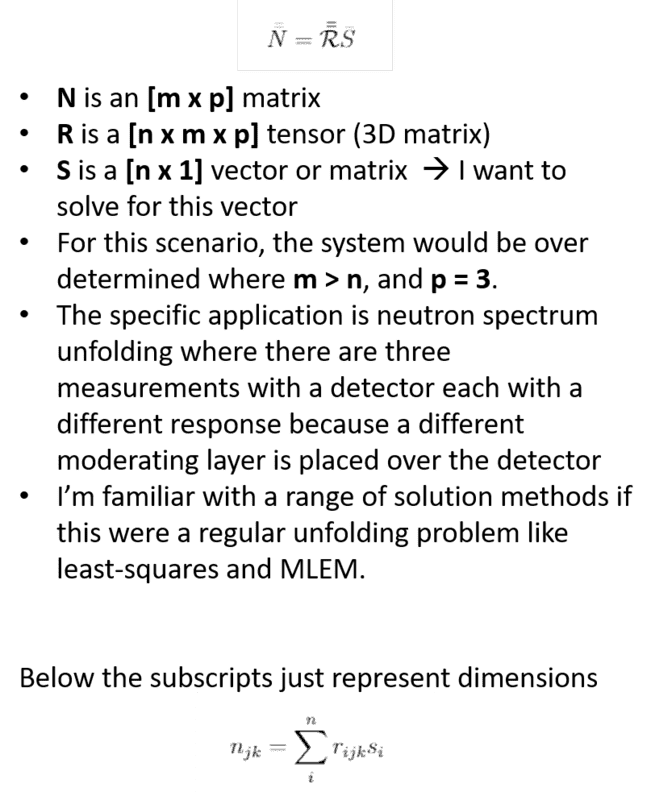
Figure.png
 
Physics news on Phys.org
Why can't one just apply least-squares?

Okay, convert ##r_{i,j,k}## to a ##[n\times m p ]## matrix. It's just indexing.
 
Whoops, I'll check this, thank you!
 
I am studying the mathematical formalism behind non-commutative geometry approach to quantum gravity. I was reading about Hopf algebras and their Drinfeld twist with a specific example of the Moyal-Weyl twist defined as F=exp(-iλ/2θ^(μν)∂_μ⊗∂_ν) where λ is a constant parametar and θ antisymmetric constant tensor. {∂_μ} is the basis of the tangent vector space over the underlying spacetime Now, from my understanding the enveloping algebra which appears in the definition of the Hopf algebra...

Similar threads

  • · Replies 2 ·
Replies
2
Views
999
  • · Replies 8 ·
Replies
8
Views
3K
  • · Replies 5 ·
Replies
5
Views
2K
  • · Replies 6 ·
Replies
6
Views
2K
  • · Replies 10 ·
Replies
10
Views
3K
  • · Replies 1 ·
Replies
1
Views
3K
  • · Replies 15 ·
Replies
15
Views
2K
  • · Replies 4 ·
Replies
4
Views
2K
  • · Replies 12 ·
Replies
12
Views
3K
  • · Replies 11 ·
Replies
11
Views
3K