How Do You Solve a Limit as x Approaches Negative Infinity?

  • Thread starter Thread starter newguy_13
  • Start date Start date
  • Tags Tags
    Infinity Limit
Join the discussion
Ask a follow-up here, or get your own question answered by working scientists, mathematicians and engineers — people, not an autocomplete.
Real named experts · corrections over time · the nuance an AI answer skips
15 replies · 4K views
newguy_13
Messages
8
Reaction score
1
Homework Statement
Limit problem
Relevant Equations
There are none
I don't know what do do from here other than i can make the 3/e^x a 0 due to the fact its divided by such a large number. What do i do with the e^-3x? Thanks for the help
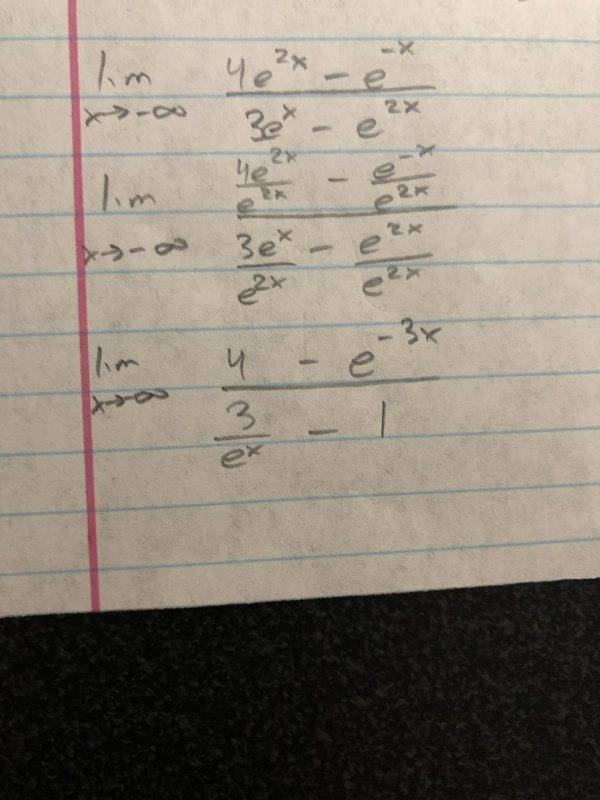
image.jpg
 
Last edited by a moderator:
Physics news on Phys.org
newguy_13 said:
Homework Statement: Limit problem
Homework Equations: There are none

I don't know what do do from here other than i can make the 3/e^x a 0 due to the fact its divided by such a large number. What do i do with the e^-3x? Thanks for the help
The same. What happens to ##e^{-3x}## if ##x## gets larger and larger? What does ##e^{-sth.}## mean?
 
So the answer is just -4?
 
You must be careful if you cancel factors, as they can tend to zero and then you lose information which one is faster. It is always better to avoid divisions as long as possible. That means: Simplify the initial quotient by considering ##x \to -\infty##, then you get one single term ##e^{...x}## which tells you the result.
 
Ok so can you let me know what the answer is? That would help me to understand where i went wrong and what to do in the future problems. Thanks!
 
newguy_13 said:
Ok so can you let me know what the answer is? That would help me to understand where i went wrong and what to do in the future problems. Thanks!

Re helping you with the problem. The first thing I would do is look at each of the four terms and see what happens in the limit. The numerator should be clear, but you may need to take a closer look at the denominator.
 
PeroK said:
You're looking for the limit as ##x## tends to ##-\infty##.
I think that's what the OP has, but may have misread what he/she wrote in the 3rd line, where the limit part looks a bit like x -->-- ∞.
 
Mark44 said:
I think that's what the OP has, but may have misread what he/she wrote in the 3rd line, where the limit part looks a bit like x -->-- ∞.

Yes, but the OP has calculated the terms based on ##x \rightarrow +\infty##.

newguy_13 said:
So the answer is just -4?
 
We have

[itex]lim_{x\rightarrow -\infty}\frac{4e^{2x}-e^{-x}}{3e^{x}-e^{2x}}=lim_{x\rightarrow -\infty}\frac{4e^{2x}-\frac{1}{e^{x}}}{e^{x}\left( 3-e^{x}\right) }=lim_{x\rightarrow -\infty}\frac{4e^{3x}-1}{e^{2x}\left( 3-e^{x}\right) }[/itex]

then [itex]\left( 4e^{3x}-1\right) \rightarrow -1[/itex] and [itex]\left( 3-e^{x}\right)\rightarrow 3[/itex] as [itex]x\rightarrow -\infty[/itex] but [itex]\frac{1}{e^{2x}}\rightarrow[/itex] ? as [itex]x\rightarrow -\infty[/itex]?
 
  • Like
Likes   Reactions: Delta2
benorin said:
We have

[itex]lim_{x\rightarrow -\infty}\frac{4e^{2x}-e^{-x}}{3e^{x}-e^{2x}}=lim_{x\rightarrow -\infty}\frac{4e^{2x}-\frac{1}{e^{x}}}{e^{x}\left( 3-e^{x}\right) }=lim_{x\rightarrow -\infty}\frac{4e^{3x}-1}{e^{2x}\left( 3-e^{x}\right) }[/itex]

then [itex]\left( 4e^{3x}-1\right) \rightarrow -1[/itex] and [itex]\left( 3-e^{x}\right)\rightarrow 3[/itex] as [itex]x\rightarrow -\infty[/itex] but [itex]\frac{1}{e^{2x}}\rightarrow[/itex] ? as [itex]x\rightarrow -\infty[/itex]?
##\frac {1}{e^{2x}}## will go to +##\ infty## as ## x \rightarrow \infty##. Denominator will become indefinitely small.