How Do You Solve an Integral with Two Variables?

  • Topic:
  • Thread starter Thread starter goohu
  • Start date Start date
  • Tags Tags
    Integral Variables
Join the discussion
Registration is free. Start your own thread to ask a follow-up.
5 replies · 2K views · last reply
goohu
Messages
53
Reaction score
3
Hey there, trying to figure out how to solve this integral (see picture).

View attachment 8728

I've never seen an integral written in this way before.

I've tried to integrate the x-part first and then the y-part and vice versa but they both gave the wrong results.
 
Attachments
  • Equation f_{X,Y}(x, y) = f_X(x) f_Y(y) = (9/4)(1 - x^2)(1 - y^2), 0 < x, y < 1
    dd.JPG
    3.2 KB · Views: 154
  • Typeset math: joint density f(X,Y)(x,y) = f(X)(x)f(Y)(y) = (9/4)(1 - x^2)(1 - y^2) for 0 < x, y < 1, then P(X < Y/2) = P(2X < Y) as a double integral over 2x < y of f(X,Y) dx dy, equal to (9/4) times the integral from 0 to 1 of (1 - y^2) times the integral from 0 to y/2 of (1 - x^2) dx dy = 35/128.
    dd.JPG
    8.6 KB · Views: 142
  • Double integral over the region 2x < y of f(x,y) dx dy equals 9/4 times the integral from 0 to 1 of (1-y^2) times the integral from 0 to y/2 of (1-x^2) dx dy, which equals 35/128.
    dd.JPG
    4.3 KB · Views: 183
Last edited:
Physics news on Phys.org
First [tex]\int_0^{y/2} (1- x^2) dx= \left[x- \frac{x^3}{3}\right]_0^{y/2}= \frac{y}{2}- \frac{1}{3}\frac{y^3}{8}[/tex]

Then [tex]\int_0^1 (1- y^2)(\frac{y}{2}- \frac{y^3}{24} dy= \int_0^1 \frac{y}{2}- \frac{13y^3}{24}+ \frac{y^5}{24} dy= \left[\frac{y^2}{4}- \frac{13y^4}{96}+ \frac{y^6}{144}\right]_0^1= \frac{1}{4}- \frac{13}{96}+ \frac{1}{144}= \frac{72+ 39+ 2}{288}= \frac{113}{288}[/tex].

Finally, [tex]\frac{9}{4}\frac{113}{288}= \frac{113}{128}[/tex].
(Check my arithmetic.)
 
thanks for the quick reply. I re-did your calculations and get the same results as you. After using wolfram alpha (online calculator) i get different results though:

first step:
View attachment 8730

second step:
View attachment 8731

(35/288)*(9/4) = 35/128 = correct answer.

This is weird and its bugging me. Are the hand calculation wrong somewhere?
 
Attachments
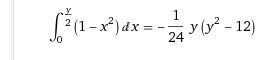
  • Handwritten integral: the integral from 0 to y/2 of (1 - x^2) dx equals -(1/24) y (y^2 - 12).
    1st.JPG
    2.2 KB · Views: 164
  • Typeset integral from 0 to 1 of (1/24)(1 - y^2)(-y(y^2 - 12)) dy, equal to 35/288, approximately 0.12153.
    2st.JPG
    3.1 KB · Views: 151
goohu said:
thanks for the quick reply. I re-did your calculations and get the same results as you. After using wolfram alpha (online calculator) i get different results though:

first step:second step:(35/288)*(9/4) = 35/128 = correct answer.

This is weird and its bugging me. Are the hand calculation wrong somewhere?
That's why I deleted my post in this thread. I can't find an error in Country Boy's result, which is essentially identical to my own. I can't explain why the two are different.

-Dan
 
goohu said:
thanks for the quick reply. I re-did your calculations and get the same results as you. After using wolfram alpha (online calculator) i get different results though:

first step:second step:(35/288)*(9/4) = 35/128 = correct answer.

This is weird and its bugging me. Are the hand calculation wrong somewhere?

Country Boy said:
[tex]\ldots = \frac{1}{4}- \frac{13}{96}+ \frac{1}{144}= \frac{72+ 39+ 2}{288}= \frac{113}{288}[/tex]

It's a plus-and-minus thing.
It should be [tex]\frac{1}{4}- \frac{13}{96}+ \frac{1}{144}= \frac{72 {\color{red}-} 39+ 2}{288}= \frac{35}{288}[/tex]
 
heh found it.

$$\displaystyle \frac{1}{4}-\frac{13}{96}+\frac{1}{144} = \frac{72-39+2}{288}$$
while i was figuring out how to post equations klaas beat me to it. Cheers anyways!