How does an air flow bench work

Click For Summary

Discussion Overview

The discussion centers around the operation and understanding of air flow benches, particularly how to interpret readings from manometers and perform calculations for air flow volume. Participants explore both theoretical and practical aspects, including calibration and the influence of pressure differentials.

Discussion Character

  • Technical explanation
  • Conceptual clarification
  • Debate/contested
  • Experimental/applied

Main Points Raised

  • One participant questions how pressure changes occur in the plenums of an air flow bench and whether readings from manometers would differ based on their positioning.
  • Another participant asserts that pressure should be the same at all points once equilibrium is reached, noting that manometer values will stabilize.
  • Concerns are raised about the implications of using a homemade flow bench and the need for calibration to obtain accurate flow volume calculations.
  • A participant explains that the metering element's size and its discharge coefficient are crucial for calculating air flow based on pressure differentials before and after the orifice.
  • Several participants provide links to external forums and resources for further information on flow bench design and operation.

Areas of Agreement / Disagreement

Participants express varying views on the necessity of equilibrium for accurate measurements and the calibration process for homemade flow benches. There is no consensus on the best approach to calculating air flow volume from manometer readings.

Contextual Notes

Participants mention the influence of testing pressure and the capabilities of air supply sources on measurements, indicating that various factors can affect the outcomes of flow testing.

Who May Find This Useful

This discussion may be useful for individuals interested in fluid mechanics, engineering students, hobbyists building homemade flow benches, and those seeking practical insights into air flow measurement techniques.

kibestar
Messages
16
Reaction score
2
Hello, I'm new to these forums and they seemed like an excellent way to have my questions answered.

I'll start by saying that I've never had any course that dealt with fluid mechanics (mechanical engineering freshman), so I'm having quite some trouble grasping how readings on an air flow bench are to be correctly made. I'm using wikipedia's top image on its page on air flow benches to try to understand this topic:
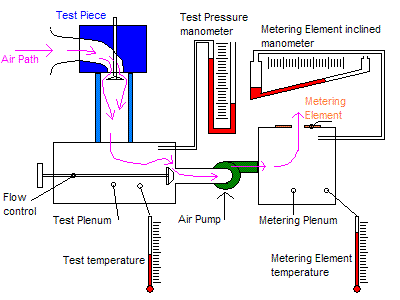
Flow_bench_schematic.GIF


Firstly, when the air pump is on, what happens with respect to pressure changes in each plenum? Is the pressure change experienced in every point inside each plenum equally, so a difference in the positioning of the manometers wouldn't cause a difference in readings? And what exact readings of the manometers and calculations would you perform to obtain the air flow volume?

I apologize for any english related mistakes, I'm not a native speaker.

Thanks in advance!
 
Engineering news on Phys.org
To be accurate the pressure should be the same at all points - yes.
So you would have to wait for an equilibrium to be reached. This is easy to see - the manometer value stops changing.

All metering elements should be engineered to have a negligible impact on the performance being measured.

The exact calculations you need should be supplied with the equipment, and can vary with the equipment.
It is common these days for a computer to do that job.

But there does not need to be an equilibrium - only that the appropriate relationships are known.
These will have been determined empirically during calibration.
 
Thank you for your answer. But what if the flow bench is home made and the calculations are to be done manually? Suppose you turn the device on, disregard temperature differences between the plenums and read 'x' for the test manometer and 'y' for the metering manometer, what is to be made of those values in order to obtain flow volume? Thanks.
 
If you made the bench, then you will have to calibrate it.
 
The metering element is of a know size either sharp edge orifice or straight edge orifice that is calibrateed to a know test orifice. Its Cd coefficient discharge is known.

Before and after the orifice pressure differentials is measured and air flow in CFM is calculated Testing pressure of 28inches of WC is cylinder head industry standard but testing at lower and Or high pressures can be more beneficial for testing. This will all be influence on your air supply sources capability of you apparatus? Please note its not all about higher CFM numbers? You will learn more as you go along the flow testing path. Big holes flow big numbers but don't make big power!

I have already responded to another one of your posts but here it is again.
"Hi , join <http://www.flowbenchtech.com all> the information and question/answered you have in regards to " How a flow bench works ", you will find on this fourm.
This forum is dedicated forum to flow bench design and workings.
http://www.flowbenchtech.com/forum/viewtopic.php?f=3&t=626
AND ALSO
Link to the Old Tractorsport Flowbench Forum. It is READ ONLY and is an archive only forum and can not be posted to. BUT holds valuable information on the topic of flow bench and flow testing procedures. http://www.tractorsport.com/forum/
Hope this information helps you "


Also join www.speedtalk.com a wealth of information that will be useful for you to soaurce information.

Also join www.speedtalk.com a wealth of information that will be useful for you to start your reading studys use the search function on the websites i have listed with key words of interest to you.

Get yourself pipemax software http://www.maxracesoftware.com/ and join Larry's website forum also http://maxracesoftware.com/bulletinboard/index.php?sid=0bceb2dd6ad50288b2fc0033e7ec29b8

Cheers
 
Last edited:

Similar threads

  • · Replies 6 ·
Replies
6
Views
5K
  • · Replies 9 ·
Replies
9
Views
2K
Replies
0
Views
2K
  • · Replies 45 ·
2
Replies
45
Views
6K
Replies
3
Views
2K
Replies
5
Views
3K
  • · Replies 33 ·
2
Replies
33
Views
4K
  • · Replies 14 ·
Replies
14
Views
1K
  • · Replies 1 ·
Replies
1
Views
2K
  • · Replies 6 ·
Replies
6
Views
3K