Understanding how an air flow bench works

Click For Summary

Discussion Overview

The discussion centers around understanding the operation and measurement techniques of an air flow bench, particularly focusing on pressure changes within plenums and the interpretation of manometer readings. Participants explore fluid mechanics concepts relevant to the application of air flow benches, including pressure dynamics and flow measurement methods.

Discussion Character

  • Exploratory
  • Technical explanation
  • Conceptual clarification
  • Debate/contested

Main Points Raised

  • One participant notes that pressure in a plenum is not uniform and varies with flow, suggesting that manometer placement could affect readings.
  • Another participant points out that standards like ISO 5167 may not apply in this context, as the air is released into ambient air, indicating a need for alternative standards.
  • A different viewpoint suggests that the characteristics of the equipment, such as the pipe diameter and valve types, can help determine flow rates based on pressure differentials.
  • One participant proposes that plenums are designed to minimize pressure losses and ensure accurate pressure readings, as they are larger than connected pipes.
  • Another participant speculates that plenum dimensions are chosen to maintain low flow velocities, allowing for more uniform pressure within the plenum.
  • Several participants provide links to external resources and forums for further information on flow bench design and operation.

Areas of Agreement / Disagreement

Participants express varying opinions on the uniformity of pressure within plenums and the applicability of certain standards. There is no consensus on the best methods for measuring airflow or the specific characteristics of the equipment involved.

Contextual Notes

Some assumptions about the flow characteristics and pressure dynamics remain unverified, and the discussion does not resolve the complexities of measuring airflow accurately in this context.

kibestar
Messages
16
Reaction score
2
Hello, I'm new to these forums and they seemed like an excellent way to have my questions answered.

I'll start by saying that I've never had any course that dealt with fluid mechanics (mechanical engineering freshman), so I'm having quite some trouble grasping how readings on an air flow bench are to be correctly made. I'm using wikipedia's top image on its page on air flow benches to try to understand this topic:
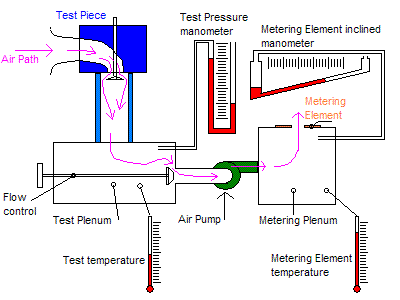
Flow_bench_schematic.GIF


Firstly, when the air pump is on, what happens with respect to pressure changes in each plenum? Is the pressure change experienced in every point inside each plenum equally, so a difference in the positioning of the manometers wouldn't cause a difference in readings? And what exact readings of the manometers and calculations would you perform to obtain the air flow volume?

I apologize for any english related mistakes, I'm not a native speaker.

Thanks in advance!
 
Engineering news on Phys.org
Your question is incomplete, there's no way for me to quantify any exact readings on meters without any given numerals like mass flow rate, known air pressure and temperature.
 
As air flows down a pipe the pressure decreases or there wouldn't be any flow. So fundamentally the pressure in each point of the plenum is not the same. In practice the differences between the pressures in a plenum might be very small compared to the pressure loss across the metering element. It depends. There are standards such as ISO 5167, which deals with metering elements somewhere in the middle of a pipe. It tells you how far you should place the manometers upstream and downstream from the element.

In your diagram the air is dumped straight into the surrounding ambient air so ISO 5167 is not applicable and there might be some other standard that deals with this case. It also seems to depict an orifice plate for which there's a wikipedia article that explains how to get either the mass flow rate or the volume flow rate. I would go with mass flow rate and calculate the volume flow rate as needed because the mass flow rate is typically constant and the volume flow rate rarely is.

edit:
To add to air flowing towards decreasing pressure, that is to say that the static pressure decreases. In an ideal world with frictionless pipes the total or stagnation pressure remains the same and the dynamic pressure or simply air velocity will increase. Your manometer will measure some value in between static and total pressure making practical measurements difficult.
 
Last edited:
kibestar said:
Hello, I'm new to these forums and they seemed like an excellent way to have my questions answered.

I'll start by saying that I've never had any course that dealt with fluid mechanics (mechanical engineering freshman), so I'm having quite some trouble grasping how readings on an air flow bench are to be correctly made. I'm using wikipedia's top image on its page on air flow benches to try to understand this topic:

Flow_bench_schematic.GIF


Firstly, when the air pump is on, what happens with respect to pressure changes in each plenum? Is the pressure change experienced in every point inside each plenum equally, so a difference in the positioning of the manometers wouldn't cause a difference in readings? And what exact readings of the manometers and calculations would you perform to obtain the air flow volume?

I apologize for any english related mistakes, I'm not a native speaker.

Thanks in advance!

I'm not 100% sure about the application, so take my words with a grain of salt (i.e. bear in mind that I may be mistaken) but here's how I see it working:

Each piece of equipment there has known characteristics. The pipe has a set diameter, the test piece has what looks like a valve (a one-way valve, maybe?) which has specific loss characteristics for given differential pressures, same is true for the flow control device. The fan, too, has known flow characteristics for given differential pressures. That is, knowing the pressure upstream of the fan and knowing the pressure downstream, you can determine the flow rate (say, in SCFM) through the fan.

Plenum's are used for precisely the reasons indicated by ares. All pipes with air flow through them experience pressure losses. Plenums (or plena), however, are significantly larger in volume than the pipes connected to them. This is a practical way to ensure that the pressure you are measuring is an accurate representation of the pressure of the fluid (in this case air) at that point as the losses in the plenum are significantly lower than in the attached valves and piping. They are also used because introducing a measuring device into a plenum doesn't disrupt the flow (causing further losses) as much as it would if you had put the device into a pipe.

So, using the inlet pressure and inlet temperature and comparing that to the discharge pressure and discharge temperature, you can use the known characteristics of the pump to determine the airflow.
 
Like Travis, I'm not familiar with flow benches but I imagine the plenum dimensions are chosen to ensure a very low flow velocity within; that way the entire plenum is at the same pressure. Or close enough that the variation does not matter.
 
Hi , join <http://www.flowbenchtech.com all> the information and question/answered you have in regards to " How a flow bench works ", you will find on this fourm.
This forum is dedicated forum to flow bench design and workings.
http://www.flowbenchtech.com/forum/viewtopic.php?f=3&t=626
AND ALSO
Link to the Old Tractorsport Flowbench Forum. It is READ ONLY and is an archive only forum and can not be posted to. BUT holds valuable information on the topic of flow bench and flow testing procedures. http://www.tractorsport.com/forum/
Hope this information helps you
Cheers
 

Similar threads

  • · Replies 4 ·
Replies
4
Views
5K
  • · Replies 9 ·
Replies
9
Views
2K
  • · Replies 4 ·
Replies
4
Views
3K
Replies
0
Views
2K
  • · Replies 45 ·
2
Replies
45
Views
7K
Replies
3
Views
3K
  • · Replies 33 ·
2
Replies
33
Views
4K
Replies
5
Views
3K
  • · Replies 14 ·
Replies
14
Views
2K
  • · Replies 1 ·
Replies
1
Views
2K