Java How does backtracking work in solving the n queens problem?

  • Thread starter Thread starter FallenApple
  • Start date Start date
Click For Summary
The discussion focuses on the n queens problem, specifically how backtracking is implemented to place queens on an n×n chessboard without them attacking each other. Participants emphasize the need for a mechanism to "unplace" queens after recursive calls, suggesting that a line of code should reset the board position to allow for further exploration of solutions. It is noted that backtracking occurs when the algorithm finds no valid placements, necessitating the removal of queens to continue searching for other configurations. The conversation highlights the importance of correctly structuring the code to ensure queens are removed after each attempt, allowing the algorithm to function effectively. Understanding these principles is crucial for solving the n queens problem efficiently.
FallenApple
Messages
564
Reaction score
61
I'm watching a vid on the n queens problem. Basically I have find out how to put n queens on a chess board of size n without them attacking each other. It's a rather famous puzzle.

"The eight queens puzzle is the problem of placing eight chess queens on an 8×8 chessboard so that no two queens threaten each other. Thus, a solution requires that no two queens share the same row, column, or diagonal. The eight queens puzzle is an example of the more general n queens problem of placing n non-attacking queens on an n×n chessboard, for which solutions exist for all natural numbers n with the exception of n=2 and n=3."

https://en.wikipedia.org/wiki/Eight_queens_puzzle
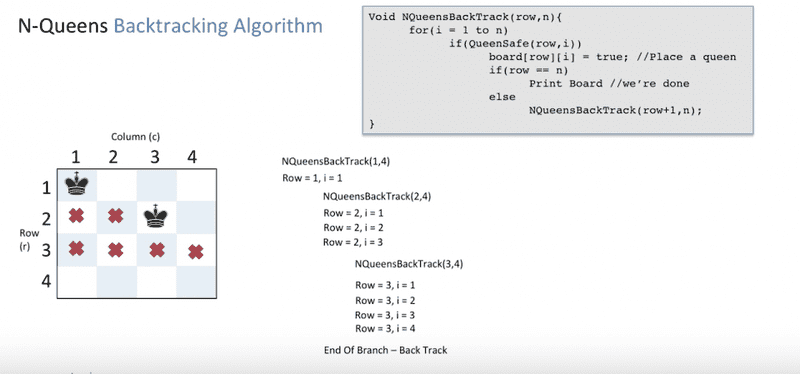
Nqueen1.png


here there is no positions after the second level of the recursion. So it makes sense that after the third level of the recursion is popped from the stack, the second level will just continue the for loop.But why is the previous placement replaced?
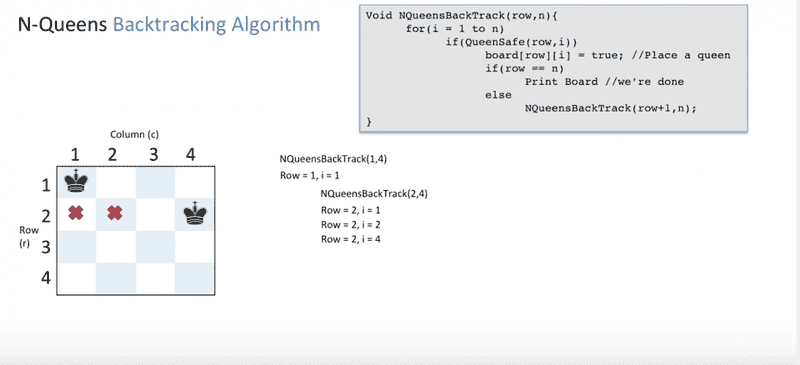
Nqueen2.png


He mentions that when the backtrack happens, the queen is placed on the 4th column. But that is only possible if the previous placement is nullifed. But how? I see nothing in the code that can erase the result of board[2][3]==2.
 
Technology news on Phys.org
Even a youtube commenter got this:

Shouldn't there be a line to unplace a queen like this: board[row][column] = false; Otherwise, the queen will never be unplaced after the recursive call.

answer yes, there should be such a line, which should come after the if/else statement. You could only skip it if the board[][] array is a local variable which would be passed by value to NQueensBackTrack(). Adding and later removing the queensl should be faster.
 
willem2 said:
Even a youtube commenter got this:

Shouldn't there be a line to unplace a queen like this: board[row][column] = false; Otherwise, the queen will never be unplaced after the recursive call.

answer yes, there should be such a line, which should come after the if/else statement. You could only skip it if the board[][] array is a local variable which would be passed by value to NQueensBackTrack(). Adding and later removing the queensl should be faster.
So its right after the if else statement on the same level as it but not within it?
 
FallenApple said:
So its right after the if else statement on the same level as it but not within it?

It seems the progam continues after "Print board" to find other solutions, so you should remove the queen always, so the program can continue, so it should not be in the else block, but after the entire if-else
 
willem2 said:
It seems the progam continues after "Print board" to find other solutions, so you should remove the queen always, so the program can continue, so it should not be in the else block, but after the entire if-else

That makes sense. So the backtrack happens when the for loop finds nothing. If the for loop keeps finding something, eventually it will just hit print board, and never returns to the earlier call to reset the queen as removed.
 
For an explanation of this problem see Wirth, Algorithms + Data Structures = Programs (1976), Section 3.5. The whole of chapter 3 deals with recursive algorithms with great clarity.
 
Learn If you want to write code for Python Machine learning, AI Statistics/data analysis Scientific research Web application servers Some microcontrollers JavaScript/Node JS/TypeScript Web sites Web application servers C# Games (Unity) Consumer applications (Windows) Business applications C++ Games (Unreal Engine) Operating systems, device drivers Microcontrollers/embedded systems Consumer applications (Linux) Some more tips: Do not learn C++ (or any other dialect of C) as a...

Similar threads

  • · Replies 11 ·
Replies
11
Views
4K
  • · Replies 20 ·
Replies
20
Views
6K
Replies
1
Views
2K
  • · Replies 17 ·
Replies
17
Views
6K
Replies
5
Views
2K
  • · Replies 107 ·
4
Replies
107
Views
19K
  • · Replies 39 ·
2
Replies
39
Views
6K
  • · Replies 65 ·
3
Replies
65
Views
11K