How Does Charge Distribution Affect Electric Fields and Forces on the X-axis?

Click For Summary
SUMMARY

The discussion focuses on calculating the electric field and force exerted by a uniformly distributed positive charge Q along the x-axis, specifically from x=0 to x=a, on a point charge q located at x=a+r. Participants clarify the need to use integration to derive the electric field components at points where x>a and emphasize the importance of correctly defining variables to avoid confusion. The integral setup involves expressing the differential charge dQ as λdx and integrating from 0 to a, ultimately leading to the force approximation of Qq/(4πεr²) when r>>a.

PREREQUISITES
  • Understanding of electric fields and forces in electrostatics
  • Familiarity with integration techniques in calculus
  • Knowledge of linear charge density (λ) and its application
  • Concept of point charges and their electric field equations
NEXT STEPS
  • Study the derivation of electric fields from continuous charge distributions
  • Learn about the concept of linear charge density and its calculations
  • Explore the implications of the inverse square law in electrostatics
  • Investigate the application of limits in calculus for evaluating integrals
USEFUL FOR

Students and professionals in physics, particularly those focusing on electromagnetism, as well as educators seeking to enhance their understanding of electric fields and forces from charge distributions.

btbam91
Messages
91
Reaction score
0
Hey guys, I'm kind of stuck on how to do this one.
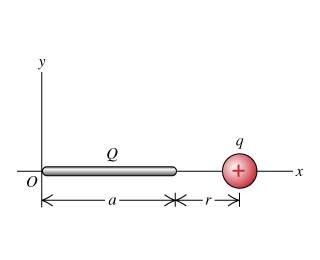
yf_Figure_21_37.jpg


Positive charge Q is distributed uniformly along the x-axis from x=0 to x=a. A positive point charge q is located on the positive x-axis at x=a+r, a distance r to the right of the end of Q.

(a) Calculate the x- and y- components of the electric field produced by the charge distribution Q at points on the positive x-axis where x>a.

(b) Calculate the force (magnitude and direction) that the charge distribution Q exerts on q.

(c) Show if r>>a, the magnitude of the force in part (b) is approximately Qq/4pi(epsilon)r^2. Explain why this result is obtained.


Alright, I'm having trouble getting started. First off, I understand that the y components is 0, no need to go there.

I know that since the charge is distributed, I have to use an integral. the Limits of the integral are from (0,a)

But what how exactly is the integral? (I'm going to use k instead of 1/4piepsilon

To my understanding...

E=kq/r^2

So, dE=kdq/r^2

How would I go from there? (if that were correct...)

Thanks!
 
Physics news on Phys.org
Hello btbam91,

I'll attempt to get you started.
btbam91 said:
To my understanding...

E=kq/r^2
That is correct for a point charge, or for somewhere outside a sphere are shell with spherically symmetrical charge distribution.
So, dE=kdq/r^2

How would I go from there? (if that were correct...)
Now here, be careful about your variable names. The variable 'r' means something very specific to this particular problem. And it isn't the distance from dQ to the test charge. See the figure. The variable 'r' is already taken, so you'll have to create a new variable.

But instead of creating a variable that represents the distance from dQ to the test point, let's just create a variable which specifies where dQ lies on the x-axis.

I'll call this variable 'x'. You can call it something else if you want (you might prefer to call it 'l' to distinguish it from any old point on the x-axis). The variable will vanish when you evaluate the integral anyway, but you need to call it something for now. I'll respecify what x is (or at least what I am calling 'x'): 'x' is the location on the x-axis of the infinitesimal point charge dQ.

The next thing you need to do is come up with an expression for the distance from dQ to the test charge (where the test charge is on the x-axis, at some point greater than a). Create your expression in terms of x, a, and r.

Next break down dQ. dQ is the linear charge distribution times the differential length, dx. (Hint: dQ = λdx.)

You should have enough information to set up your integral now. Integrate over x, where x ranges from 0 to a (a and r can be treated as constants for this integration). The result is that x vanishes and you are left with an expression in terms of a and r.
 

Similar threads

  • · Replies 1 ·
Replies
1
Views
2K
  • · Replies 5 ·
Replies
5
Views
460
  • · Replies 18 ·
Replies
18
Views
3K
Replies
1
Views
824
  • · Replies 9 ·
Replies
9
Views
2K
  • · Replies 2 ·
Replies
2
Views
1K
  • · Replies 7 ·
Replies
7
Views
2K
  • · Replies 10 ·
Replies
10
Views
1K
Replies
1
Views
1K
Replies
17
Views
1K