Math Amateur
Gold Member
MHB
- 3,920
- 48
- TL;DR
- I need help in order to understand Willard Theorem 3.7 concerning topological closure ...
I am reading Stephen Willard: General Topology ... ... and am currently reading Chapter 2: Topological Spaces and am currently focused on Section 1: Fundamental Concepts ... ...
I need help in order to fully understand an aspect of the proof of Theorem 3.7 ... ..Theorem 3.7 and its proof read as follows:
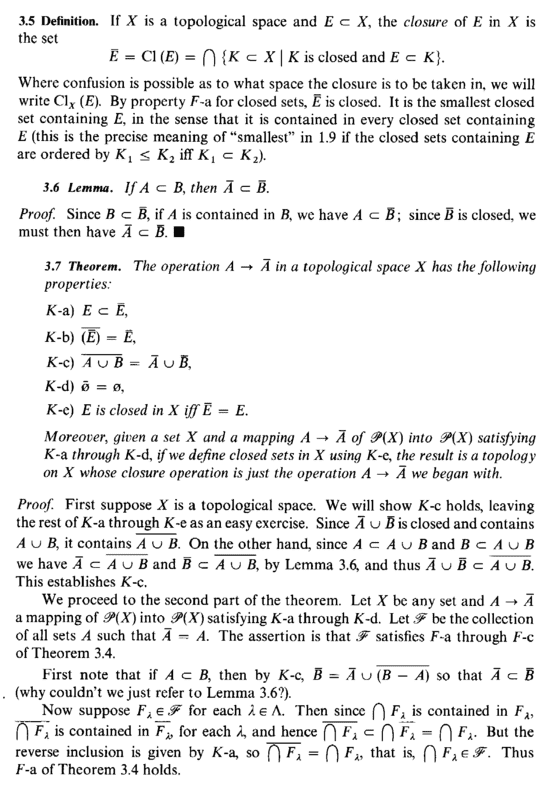
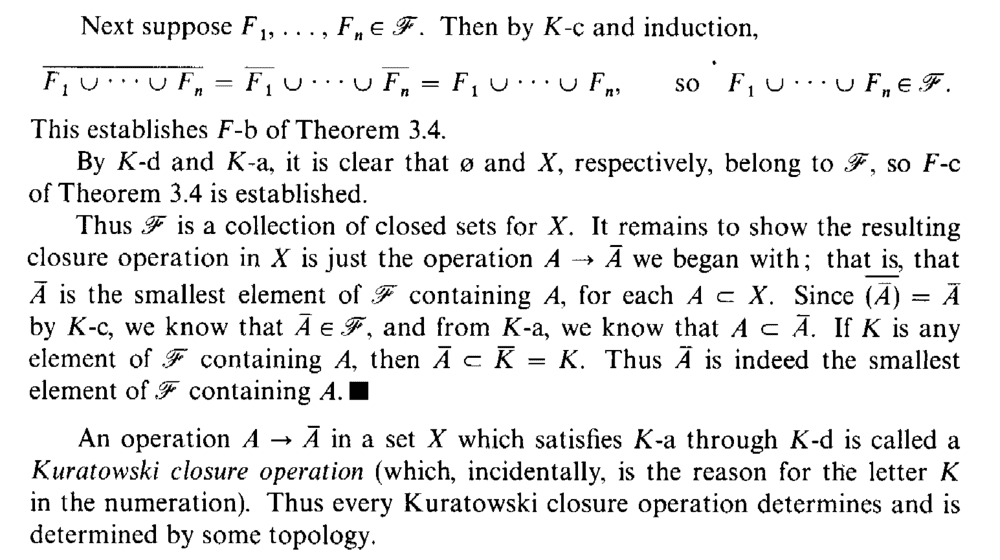
In the above proof by Willard we read the following:
" ... ... First note that if ##A \subset B##, then by K-c, ##\overline{B} = \overline{A} \cup \overline{ (B -A) }## so that ##\overline{A} \subset \overline{B}## ... ... "Can someone please demonstrate, formally and rigorously, how ##\overline{B} = \overline{A} \cup \overline{ (B -A) }## implies that ##\overline{A} \subset \overline{B}## ...
Help will be much appreciated ...
Peter
I need help in order to fully understand an aspect of the proof of Theorem 3.7 ... ..Theorem 3.7 and its proof read as follows:
In the above proof by Willard we read the following:
" ... ... First note that if ##A \subset B##, then by K-c, ##\overline{B} = \overline{A} \cup \overline{ (B -A) }## so that ##\overline{A} \subset \overline{B}## ... ... "Can someone please demonstrate, formally and rigorously, how ##\overline{B} = \overline{A} \cup \overline{ (B -A) }## implies that ##\overline{A} \subset \overline{B}## ...
Help will be much appreciated ...
Peter
Last edited: