SUMMARY
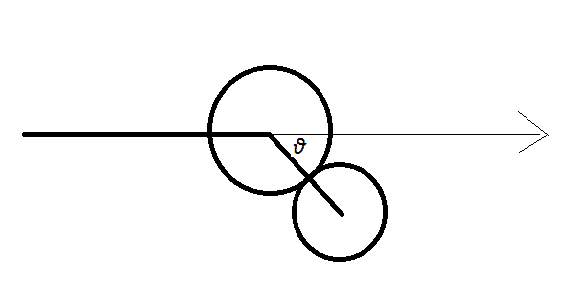
The discussion focuses on the relationship between collision angles and mass ratios in elastic collisions, specifically between a large mass (M) and a small mass (m). It establishes that maximum deflection occurs when cos(2θ) = m/M, rather than cos(θ) = m/M, leading to the conclusion that the deflection angle β is complementary to the collision angle θ. The analysis emphasizes the importance of momentum conservation and the correct interpretation of kinetic energy transfer during collisions, particularly when m < M.
PREREQUISITES
- Understanding of elastic collisions and momentum conservation principles
- Familiarity with trigonometric relationships in physics
- Knowledge of kinetic energy concepts and their mathematical representations
- Ability to analyze vector components in collision scenarios
NEXT STEPS
- Study the derivation of elastic collision equations in two dimensions
- Learn about the implications of mass ratios on collision outcomes
- Explore the concept of center of mass (ZMF) in collision analysis
- Investigate the mathematical relationships between angles in elastic collisions
USEFUL FOR
Physics students, researchers in mechanics, and anyone interested in the dynamics of elastic collisions and their mathematical underpinnings.