How Does Hanging a Weight Affect the Sag and Tension in a Pulley System?

  • Context: Undergrad 
  • Thread starter Thread starter alba
  • Start date Start date
  • Tags Tags
    Pulley Weight
Click For Summary

Discussion Overview

The discussion revolves around the effects of hanging weights on the sag and tension in a pulley system. Participants explore the relationships between the weights, angles, and distances involved in the system, considering both theoretical and practical implications.

Discussion Character

  • Exploratory
  • Technical explanation
  • Debate/contested
  • Mathematical reasoning

Main Points Raised

  • One participant proposes that if a weight C (1 kg) is hung as a counterweight, the lengths of the ropes BD and BC will be equal, assuming the pulley is not connected to the wall.
  • Another participant challenges this by stating that for a massless rope, the lengths could vary while still maintaining equilibrium.
  • There is a discussion about the sag of the rope when weight C is added, with one participant suggesting that the sag distance h can be related to the angle of the rope, hypothesizing that h should equal sin=cos 45.
  • Participants question the relationship between the sag distance h and the weights involved, particularly whether h corresponds to the weight of P1 or the length of BC.
  • One participant expresses frustration over the lack of guidance and seeks a general procedure for determining the relationships in the system.
  • There is a debate over the validity of using angles from sketches to determine forces, with one participant asserting that reading angles from drawings is inappropriate for solving the problem.
  • Another participant suggests that it is possible to determine a simple relation between h and the weights, indicating a willingness to assist in this exploration.

Areas of Agreement / Disagreement

Participants express differing views on the relationships between the weights, angles, and sag in the pulley system. There is no consensus on the correct approach or solution, and multiple competing perspectives remain throughout the discussion.

Contextual Notes

Participants reference angles and distances based on a sketch, which may not accurately represent real-world conditions. The discussion includes unresolved assumptions about the nature of the rope (e.g., massless, frictionless) and the behavior of the weights in relation to the angles.

Who May Find This Useful

This discussion may be of interest to individuals studying mechanics, particularly those exploring pulley systems, tension, and the effects of weights on angles and distances in physical systems.

alba
Messages
140
Reaction score
4
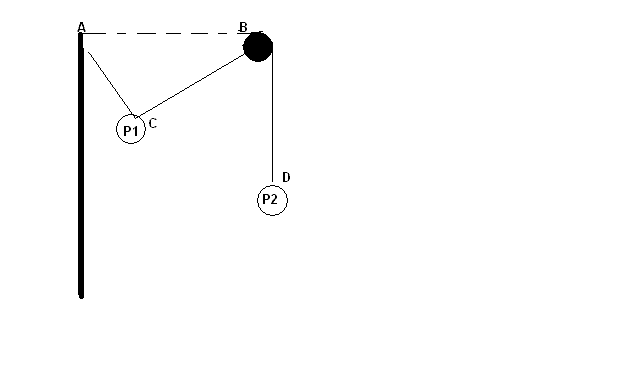
Suppose we have a weight D (1 Kg) hanging from a pulley on a rope connected to a wall A
uPHmi.png


suppose also the distance AB from the wall is 1 m.

If I hung a weight C =1 kg as a counterweight and the pulley were not connected to the wall, the length of the rope BD (1) would equal the length of the rope BC.

If I hang a weight C = 0 on the rope AB this will not sag (h = 0) what will the distance of C from the line AB if I hang a weight of 1 Kg? My guess is that h should be sin=cos 45, since a imagine that half the weight is carried by the wall at A.

In general, is there a simple formula to determine the distance h wrt to the weight? I know this is all about forces and tension http://en.wikipedia.org/wiki/Tension_(physics), where can I find an article that explains all that with examples?

Any help is appreciated! Thanks
 
Physics news on Phys.org
alba said:
If I hung a weight C =1 kg as a counterweight and the pulley were not connected to the wall, the length of the rope BD (1) would equal the length of the rope BC.
As I understand this, you are allowing weights C and D (both 1 kg) to hang from the pulley. The wall is not involved. You assert that, in this situation, rope length BD must be equal to rope length BC.

For a massless rope, this is not the only possible solution. Rope length BD could be greater, equal or less than rope length BC and the weights could still be in equilibrium.

Now you reconnect the rope to the wall and...

If I hang a weight C = 0 on the rope AB this will not sag (h = 0) what will the distance of C from the line AB if I hang a weight of 1 Kg?
As I understand this, you are saying that rope segment AB will not sag until you hang weight C from it. After you hang it, weight C will be a distance h below the previous position of rope segment AB. You may be assuming a frictionless rope so that weight C is free to slide.

My guess is that h should be sin=cos 45, since a imagine that half the weight is carried by the wall at A.
If the tension in the rope is 1 kg-force, what is the vertical component of that force when the rope is at a 45 degree angle?
 
jbriggs444 said:
As I understand this, you are saying that rope segment AB will not sag until you hang weight C from it. After you hang it, weight C will be a distance h below the previous position of rope segment AB. You may be assuming a frictionless rope so that weight C is free to slide.If the tension in the rope is 1 kg-force, what is the vertical component of that force when the rope is at a 45 degree angle?

I already said I think the components are equal to sin=cos 45°

If you look at the sketch the angle at B is roughly 30°, does the distance h from C to the line AB correspond to the weight of P1? or is it the length of BC? what I do not know is what part of the weght of P1 is discharged on the wall.

Can anybody tell me if it is at all possible to determine a simple relation between h (or BC) and the weight of P1/P2?
Thanks
 
Last edited:
alba said:
I already said I think the components are equal to sin=cos 45°
Your justification for that was incorrect.

If you look at the sketch the angle at B is roughly 30°, does the distance h from C to the line AB correspond to the weight of P1?

Reading angles from drawings in textbook exercises is an inappropriate way to solve problems. Was this sketch drawn from real life or from a textbook exercise?

Can anybody tell me if it is at all possible to determine a simple relation between h (or BC) and the weight of P1/P2?
Yes, it is possible to determine a simple relation. I am working to help you do so.
 
Last edited:
jbriggs444 said:
Yes, it is possible to determine a simple relation. I am working to help you do so.
You are not really helping me, you did not give me a single clue or a link. The sketch is just a quick way to visualize the problem, it is not an exercise. I want to learnthe general procedure. I think that if P2 is 1 the tension on the rope (both if it goes to rhe wall and if it goes to P1) is 1 and that P1 must be 1/cos30 and h 1*sin30*cos30 = .433
 
Is the weight P1 free to slip on the rope or is it firmly tied to the rope? Are you trying to compute the weights based on the angles in the picture or the angles in the picture based on the weights?

If the diagrram is intended as a visualization aid then you cannot have correctly determined the 30 degree sag angle by looking at the diagram.

If the sag angle is 30 degrees, how did did you conclude that the total supporting force on weight P1 was 1/cos(30 degrees)?
 

Similar threads

  • · Replies 16 ·
Replies
16
Views
2K
  • · Replies 4 ·
Replies
4
Views
3K
  • · Replies 8 ·
Replies
8
Views
5K
  • · Replies 2 ·
Replies
2
Views
2K
  • · Replies 1 ·
Replies
1
Views
2K
  • · Replies 8 ·
Replies
8
Views
1K
  • · Replies 5 ·
Replies
5
Views
2K
  • · Replies 4 ·
Replies
4
Views
2K
  • · Replies 28 ·
Replies
28
Views
3K
  • · Replies 2 ·
Replies
2
Views
2K