How Does Heat Relate to Work in Thermodynamics?

Click For Summary
SUMMARY

The discussion centers on the relationship between heat and work in thermodynamics, emphasizing that both are forms of energy in transit. Participants clarify that heat can be viewed as the microscopic work done by particles within a system, while work is defined as macroscopic mechanical work. The first law of thermodynamics is highlighted, stating that the heat flow (Q) into a system equals the change in internal energy (ΔU) plus the work done by the system (W), expressed as Q = ΔU + W. The conversation also distinguishes between different types of energy transfer, including radiation.

PREREQUISITES
  • Understanding of the first law of thermodynamics
  • Familiarity with kinetic and potential energy concepts
  • Knowledge of energy transfer mechanisms, including heat flow
  • Basic grasp of macroscopic vs. microscopic work definitions
NEXT STEPS
  • Study the first law of thermodynamics in detail
  • Explore the concepts of kinetic and potential energy in thermodynamic systems
  • Learn about different modes of heat transfer, including conduction, convection, and radiation
  • Investigate the distinctions between macroscopic and microscopic work in thermodynamics
USEFUL FOR

Students and professionals in physics, particularly those studying thermodynamics, as well as engineers and scientists involved in energy transfer and system dynamics.

Pushoam
Messages
961
Reaction score
53
// moved from general forum, homework template missing //
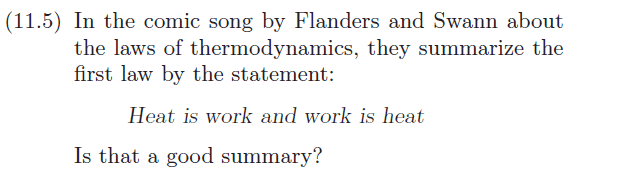
upload_2017-10-3_15-7-39.png

Assuming that by the word "Work", work on the system is meant.
Both heat and work is energy in transit.
I think heat is work done by constituent particles of a system on another system in contact.
Now the work done by us on a system gets transformed into the K.E. and P.E. of the system.
In thermodynamics, here it is assumed that the change in the P.E. is 0. So, work done by us is nonthing but the change in the K.E. of the system.
This change in the K.E. of the system is nothing but the change in the average K.E. of the constituent particles of the system. Now this change in the average kinetic energy of the constituent particles is nothing but the work done on the constituent particles , hence, heat.

Is this right?
 
Last edited by a moderator:
Physics news on Phys.org
Have you Googled for definitions of 'Heat'?
 
Pushoam said:
// moved from general forum, homework template missing //
View attachment 212198
Assuming that by the word "Work", work on the system is meant.
Both heat and work is energy in transit.
I think heat is work done by constituent particles of a system on another system in contact.
Now the work done by us on a system gets transformed into the K.E. and P.E. of the system.
In thermodynamics, here it is assumed that the change in the P.E. is 0. So, work done by us is nonthing but the change in the K.E. of the system.
There is no such assumption. Internal energy can consist of kinetic and potential energy.
This change in the K.E. of the system is nothing but the change in the average K.E. of the constituent particles of the system. Now this change in the average kinetic energy of the constituent particles is nothing but the work done on the constituent particles , hence, heat.
This is not what the first law says. It says that heat flow into the system plus the mechanical work done on the system is equal to the the change in internal energy of the system. In thermodynamics we distingush between microscopic work that is randomly done on by molcules by or on other molecules (Q) and useful macroscopic work done on or by systems (W).

AM
 
Thank you for the reply.
Heat is energy in transit.
I am studying thermodynamics by Blundell and Blundell.
 
Andrew Mason said:
. In thermodynamics we distingush between microscopic work that is randomly done on by molcules by or on other molecules (Q) and useful macroscopic work done on or by systems (W).
So, heat is nothing but another name for the microscopic work. Right?
 
Pushoam said:
So, heat is nothing but another name for the microscopic work. Right?
If you define work as a force applied over a distance and if you are dealing only with discrete particles randomly applying forces to other discrete particles over microscopic distances, then heat flow can be thought of as that kind of work But there are other means by which heat flow can occur, such as radiation. In thermodynamics we use heat flow to refer to all types of energy transfer other than useful macroscopic mechanical work done by, or on, systems.

AM
 
Last edited:
  • Like
Likes   Reactions: Pushoam
Andrew Mason said:
If you define work as a force applied over a distance and if you are dealing only with discrete particles applying forces to other discrete particles over microscopic distances, then hsat flow can be thought of as that kind of work But there are other means by which heat flow can occur, such as radiation. in thermodynamics we use heat flow to refrer to all types of energy transfer other than useful macroscopic mechanical work done by or on systems.

AM
So, this means depending on the process, sometimes heat could be microscopic work, sometimes it could be radiation, sometimes something else.
Here, in the question , heat is microscopic work. Right?
 
Pushoam said:
So, this means depending on the process, sometimes heat could be microscopic work, sometimes it could be radiation, sometimes something else.
Here, in the question , heat is microscopic work. Right?
I would not use the term "microscopic work". Thermodynamics is confusing enough as it is. Work, in thermodynamics, means mechanical, macroscopic work done by a system. Besides, not all random energy transfers to molecules fit the normal definition of work: ##W = \int \vec{F}\cdot\vec{d}##. For example, photon absorption by an atom is a quantum mechanical event. The photon does not really apply a force to an atom over a distance when it is absorbed by the atom. But that atom's internal energy increases.

Heat, or heat flow (which is a better term, in my opinion), has a particular meaning in thermodynamics. If a system and its surroundings are initially in equilibrium states and undergo a process resulting in new equilibrium states, the first law will tell you the relationship between the heat flow that occurred during that process, the work done by the system during the process, and the change in internal energy of the system between initial and final states:
Q = ΔU + W
where Q is the heat flow (into the system), W is the mechanical work done BY the system and ΔU is the change in internal energy of the system. That is the best way to define heat flow: it is an energy transfer to the system that is the sum of the system's change in internal energy + the work done BY the system.

AM
 
  • Like
Likes   Reactions: Pushoam
Thank you.
 

Similar threads

  • · Replies 1 ·
Replies
1
Views
2K
  • · Replies 30 ·
2
Replies
30
Views
2K
  • · Replies 12 ·
Replies
12
Views
2K
  • · Replies 9 ·
Replies
9
Views
2K
Replies
3
Views
2K
  • · Replies 6 ·
Replies
6
Views
2K
  • · Replies 58 ·
2
Replies
58
Views
3K
  • · Replies 3 ·
Replies
3
Views
2K
  • · Replies 28 ·
Replies
28
Views
2K
  • · Replies 4 ·
Replies
4
Views
2K