How does NASA achieve zero gravity on their zero gravity flights?

Click For Summary

Discussion Overview

The discussion revolves around how NASA achieves weightlessness during zero gravity flights, specifically focusing on the mechanics of parabolic flight paths used in aircraft like the KC-135. Participants explore the principles of freefall, lift, and the role of pilots in managing the aircraft's trajectory during these maneuvers.

Discussion Character

  • Exploratory
  • Technical explanation
  • Debate/contested

Main Points Raised

  • One participant suggests that weightlessness is achieved when the plane is in freefall, but questions how lift is managed during the flight path, particularly at the peak of the parabola.
  • Another participant explains that during the initial ascent, the plane accelerates upwards, and at a certain point, thrust is reduced to match drag, allowing the plane to fall gently.
  • It is noted that the plane can lose lift by pitching down, which can occur before reaching the peak of the parabola.
  • Some participants discuss the angle of attack of the wings and how a slight downward pitch can result in zero lift, allowing for zero-g conditions.
  • One participant shares personal experience with the KC-135, describing the transitions between normal and reduced gravity and the role of pilots in maintaining desired acceleration.
  • There is a mention of different gravity levels experienced during flights, such as 'lunars' and 'martians', and how these are managed by the pilots.
  • Questions arise regarding whether the control of these zero-g planes is entirely manual during maneuvers, with a later reply confirming this as far as known.

Areas of Agreement / Disagreement

Participants express various viewpoints on the mechanics of achieving weightlessness, with no consensus reached on the specifics of lift management and the exact conditions for freefall during the parabolic flight path.

Contextual Notes

Some discussions involve assumptions about the aircraft's behavior and the pilots' techniques, which may not be fully detailed or universally applicable. The accuracy of diagrams referenced is also questioned, indicating potential limitations in visual representations of the flight path.

Jimmy87
Messages
692
Reaction score
19
Hi,

Please could someone kindly explain how zero weightlessness is achieved in this aircraft. I have tried to use my own understanding and what I have read online.

My ideas are:
To experience weightlessness the plane must be in freefall so the only force acting on it must be gravity. Since planes have wings then simply shutting off the engines will not achieve this since there will still be lift. However, flying in a parabola means that the nose of the plane can tip down over the parabola and effectively remove the lift. On don't understand this picture from wiki though:
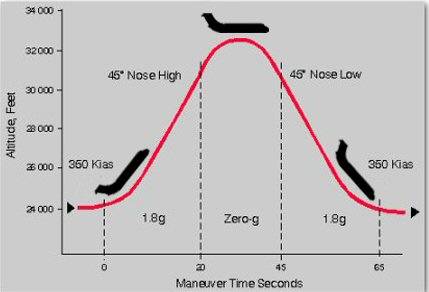
Zero_gravity_flight_trajectory_C9-565.jpg
This says that free fall is achieved slightly before and at the peak of the parabola. How does that work? If the plane is perfectly level (like at the top) then there will still be lift surely just like every commercial airliner during the main flight? You would have to effectively tilt the wings downward to get rid of the lift which I thought could only happen after the peak of parabola like I have drawn in green here:
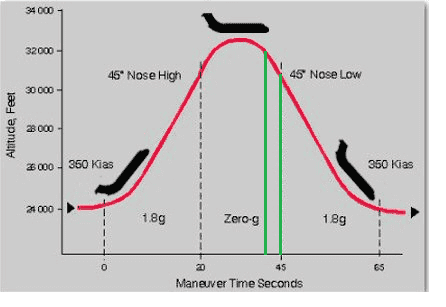
upload_2017-10-1_11-38-19.png


Could someone please explain?

Many thanks!
 
Science news on Phys.org
In the beginning, as in the graph where it says 1.8g you are being accelerated upwards by the airplane. When you reach the 20 second mark the plane stops accelerating by reducing thrust to the point where it exactly matches drag from air resistance, and you continue moving upward at the same velocity. So basically the plane gently falls out from beneath you as if you were a projectile with no air resistance since the plane is isolating you from the wind.
 
Jimmy87 said:
You would have to effectively tilt the wings downward to get rid of the lift which I thought could only happen after the peak of parabola
You may have noticed that planes are able to maneuver. They do this by pitching up or down relative to the relative airflow. There is no requirement that the plane's nose be aligned with the plane's current path through the air. In order to lose lift, all that is required is for the pilot to push forward on the stick. This points the elevators on the tail downward, pushes the tail upward and pitches the plane downward.

At the top of the parabola, the plane may be pitched slightly downward.

You may also have noticed that the wings on planes are pitched upward. At the top of the parabola, even with the plane pitched somewhat downward, chord of the wings will be closer to horizontal.
 
Jimmy87 said:
If the plane is perfectly level (like at the top)
Why does it have to be perfectly level at the top of the parabola? A slight down-pitch is enough to make the total lift of the whole plane zero. The engines then just have to cancel the drag, and you have zero-g.
 
  • Like
Likes   Reactions: jbriggs444
+1

The diagram isn't intended to be super accurate.

Most conventional aircraft have a wing section that produces zero lift at a slightly negative angle of attack. Perhaps only 1 or 2 degrees negative.
 
Just for entertainment I tried to find details for a Boeing 727-200 but could only find polars for the 737. The zero lift angle of attack for the root section was about -1 degree.
 
Jimmy87 said:
Hi,

Please could someone kindly explain how zero weightlessness is achieved in this aircraft. I have tried to use my own understanding and what I have read online.

<snip>
Could someone please explain?

I've been lucky enough to have ridden the 'vomit comet' (KC-135 plane) enough to accrue weightlessness time equivalent to a couple of Earth orbits.

Everything depends on the pilots (and co-pilots), who are amazingly awesome. Besides 0-g, there are also 'lunars' (0.16 g) and 'martians' (0.38 g). There's a large accelerometer display, and the pilots are able to keep the desired acceleration within a percent or so during the 'reduced-gravity' phase. During a dive, the engine output is reduced, but the plane never 'coasts' because of air resistance.

The diagram you posted isn't exactly right- yes, as the nose comes over the top and diving begins, we enter a short period of weightlessness- however, this period occurs during the dive, not symmetrically as shown in the picture. I know this because we can see out of the windows. Transitions between 'normal' and 'reduced' gravity are rapid- a couple of seconds at most. The climbing period subjects crew members to a 2-g load for a minute or so, that's when most people barf. Overall, the plane executes about 10 parabolas, then climbs during a turn to head the other way- these longer climbs are at lower 'g', maybe 1.5g.
 
  • Like
Likes   Reactions: Jimmy87 and sophiecentaur
Andy Resnick said:
Everything depends on the pilots (and co-pilots)
Are these specialized zero-g planes still controlled completely manually, during the maneuver?
 
A.T. said:
Are these specialized zero-g planes still controlled completely manually, during the maneuver?

Yep, at least as far as I know.
 
  • #10
Andy Resnick said:
I've been lucky enough to have ridden the 'vomit comet' (KC-135 plane) enough to accrue weightlessness time equivalent to a couple of Earth orbits.

Everything depends on the pilots (and co-pilots), who are amazingly awesome. Besides 0-g, there are also 'lunars' (0.16 g) and 'martians' (0.38 g). There's a large accelerometer display, and the pilots are able to keep the desired acceleration within a percent or so during the 'reduced-gravity' phase. During a dive, the engine output is reduced, but the plane never 'coasts' because of air resistance.

The diagram you posted isn't exactly right- yes, as the nose comes over the top and diving begins, we enter a short period of weightlessness- however, this period occurs during the dive, not symmetrically as shown in the picture. I know this because we can see out of the windows. Transitions between 'normal' and 'reduced' gravity are rapid- a couple of seconds at most. The climbing period subjects crew members to a 2-g load for a minute or so, that's when most people barf. Overall, the plane executes about 10 parabolas, then climbs during a turn to head the other way- these longer climbs are at lower 'g', maybe 1.5g.

Thanks - very interesting and I'm very jealous :(
 

Similar threads

  • · Replies 11 ·
Replies
11
Views
22K
  • · Replies 8 ·
Replies
8
Views
3K
Replies
16
Views
808
Replies
1
Views
1K
  • · Replies 7 ·
Replies
7
Views
3K
  • · Replies 4 ·
Replies
4
Views
3K
  • · Replies 4 ·
Replies
4
Views
4K
  • · Replies 6 ·
Replies
6
Views
2K
  • · Replies 10 ·
Replies
10
Views
1K
  • · Replies 36 ·
2
Replies
36
Views
5K