How Does Substitution Work in Mesh Analysis Equations?

Click For Summary

Discussion Overview

The discussion revolves around the process of substitution in mesh analysis equations, particularly focusing on the application of Kirchhoff's Current Law (KCL) and how it relates to deriving equations in circuit analysis. Participants seek clarification on specific steps in the derivation process.

Discussion Character

  • Technical explanation

Main Points Raised

  • One participant expresses confusion about a specific part of the mesh analysis and requests clarification.
  • Another participant identifies the application of KCL at a specific node, stating the relationship between currents entering and leaving the node.
  • Some participants discuss the substitution process, indicating that one current can be expressed in terms of others, specifically mentioning the substitution of i0 into the mesh equation.
  • A later reply acknowledges a misunderstanding regarding the substitution process, indicating a realization about how the equation was derived.

Areas of Agreement / Disagreement

Participants generally agree on the application of KCL but there is some confusion regarding the substitution process, which remains partially unresolved as one participant clarifies their misunderstanding.

Contextual Notes

The discussion does not fully resolve the steps involved in the substitution process, and there may be assumptions about the definitions of the currents that are not explicitly stated.

Novark
Messages
14
Reaction score
0
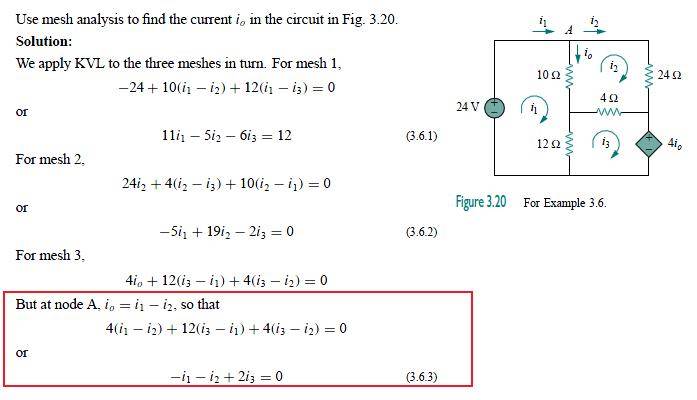
I understand everything up to the point which I've marked in red...
4020753639_1f2649796d_o.jpg


Can anyone explain those few lines?

I would greatly appreciate it!

Thanks.
 
Engineering news on Phys.org
Seems like KCL (Kirchoff's Current Law) at node A.
i1 = i0 + i2

(sum of currents entering) = (sum of currents leaving)
 
muhandis said:
Seems like KCL (Kirchoff's Current Law) at node A.
i1 = i0 + i2

(sum of currents entering) = (sum of currents leaving)

I understand that part, but how did they derive the equation below that line?
 
They just substituted into the equation above.
 
muhandis said:
They just substituted into the equation above.

Oh, I see it now. I totally misunderstood the fact that they were simply substituting i0 = i1 - i2 into the third mesh equation.

Thanks :-)
 

Similar threads

Replies
0
Views
1K
  • · Replies 4 ·
Replies
4
Views
2K
  • · Replies 7 ·
Replies
7
Views
2K
Replies
3
Views
1K
Replies
5
Views
2K
  • · Replies 4 ·
Replies
4
Views
6K
  • · Replies 9 ·
Replies
9
Views
4K
  • · Replies 3 ·
Replies
3
Views
2K
  • · Replies 15 ·
Replies
15
Views
4K
  • · Replies 5 ·
Replies
5
Views
4K