How Does the Cassie-Baxter Model Explain the Lotus Effect?

Click For Summary
The lotus effect describes the self-cleaning properties of lotus leaves due to their ultrahydrophobic surface, which minimizes droplet adhesion through micro- and nanoscopic structures. The discussion involves calculating the contact angle using the Cassie-Baxter model, which accounts for the surface's texture. Initially, a user struggled with the mathematical modeling of droplet behavior but later successfully derived the Cassie-Baxter equation. This model explains how the apparent and real contact areas affect droplet dynamics on textured surfaces. Ultimately, the Cassie-Baxter model effectively illustrates the principles behind the lotus effect.
Klaus von Faust
Messages
37
Reaction score
10
1.The lotus effect refers to self-cleaning properties that are a result of ultrahydrophobicity as exhibited by the leaves of "lotus flower". Dirt particles are picked up by water droplets due to the micro- and nanoscopic architecture on the surface, which minimizes the droplet's adhesion to that surface. If the apparent contact area of a droplet with such a surface is A, and the real contact area because of the microscopic whiskers is xA with x = 0.003, what is the contact angle? Assume that without “whiskers”, the contact angle would be α0 = 110 ◦ .2. F = σa
U = Sσ


e7d4f0384ad54c7229f9e136509bb9076092bbe2

7f8b53f214de5ac4cd0f8a092ae11529ba53b68c

5ecad9324b653bc99f252908942078cb6675b421


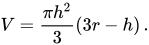
3. I tried to use the fact that the volume is being constant, and I assumed that the drop has the shape of a spherical cap, so I expressed it's volume in terms of contact angle.
A/xA=pi*R^2/pi*r^2
V=const
V=pi/3*R^3*(2+cos(a))(1-cos(a))^2=pi/3*r^3*(2+cos(b))(1-cos(b))^2
But the equation I have obtained which is not solvable. Can you help me and show another approach?
 
Last edited by a moderator:
Physics news on Phys.org
I can't understand what you are modeling. Can you please provide a schematic diagram?
 
  • Like
Likes Bystander
Chestermiller said:
I can't understand what you are modeling. Can you please provide a schematic diagram?
I solved it myself, I don't know how to draw on this forum properly, but I searched and read about wetting and about 3 models of wetting, Young's model, Wenzel's model and Cassie-Baxter model. This case particularly is a Cassie-Baxter model, so after deriving the Cassie-Baxter equation I got the right result.
File:Cassie-Baxter.png

https://en.m.wikipedia.org/wiki/File:Cassie-Baxter.png
 

Similar threads

  • · Replies 63 ·
3
Replies
63
Views
4K
  • · Replies 18 ·
Replies
18
Views
2K
  • · Replies 33 ·
2
Replies
33
Views
3K
Replies
2
Views
2K
  • · Replies 1 ·
Replies
1
Views
2K
Replies
7
Views
2K
  • · Replies 1 ·
Replies
1
Views
3K
  • · Replies 6 ·
Replies
6
Views
8K
  • · Replies 5 ·
Replies
5
Views
7K
  • · Replies 5 ·
Replies
5
Views
3K