How Does the Cassie-Baxter Model Explain the Lotus Effect?

Click For Summary
SUMMARY

The discussion centers on the Cassie-Baxter model, which explains the lotus effect's self-cleaning properties through ultrahydrophobicity. The model describes how the micro- and nanoscopic architecture of lotus leaves minimizes droplet adhesion, allowing dirt to be removed effectively. Participants explored the mathematical relationships involved, particularly the contact angle and volume of water droplets, and concluded that the Cassie-Baxter equation accurately models this phenomenon. A schematic diagram was referenced to aid understanding of the model's application.

PREREQUISITES
  • Understanding of ultrahydrophobicity and its applications
  • Familiarity with the Cassie-Baxter model and its equations
  • Basic knowledge of contact angle measurements
  • Experience with mathematical modeling of fluid dynamics
NEXT STEPS
  • Study the derivation of the Cassie-Baxter equation in detail
  • Learn about Young's model and Wenzel's model for comparison
  • Research practical applications of the lotus effect in material science
  • Explore advanced fluid dynamics concepts related to droplet behavior
USEFUL FOR

Researchers, material scientists, and engineers interested in surface science, particularly those focusing on hydrophobic materials and their applications in self-cleaning technologies.

Klaus von Faust
Messages
37
Reaction score
10
1.The lotus effect refers to self-cleaning properties that are a result of ultrahydrophobicity as exhibited by the leaves of "lotus flower". Dirt particles are picked up by water droplets due to the micro- and nanoscopic architecture on the surface, which minimizes the droplet's adhesion to that surface. If the apparent contact area of a droplet with such a surface is A, and the real contact area because of the microscopic whiskers is xA with x = 0.003, what is the contact angle? Assume that without “whiskers”, the contact angle would be α0 = 110 ◦ .2. F = σa
U = Sσ


e7d4f0384ad54c7229f9e136509bb9076092bbe2

7f8b53f214de5ac4cd0f8a092ae11529ba53b68c

5ecad9324b653bc99f252908942078cb6675b421


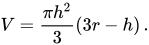
3. I tried to use the fact that the volume is being constant, and I assumed that the drop has the shape of a spherical cap, so I expressed it's volume in terms of contact angle.
A/xA=pi*R^2/pi*r^2
V=const
V=pi/3*R^3*(2+cos(a))(1-cos(a))^2=pi/3*r^3*(2+cos(b))(1-cos(b))^2
But the equation I have obtained which is not solvable. Can you help me and show another approach?
 
Last edited by a moderator:
Physics news on Phys.org
I can't understand what you are modeling. Can you please provide a schematic diagram?
 
  • Like
Likes   Reactions: Bystander
Chestermiller said:
I can't understand what you are modeling. Can you please provide a schematic diagram?
I solved it myself, I don't know how to draw on this forum properly, but I searched and read about wetting and about 3 models of wetting, Young's model, Wenzel's model and Cassie-Baxter model. This case particularly is a Cassie-Baxter model, so after deriving the Cassie-Baxter equation I got the right result.
File:Cassie-Baxter.png

https://en.m.wikipedia.org/wiki/File:Cassie-Baxter.png
 

Similar threads

  • · Replies 63 ·
3
Replies
63
Views
5K
  • · Replies 18 ·
Replies
18
Views
2K
  • · Replies 33 ·
2
Replies
33
Views
3K
Replies
2
Views
3K
  • · Replies 1 ·
Replies
1
Views
2K
Replies
7
Views
2K
  • · Replies 1 ·
Replies
1
Views
3K
  • · Replies 6 ·
Replies
6
Views
8K
  • · Replies 5 ·
Replies
5
Views
7K
  • · Replies 5 ·
Replies
5
Views
3K