Science Advisor
Homework Helper
Gold Member
Dearly Missed
- 24,752
- 795
Neanderthal, I think I wouldn't include that table in a PDF, not transparent enough. A PDF should be edited so it is mostly clear self-explanatory not overly dense.
How do you feel about the timeline? the way I tried to include it in some challenge exercises did not work, I think. But does the timeline itself add something? I'd be grateful for any reactions you have to any of the stuff. What works, what's enlightening, feels good to have read, and what doesn't work.
About the timeline, it relates the history of expansion to a few of the events that made us possible. It locates events in cosmological time and connects these events to the expansion factor S that governs wavelengths of light on its way to us. Or equivalently to its reciprocal, the scale factor a = 1/s that tracks the size of distances. How big was the universe when our galaxy disk formed? when the Earth formed? when the atmosphere finally got a lot of oxygen? It seems like that might be information worth visualizing, assimilating. Might. It's not a foregone conclusion.
Reionization was the second time space became transparent and coincides with the production of enough heavier elements to enable ordinary stars to form. The Planck report indicates it was half done by 0.023 zeit and it's believed to have been complete by 0.04.
I'll attach a S = z+1 number to each of these times. It won't be exact because the times are rounded off. I'll just compute the 1/a(t) for each t and see what it looks like:
1.3115*(sinh(1.5*t))^(-2/3)
0.023 reionization half done, giant PopIII (light element) stars [12.4]
0.04 reionization complete, mostly ordinary stars, few PopIII left. [8.6]
0.234 maximum lightcone radius [2.6]
0.29 galaxy disk [2.2]
0.44 switch from deceleration to acceleration [1.65]
0.54 Earth [1.4]
0.59 single cell life -- fossilized microbial mat [1.3]
0.66 "Great Oxygen Event" [1.2]
0.77 "Cambrian explosion" [1.03]
0.797 present [1]
This is an illustration for "maximum lightcone girth". The red curve shows the size of the past and future lightcones. Until time 0.234 light destined to get to us today was being swept back by expansion and actually losing ground.
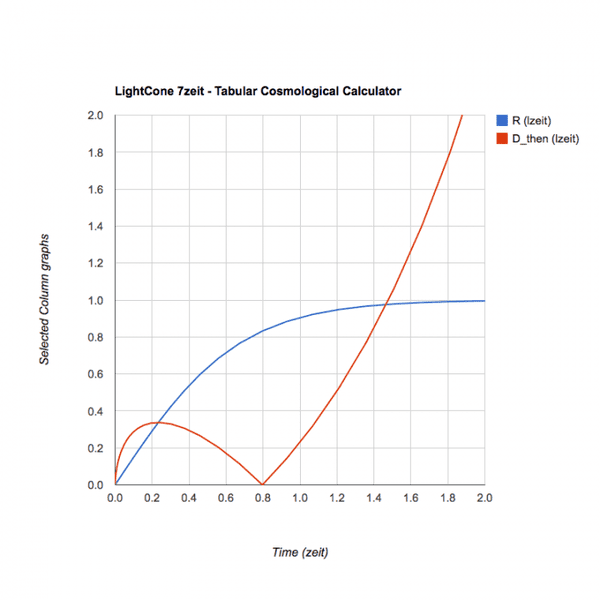
The blue curve shows at any given time the size of those distances which are increasing at speed c.
It crosses the red curve where the latter has zero slope (at time 0.234) where a photon aimed in our direction would be neither gaining nor losing ground--it's forward speed exactly canceled by the growth of the distance it has to go.
How do you feel about the timeline? the way I tried to include it in some challenge exercises did not work, I think. But does the timeline itself add something? I'd be grateful for any reactions you have to any of the stuff. What works, what's enlightening, feels good to have read, and what doesn't work.
About the timeline, it relates the history of expansion to a few of the events that made us possible. It locates events in cosmological time and connects these events to the expansion factor S that governs wavelengths of light on its way to us. Or equivalently to its reciprocal, the scale factor a = 1/s that tracks the size of distances. How big was the universe when our galaxy disk formed? when the Earth formed? when the atmosphere finally got a lot of oxygen? It seems like that might be information worth visualizing, assimilating. Might. It's not a foregone conclusion.
Reionization was the second time space became transparent and coincides with the production of enough heavier elements to enable ordinary stars to form. The Planck report indicates it was half done by 0.023 zeit and it's believed to have been complete by 0.04.
I'll attach a S = z+1 number to each of these times. It won't be exact because the times are rounded off. I'll just compute the 1/a(t) for each t and see what it looks like:
1.3115*(sinh(1.5*t))^(-2/3)
0.023 reionization half done, giant PopIII (light element) stars [12.4]
0.04 reionization complete, mostly ordinary stars, few PopIII left. [8.6]
0.234 maximum lightcone radius [2.6]
0.29 galaxy disk [2.2]
0.44 switch from deceleration to acceleration [1.65]
0.54 Earth [1.4]
0.59 single cell life -- fossilized microbial mat [1.3]
0.66 "Great Oxygen Event" [1.2]
0.77 "Cambrian explosion" [1.03]
0.797 present [1]
This is an illustration for "maximum lightcone girth". The red curve shows the size of the past and future lightcones. Until time 0.234 light destined to get to us today was being swept back by expansion and actually losing ground.
The blue curve shows at any given time the size of those distances which are increasing at speed c.
It crosses the red curve where the latter has zero slope (at time 0.234) where a photon aimed in our direction would be neither gaining nor losing ground--it's forward speed exactly canceled by the growth of the distance it has to go.
Last edited:
